Showing posts with label Captain America. Show all posts

Wednesday, May 13, 2015

Age of Ultron is a B-plus, and here's why.

So I saw Avengers: Age of Ultron on Friday night and much as I liked most of it, and much as I thought I'd never need to say this—Joss Whedon, you need to move on.

I know, I know, Joss is moving on; this is his last contracted Marvel movie, and the Russo brothers (of Winter Soldier fame) will be taking over future installments in the Avengers franchise. But this isn't the sendoff I would have liked. I wanted to miss Joss when he was gone.

Okay. Time to put on my big-fangirl pants and deal. I had very high expectations for this movie and they weren't met, that's all. Most of my disappointment here is that I expected this movie to be as awesome as the first one and it was just kinda goodish. Goodish isn't so bad. It's only bad when you expected better.

For those who want the capsule description, Avengers: Age of Ultron mostly focuses on what happens when the ad hoc superteam of the first Avengers movie has to grow up and deal with the world in a systematic, adult way. Spoiler: it doesn't go well. When Tony Stark decides to use a little evil science to kickstart his world-defending AI system (because what could possibly go wrong with that?), the world pretty much goes to hell in a handbasket and the good guys spend two hours trying to fix it, with mixed results. I'm going to start with the good before I move on to the problematic.

Now, because this is me and I tend to dwell on the things that annoy me, I'll probably have more to say on the negative side of the balance sheet, so I want to establish right up front that as much as I dislike the problematic stuff, I consider AoU a pretty good movie overall. If the first Avengers was an A, this is a B-plus. It's good, okay? You'll have fun. It's just not without its problems, is all. And one or two (or three) of those problems are significant.

All right. Here we go. This is your last spoiler warning ...

The good:

1. This is a really darned good superhero movie. Seriously. Everything you look for in a tentpole popcorn flick is here. And it's all done really well. A lot of stuff blows up. There's a whirlwind tour of the endangered globe. There are moments of real excitement and humor. If there's a checklist for how to make a good superhero movie, this one checks nearly all the boxes. Anything involving the Vision, in particular, is damn near perfect (and gorgeous to boot). It's just a well-made superhero movie by the standards of what makes a good 'un.

2. Nice action sequences. That's an understatement. This movie doesn't just go for spectacle—it pays real attention to how the Avengers would function in combat after some practice together. They use their strengths and compensate for one another's weaknesses. Whether it's Captain America using a motorcycle as both personal transportation and blunt instrument, or Iron Man having a contingency plan for the Hulk losing his few remaining marbles, or Hawkeye doing his mere-mortal schtick in places where the superpowered gods can't go, this movie has everything you want to see in the way of the Avengers in action.

Early on, a bad guy asks his henchman why their defenses are failing, and his baffled henchman replies, "They're the Avengers, sir." And that pretty much sums it up.

3. Hello to the funny. It's a Joss Whedon movie, so this shouldn't be a surprise, but there are more than enough jokes. I'd guess I had to lip-read maybe fifteen to twenty percent of the dialogue because the people around me were laughing so loudly at what had just been said. It's funny, okay? There's plenty of funny.

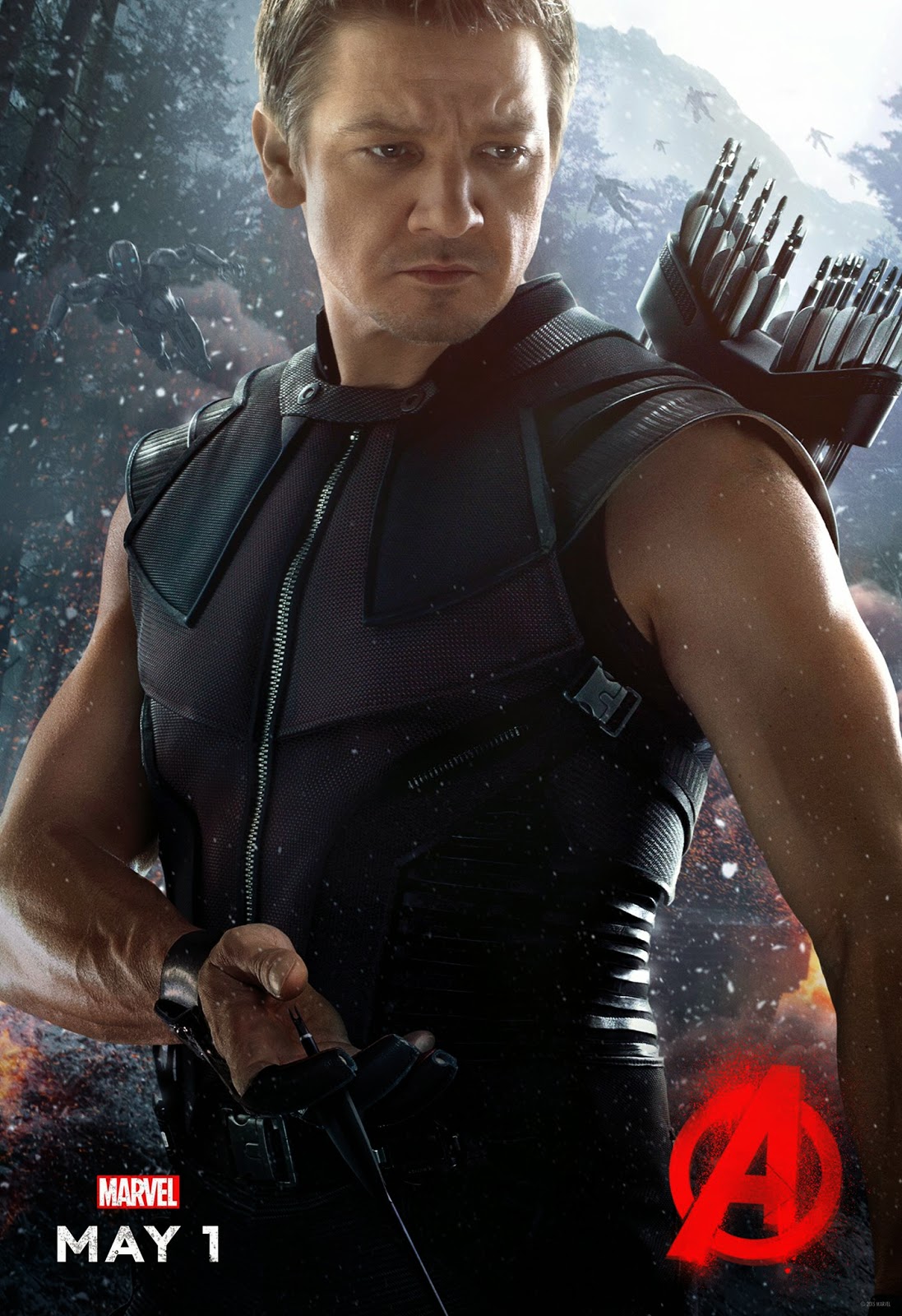
4. Hawkeye! If you felt there wasn't enough Hawkeye in earlier Marvel movies, this movie will be your jam because he's everywhere. He gets a lot of the best action and the best snark. And as the movie delves into his personal life, including glimpses of his home (yes, he has one), he carries a lot of the film's emotional weight, too. And he does it well. Jeremy Renner, I would start a petition to give you your own solo film except that this movie kind of was that film.

5. Ultron is a hoot. James Spader is hilarious. If you've ever snorted a drink out your nose at something he said or did in The Blacklist, you'll be happy here. There's nothing quite like hearing him say, "Stop it!" like the annoyed parent of a toddler after Captain America tries to kick him in the face for the fourth or fifth time. Spader does for Ultron what Tom Hiddleston did for Loki—take a two-dimensional megalomaniac and turn him into something complex, sympathetic, and charming. I don't think Ultron will be getting a fangirl army any time soon, but it's not for lack of effort on Spader's part.

6. Sam Wilson is an Avenger. I repeat, SAM WILSON IS AN AVENGER. Yes. He makes it. Anybody who's been rooting for the Falcon to make it to the big show, you will be pleased. He's in the final roll call, with a new set of wings.

6. NEBBISH! This is a personal thing, but I was delighted (and actually screamed in the theater) to see the return of one of my favorite minor MCU characters. Remember the SHIELD technician who refused to launch the helicarriers? The guy who started the "captain's orders" meme? He doesn't have a name in the canon, but after I saw him in Winter Soldier he quickly became my personal Figwit. I loved the fact that he was obviously scared out of his mind, the last person who should be fighting somebody like Rumlow, and yet he was the first speaking SHIELD agent we saw resisting Hydra's takeover. While everyone else was looking at each other and wondering what to do, this little nebbishy guy proved himself more heroic than Captain America (and nearly got his brains blown out for it, in a nice touch of realism). It was established that a lot of SHIELD agents died when the Triskelion fell, and unlike named characters like Agent 13 and Maria Hill, Nebbish didn't get an epilogue in Winter Soldier. He wasn't important enough to be shown, alive or dead, at the end.

Well, it looks like Nebbish made it out okay, because he's shown (briefly) working for Nick Fury in the climax of the film. And that was probably my favorite part.

Yeah, Nebbish was the best. Because a lot of the other good in this movie was soured by ...

The bad:

1. It's too many movies in one movie. Maybe there's a way to do Ultron and the birth of the Vision and the introduction of Quicksilver and the Scarlet Witch and the foundations of Civil War and build Hawkeye into a fully developed character—but this wasn't it. There was just too much going on—so much that it was hard to care about any one plot thread when the next action scene (however excellent) was barreling at you before you could process. This was about a movie and a half packed into only one flick, and not in the good way.

2. Wait, are there three SHIELDs now? And other plot holes. Let's just say there was insufficient attention to detail, which is a lousy thing to say about a Joss Whedon production. But there are plot holes you could drive a truck through. Like the part where Bruce finds Natasha in the oh-so-secret dungeon in the middle of Ultron's base. How? She was unconscious when she was brought there, so she couldn't have correctly described her location to Clint. How did Bruce find the place? How did he get in there? How did he find her inside a sprawling building? Honestly, would one shot of Bruce creeping down a hallway have been too much?

Similarly, when Nick Fury randomly shows up out of nowhere with a helicarrier, it's a little weird. Seriously, dude, where were you an hour ago? And does this mean that you have your own SHIELD faction now, to replace the two that have been squabbling all season on Agents of SHIELD? How did you suddenly become a slick and well-funded operation again at the end?

And perhaps most importantly, why does nobody notice that smashing robot bodies does absolutely no good in the age of cloud computing? There's nothing to suggest Ultron hasn't backed himself up somewhere online. Breaking the hardware shouldn't do anything of substance. So the movie ends with only token evidence that the bad guy has even been defeated, yet everyone relaxes like they won.

I could go on, but ... seriously, there's just a lot of plot holes. Enough to be distracting.

3. Why is there a romance in this movie? And why is it this romance? One of the things I liked best in the first Avengers movie is that there wasn't much in the way of romance. The whole thing happened over, like, two days, and there was just no time for it. I liked that a lot better than a typical action movie where the love story feels shoehorned in.

Well ...

The big romance in this movie is between Natasha and Bruce. And I don't care whether you ship that or not, but I have two problems with it strictly from a filmmaking perspective. First, Scarlett Johansson and Mark Ruffalo don't have that much chemistry together. Their scenes feel dull and forced. So you're adding a romance that doesn't work, from a strict filmmaking standpoint.

Second, the romance is pretty much all Natasha does in this movie. Seriously, even Bruce gets to weigh in on the creation of Ultron and how to defeat him. Natasha just gets kidnapped and turned into Bruce's damsel in distress. I don't care what your view of Joss Whedon's self-described feminism is—that is a waste of a good character. Why is Natasha even here if this is all she does? You could have swapped her for Betty Ross and gotten the same results.

4. Tony Stark is an idiot. This is the first of many signs that Joss Whedon hates his job. Tony was the darling of the first Avengers movie, the wisecracking scene-stealer who got all the best snark. That is a sign that Joss loves you right there. And he got to make the big dramatic sacrifice to save the world.

This time? Tony is still snarky, but it's pointlessly mean snark—lines like a joke about reinstating prima nocta when he rules Asgard. There were a million jokes Tony could have made while trying to lift the hammer, but somehow we ended up with a rape joke. And yeah, Tony then turns out to be unworthy, which has led a lot of online pundits to suggest that this was Joss trying to undermine Tony's jerkishness, but that's not what bothers me. What bothers me is that Age of Ultron makes Tony out to be the kind of jerk who would make a joke like that. Never mind his development over four previous movies—none of that counts now, because Joss Whedon needs a straw man to tear down.

And then there's the stupidity! In Age of Ultron we get a Tony Stark who is literally unable to learn from his mistakes, even in engineering, which is supposed to be his primary area of genius. Bruce even calls him on it, saying he's "stuck in a time loop" when Tony suggests countering an out-of-control AI with another out-of-control AI, effectively repeating an action and expecting different results. And yeah, it turns out okay this time—but not because of anything Tony did.

Apparently, this movie just couldn't get along without a version of Tony Stark who was so obviously wrong about everything that no rational person could agree with him on anything. That's a terrible way to set up an antagonist for the upcoming Civil War movie. What's the matter, Joss? Couldn't be bothered to write a little complexity and nuance into someone who had to be on the wrong side of the argument?

5. Steve Rogers is unrecognizable. I guess not, because Steve got an even rawer deal than Tony. I noted in my review of the first Avengers that my one major issue was that every one of the Big Six got a serious character arc except Cap, who just kind of piddled around until it was time to punch aliens. When the Avengers Blu-ray came out with a bunch of deleted scenes that appeared to show Cap's arc, all was seemingly forgiven. It was cut for time. Understandable.

I'm not so understanding now.

The Captain America we get in Age of Ultron is nothing like the one we see in the other MCU movies. He's the most hidebound member of the team, primly correcting Tony's casual profanity (and reacting with very little grace when ribbed about it later). This is just dumb. The guy fought through World War II (in the American infantry!) and casually says things like "light the bastards up", but he has a problem with Tony saying "shit"? That's so far out of character that it's a non sequitur.

In fact, there's very little of the Steve Rogers we've come to like in other movies. The guy who tried to drink an entire pub and cried himself hoarse when Bucky died in The First Avenger is now saying things like, "If you get killed, walk it off." The guy who dismantled an Orwellian intelligence organization in Winter Soldier ends up apparently running one. And even when Sam Wilson says he's happier not being an Avenger, Steve goes and makes him one (presumably because he knows Sam can't tell him no). There's no indication that he's still actively trying to find the person he nearly killed himself saving in his last movie; Bucky's not so much as mentioned by name. Even during the downtime on Clint's farm, Steve never seems to pause and reflect on his gaping emotional wounds. He's the Tin Woodsman to Tony Stark's scarecrow—no heart, no brain.

This isn't The Wizard of Oz, Joss. Heartless Steve Rogers is not what I bought a ticket for.

6. Natasha Romanoff is ... I don't even know what. All right, before the whining starts, I am going to be absolutely clear about what bothers me about Nat's role in this film. It's not what happens. It's that this is not Natasha Romanoff.

Let's discuss the elephant in the room—the "monster" line.

At one point, Bruce tells Nat they can't be a couple because he can't have children. Nat replies that she can't either—the "graduation ceremony" in the Red Room was a mandatory surgical sterilization. Okay, fine, bad people do bad things. But Nat then goes on specifically to say that the sterilization was done so she would be a better assassin (because having a hysterectomy makes you a better murderer?) and tells Bruce that he's not the only monster on the team.

And that is where I put down my popcorn.

I'm sorry, but "monster"? Let's be charitably dense and say this isn't what it looks like—this movie saying an infertile woman is a monster because she's infertile. Let's say Nat thinks she's a monster strictly because she's killed a bunch of people. Let's ignore the fact that she was discussing her infertility right before she switched to the topic of monsters, and that she explicitly said she was rendered infertile so she'd be better at doing monster stuff. Let's assume that Joss in no way meant to imply that non-motherhood equals monsterdom, that he never meant to say that a woman who can't have children should consider herself no longer human. Let's even assume that this is not a reflection of the movie's view, just a moment of character for Nat—that she holds this idea, true or not, because that's just how she feels and feelings don't have to be logical or popular with the audience if they work as part of a character's overall arc.

That still leaves the fact that Nat calls herself a monster, on a par with the giant green rage machine that just destroyed a city, and nothing and no one in the rest of the movie contradicts that point of view. Bruce never says, "I don't think you're a monster" (even though the Hulk is shown in a middling positive light in other scenes). No one is shown treating Nat like a hero, unless you count Clint naming his next kid after her (sort of), which was apparently the plan even before the M-word entered the conversation. Steve makes her his second-in-command, but since this is the Steve Rogers who tells hypothetical dead people to walk it off, he might as well be amending "monster" to "useful monster". Of the two people in the movie who appear to care about Nat, in the end, one leaves her and the other is understandably distracted by all the kids he's got.

This is a movie that pretty much lets Nat call herself a monster, entirely or in part because she can't have babies, and replies, "Yup, you are."

And that's about 50% of Nat's role in this film (the other 50% being her damsel-in-distress routine).

Sorry, but that's not the Natasha Romanoff I bought a ticket for. I want to see the version that's slowly discovering she isn't a monster—the consummate spy of Iron Man 2 who became a steadfast best friend in The Avengers and whom Steve Rogers explicitly trusted to save his life in Winter Soldier. I want to see the Natasha Romanoff who's never perfect, but who keeps growing. Who doesn't accept the "monster" label. Who takes her vicious, sexist codename (Black Widow, poisonous man-eater) and shoves it down the throats of everyone who dismisses or underestimates her.

Natasha Romanoff is not resigned to being a monster. And damn you, Joss Whedon, for implying that she is, or should be.

7. I just don't care. Maybe it's the movie overload, maybe it's the fact that several characters went off the rails, but I just wasn't emotionally invested in this movie by the end. I wanted to be. I was sitting in that theater in a superhero hoodie, holding a teddy bear dressed up as my favorite Marvel character, in a row full of friends who were doing the same thing. I wanted to like this movie. I expected to like this movie.

And it had its moments. The Vision was gorgeous and very well done. There were moments of joy and wonder and fear. But when it comes right down to it, a group of characters I loved—had come to consider my friends, in the way really good fictional characters become your imaginary companions—either didn't show up or were treated so poorly that they'd have been better off staying home.

It's a pretty goodish movie. If it were anything other than an Avengers movie made by Joss Whedon with the Avengers in it, it would be an excellent movie. But it's not.

So I give it a B-plus. And after I saw it, I went home and Googled Chris Evans' tweets about filming the next Captain America flick.

Maybe my imaginary friends will show up for that one.

Monday, June 9, 2014

Comic Books You Should Be Reading: All-New Invaders

Hello! I’m not dead! Wow, I say that a lot.

This week’s blog is both another installment in CBYSBR and the start of what I hope will be a semi-regular tradition—Bottom of the Stack. Check the end of upcoming blog entries for an informal list of comic series I’m really enjoying at the moment. I won’t post everything I buy—just the two to five series at the bottom of my monthly comic stack. (I read in reverse order of preference, so the best stuff is at the bottom.) I hope it’ll help those of you who are contemplating getting into comics to find a way in. Not everything I read is for newbies, but my very favorite comics are usually well-written and all-around fun, so if you’re not too picky about needing to know all the continuity in advance, they should all be a good read.

Cool? On we go!

I’ve agonized over whether to add All-New Invaders to Comic Books You Should Be Reading. It is, hands down, my favorite monthly comic book at the moment. Hell, even Flatmate’s gotten into it—she asks me every couple of days when the next one hits the shelves, and complains loudly that she’s gotten so sucked into the plot and characters that she wants a new installment every week, like a TV show.

On the other hand, I yet cling to the last shreds of my journalistic objectivity, and I know that All-New Invaders, for all its virtues, is not going to be everyone’s favorite comic in the universe. I buy it for specific reasons, I love it for specific reasons, and some of those specific reasons are personal to me rather than universal to comic readers, or even general to the readers of my blog.

But what the hell. It’s my blog, and you wouldn’t be reading it if you couldn’t stand to hear my opinions now and then.

Here’s the SparkNotes version: All-New Invaders is a standard Marvel superhero comic, done extremely well, with a strong flavor of Band of Brothers and just a touch of Joss Whedon about it. If that sounds good, buy it. Seriously. Go buy any or all of the first five issues. I’ll wait here until you come back.
Captain America and the Human Torch will have coffee while they wait for you.
Here’s the backstory for the uninitiated: back during World War II, there was a superhero team called the Invaders whose membership included, among others, Captain America, Bucky Barnes, Prince Namor the Sub-Mariner, and the Human Torch. (There were also other members who came and went but don’t much matter right now.) The group broke up around the end of the war, and the heroes mostly died or disappeared. In the present day, the core team has been resurrected and/or recalled from obscurity in various Marvel books, and now they’re banding together again to handle stuff they can’t trust anybody else with. That’s where the Band of Brothers homage comes in—the core of this book is the relationships among the team’s central players and the fact that they trust and understand each other in ways that are utterly alien to most modern superheroes. 
"Don't worry, Jim." "We've got your back."
-Scene from My Little Invaders: Friendship is Explosive.
So while the main plot of All-New Invaders is standard superhero fare, the engine that drives the story is the friendship between four extraordinary men. I’m a big fan of this kind of storytelling, not least because I think the Western world would be less screwed up if there were more cultural space for intimate platonic male friendships. And the fact that writer James Robinson manages to balance excellent World War II flashbacks and present-day action with the complexity of those relationships bodes well for the future of this series.

Robinson is best known for his series Starman for DC, which itself balanced the legacy of a Golden Age superhero with a hip modern sensibility and beautifully delineated family dynamics. It’s no surprise, then, that he can turn that knack to a new family—a group of superpowered freaks and loners who essentially adopted each other in the middle of a world war, and have found those bonds unexpectedly resilient despite their decades spent apart. Robinson has also gotten lucky in his artist, Steve Pugh, whose work incorporates both gorgeous anatomy and action shots that make the book a smooth read and distinctive, expressive faces that add another layer of meaning to Robinson’s dialogue.

Don’t believe me? Take this panel, which takes place after Captain America has spent several pages insisting that another World War II hero, Aarkus the Vision, will help the Invaders out just because they palled around with him during the war. Nobody has believed Cap because Aarkus was always kind of weird and now he’s fully off his nut. But when asked, Aarkus basically says, “Of course I’ll help—you guys are my brothers,” and this panel happens:
See that wry, slightly smug smile on Captain America’s face? That’s how the nicest guy on the Avengers says, “I told you so.” It’s not easy to get that kind of expression out of a face that’s 75% covered, but Pugh does it.

Here’s the casting rundown, with what makes each character distinctive and interesting:
Pictured: not Johnny Storm
Jim Hammond/The Human Torch. Jim was one of Marvel Comics’ first hit characters, way back in 1939. He’s a “synthetic human”—android? robot? accounts vary—who, thanks to a design flaw, can burst into flame and fly. In this comic, he’s a sweet and slightly world-weary Frankenstein’s creature who likes people but doesn’t really understand them and is on the brink of giving up on ever being one himself. By the end of the first arc, he’ll be reconsidering his lost quest for humanity, and wrestling with the question of what kind of man he wants to be.
"Arrogance! Stupidity!" Namor's life words.
Namor the Sub-Mariner. Another classic, Namor is a human-Atlantean hybrid (his parents were Romeo and Juliet with more salt water involved) who’s strong, tough, and able to fly and breathe both water and air. He’s also the most arrogant, imperious character you’re likely to meet thanks to the fact that he’s the honest-to-God king of Atlantis, with a lot to prove to his people because of his half-breed status. Oh, and he’s technically a mutant—among Marvel’s first. All of that translates to a massive chip on his shoulder that he removes only for the guys who knew him before he was king. In the first story arc, his customary arrogance takes a real blow when his stubbornness gets him captured and results in the death of one of the few people he genuinely likes.
"So this is like the old days, gentlemen." Cap's favorite thing to say.
Steve Rogers/Captain America. If you don’t know who this character is, why are you reading my blog? There have been a lot of interesting interpretations of Marvel’s super-soldier, but Robinson chooses to strike a delicate balance between Cap’s military training and his feelings for his friends. Cap is the team leader, the team strategist, and also the guy who always believes his pals will come through for him just because they’re his pals. Captain America is great at reading soldiers and figuring out how they’ll handle a situation … but he tends to see only the best in his closest friends. The unspoken question of the series is who will be the first to let him down, and how he’ll cope.
Falling off a roof while shooting at aliens.
Must be Tuesday.
James “Bucky” Barnes/Winter Soldier. Rounding out the main team roster is Cap’s former sidekick, now a Marvel star in his own right. Of all the team members, Bucky is the most personally loyal to the group (or at least to Cap), but also the most problematic. He is legally dead and supposed to be keeping so far off the radar that even his former allies in the Avengers don’t know he’s still walking the shadows rather than pushing up daisies. The first story arc will leave readers questioning Bucky’s psychological stability even as he puts his life on the line for his team.

The comic has just wrapped up its first story arc, “Gods and Soldiers.” The plot involves a Kree device called the Gods’ Whisper, which can control the actions of deities—Norse gods, Eternals, pretty much anything in the Marvel Universe with god-level power. The Nazis got hold of it during the war, but three Invaders took it away from them, broke it up, hid the pieces, and then had their memories wiped so even the Allies couldn’t be tempted by the possibility of controlling the gods themselves. The story begins when the Kree decide they want their doohickey back and go after the three Invaders in question, kidnapping one of them (Namor) in the process. Once the boys realize what’s going on, Captain America leads the team to the Kree homeworld, Hala, to destroy the Gods’ Whisper and rescue Namor. They’re after the Gods’ Whisper because they don’t think anyone should have it, but they’re rescuing Namor because almost nobody else on earth actually likes Namor, which means he’ll literally die of being a jerk if they don’t do something.
Captain America delivers the team's mission statement.
Also, "Namor being Namor" is going to be that guy's official cause of death.
If that sounds a bit Whedonesque, that’s because it is. This story revolves around a group of veteran heroes (and actual veterans) being there for each other—including lots of shooting, face-punching, and death’s-head humor—because they know nobody else can or will do the job. Oh, and they’re also saving the world for pretty much the same reason. It’s a cross between a war comic, a superhero adventure, and a slightly metafictional family drama.

Meta? Oh, yeah, it’s meta.

Here’s an example. (If you can’t abide spoilers, skip down seven paragraphs RIGHT NOW.) At a key moment in the fourth chapter of the story, the heroes have been captured by the Kree and are being told the fates in store for them—imprisonment, dissection, etc. Now, because this team includes the Winter Soldier, I got to this chapter assuming that he would completely lose his composure at some point because the central macguffin is a device that controls people’s minds. Bucky does not cope well with the prospect of mind control, and the mere suggestion that he’s going to get his head messed with again is usually enough to make him go postal.

And he does go postal, in spectacular fashion—
Leap BEFORE you look!
AND HE DIES.
What, AGAIN?!
I was laughing right up until the body hit the floor. Then I started wondering whether such a popular character could be killed off with so little fanfare. It had to be a fake-out, right? Even though if Bucky were going to get killed on an Invaders mission, that’s exactly how it would happen …

But it turns out, of course, that he isn’t dead, that it was a fake-out, and that this is, in fact, all part of Captain America’s plan.
Note the bodies on the floor.
Because Bucky Barnes.
Let me be clear: Captain America planned to have Bucky completely lose his mind, get shot, and die—because it was exactly what everyone, including readers, expected of him.
"Why can't JIM die this time?" Because he lights himself on fire, that's why.
This may be the best piece of metafictional humor I’ve seen in comics in a while.
 
All told, All-New Invaders is a wonderful blend of action, humor, and personal drama. The writing is crisp, the art is both lively and technically proficient, and there’s very little continuity that requires actual explanation—you don’t need to know precisely why these guys are friends to understand that they are friends, and very good ones. Sadly, the book is on the publishing cusp right now, not selling enough copies to be a breakout hit but not an obvious failure either. If it’s going to live up to its excellent potential, it needs some more readers. (Hey, editorial! Would it kill you to slap Cap and Bucky on the cover more often? Maybe pull in some movie fans?) It suffers a bit from not being a high-concept book—I can’t sum up its appeal in one sentence that actually appeals to people who haven’t heard of the Invaders. But every issue is like a visit with old friends, combined with a really good action movie, and that’s a rare feat in a comic these days.

If you’ve got the budget for it and you’re in the mood for space adventure, superheroics, and arguments about why it can’t be Jim who fakes his death this time, this is the book for you. A new issue hits the stands this Wednesday.

Bottom of the Stack:
All-New Invaders (Marvel)
Loki: Agent of Asgard (Marvel)
Winter Soldier: The Bitter March (Marvel)
Original Sin (Marvel)
Daredevil (Marvel)

Monday, May 5, 2014

Making the invisible really freaking obvious.


Saturday was Free Comic Book Day. It was also the day I had a sadly revealing conversation that got me thinking—a lot—about the state of the culture I so enjoy. Also grammar. Bear with me here.

I’ve mentioned Flatmate, my longtime friend and house-buddy. (We decided when we moved in together that we couldn’t be roommates because we didn’t share a bedroom and, because we watched way too much British TV, “flatmate” sounded better than “housemate” or any variant thereof.) I have not mentioned what she does for a living. Flatmate is a speech and language pathologist. Basically, if your kid has a speech impediment or a speech delay, trouble pronouncing certain sounds or having certain conversations or just talking at all, you’re probably going to take the kid to someone like her. She works with a lot of kids who are on the autism spectrum and a fair number of kids who aren’t. And because she lives with me and we are both massive geeks who encourage each other in geekery, she’s started using comic books in her clinical practice.

It works really, really well.

Most speech therapy relies on traditional therapeutic tools like flashcards to get kids to practice saying certain words and sounds over and over. That’s okay for a while, but when you’re trying to get a five-year-old to say the “f” sound, you can only show him so many pictures of fish before he gets bored. So Flatmate recently pulled one of my Captain America collections out of her tote bag, turned to a page that didn’t have anything too objectionable on it, and pointed at a certain winged superhero.

“See him?” she asked her kid. “His name is the Falcon!”

“Falcon!” the kid repeated, excitedly. And suddenly he was way more interested in saying his Fs.

Flatmate does this kind of thing a lot. She’ll use popular cartoon characters, movies, and the like to get kids to do what would otherwise be boring, repetitive linguistic tasks that most of us learn to do by instinct as we’re growing up. Any comic retailer can tell you that comics are good for developing brains—good for visual and spatial processing, verbal development, the whole shebang. It’s not news to geeks, but it’s just starting to penetrate practices like speech therapy, largely thanks to geeky therapists like Flatmate, who has superhero Mr. Potato Heads in her office right next to her TARDIS cookie jar.
Thor, Potato of Thunder.
Anyway, because last Saturday was Free Comic Book Day, Flatmate and I roamed from local comic shop to local comic shop, trying to collect as many kid-friendly comics as we could for her to use on her kiddos (because Ed Brubaker comics, while useful in a pinch, really are not appropriate for five-year-olds, and there were only so many pages that contained the Falcon and not anything that would freak out a little kid). We picked up most of the appropriate free comics, but Flatmate was most interested in graphic novels and books with sturdy bindings that could take a lot of abuse. I pointed her at youngster-friendly comic lines like Marvel Adventures, Tiny Titans, and so on, and I mostly wandered around the store looking at the grown-up stuff while she sorted through the enormous pile. I bought myself a Winter Soldier bobblehead that makes me smile every time I give him a cognitive recalibration—er, a bop on the noggin.

I don't normally like bobbleheads,
but he's just so cute and disturbing!

But on the way back from the last shop, Flatmate said something revealing.

“I wish there were more girls in these comics.”

I was familiar with the lament, and gladly joined in. Yeah, it’s a crime that there aren’t more strong, well-developed female characters in comics; yeah, it sucks that the gender ratios among creators and creations are so insanely out of whack; yeah, it’s awful that comicdom so often presents itself as hostile to anyone without a Y chromosome. I was just getting a good rant going when she interrupted:

“I’m not talking about that.”

Then what, pray tell, was she talking about? I wondered.

“I’m talking about pronouns.”

As it turned out, because Flatmate so often works with young children and kids whose verbal skills lag seriously behind those of their same-age peers, she often uses her geeky books as part of therapy with kids who can’t actually read. So one of her favorite exercises is to use a series of pictures—including those in a comic—and ask the kid, “What is [name of popular character] doing here?”  The kid then replies, “He/She/It is …” This gives the kid practice at connecting subjects and verbs, creating grammatical sentences, and, yes, using pronouns. But because most of the patients Flatmate sees are boys, she fills her office with superhero and Pixar properties that appeal to little autistic boys … and therein lies the problem.

“I’ve got some great Avengers books,” Flatmate said, “and Toy Story, and Monsters Inc. … but aside from Boo and Black Widow, who don’t show up all that often, there really aren’t any girls in these books. I want to find something that will give the kids practice at saying ‘she’ and ‘her’.”
This picture is only here because it's awesome. Carry on.
Think about that for a second. We spent half a day collecting the very best pop-culture detritus … and we couldn’t come up with enough female characters to teach a male toddler that feminine pronouns exist. Not that girls can be just as strong and competent as boys, or that rigid gender roles do no one any good … I’m talking about teaching kids that the English language contains the pronoun “she”.

We finally found a Hello Kitty book. God knows whether Flatmate’s patients—and remember, spectrum-diagnosed boys far outnumber spectrum-diagnosed girls—will take to it. Iron Man and Captain America are pretty much a lock. Hello Kitty, maybe not. But for now, the fate of the feminine pronoun rests upon a Japanese cartoon cat.

This isn’t a radical feminist agenda. Flatmate’s not part of the wild and crazy liberal Left you hear about on conservative talk radio. She’s trying to teach small children to use basic parts of speech, and she’s really quite innovative about it … but she’s working with the product of a culture that, more often than not, doesn’t admit that girls exist outside of highly girl-centric media like My Little Pony. Girls looking at girl books will still learn to say “he” and “him”, if only because Disney princesses usually end up with Disney princes, and they’re a lot more likely to read boy books than boys are to read girl books anyway (because the Avengers are awesome no matter what your chromosomes look like). Boys looking exclusively at boy books, however, will not learn to say “she” and “her” because Iron Man and Captain America tend to fly solo, at least in toddler-level stories.

Is there a better indication that this culture is fundamentally FUBAR?

Never mind the high-minded attempts to get more complex female characters into pop culture aimed at grownups. I want to see some girls in the toddler market. I want to see boy books that have girls in them. Girls who do things. Girls who show up in a significant percentage of the pictures. Girls involved in the action, whatever it is. I want to see boy books that acknowledge the existence of girls in the same way that girl books acknowledge the existence of boys. I want Flatmate to be able to point at an illustration in a boy book and, at some point, ask a kiddo, “What is she doing?”

Girl books are allowed to say “he”. It’s long past time boy books learned to say “she.”

Stories are the human operating system. What does it say that our operating system, at its most basic level, denies the very existence of half the units using it? There’s a theory in linguistics that holds that ideas that cannot be expressed in words cannot, in most cases, be clearly thought. If you can’t say it, you (almost) can’t think it. It’s certainly very hard work to think it. Not something most people do without a really good reason.

We’re starting an awful lot of humans out in life without the basic tools to think about half the human population. Is it any wonder our culture treats women the way it does if, for the first few years of our lives, half of us don’t happen to learn that women (other than the ones we personally know) exist?

Come on, pop culture. The least you can do is use all the damn pronouns. 
And now, a photo of Winter Soldier Bobble with a tiny
plastic Groot on his head. You are welcome.

Tuesday, April 29, 2014

Eating crow on Winter Soldier


I’ve decided that if I’m going to devote a long blogathon to, among other things, my predictions about this movie, I’d better check in on whether I was right or wrong now that the movie is out. Honestly, I was shocked at how many of my predictions turned out to be accurate … and that the accuracy rate was slightly higher with the batshit-crazy pet theories. I did not have script access, I swear. Apparently I’ve just got one of those brains. (But you probably knew that.)
So without further ado, here’s a rundown of my predictions from the second, third and fourth days of the blogathon, and how they all turned out. Spoilers ahead, of course.

PREDICTIONS FROM THE VIDEOS (from Day 2):

1. Paranoia and conspiracies abound.
Yeah, I think we can say this showed up. I don’t know about you, but by the end of the movie I was watching every blue uniform out of the corner of my eye.

2. SHIELD vs. SHIELD is officially a thing. Well, considering that Hydra was inside SHIELD, I think we can safely say that one happened.

3. Cap goes on the run. Yeah, he took it on the lam, all right. Bonus points for the sight of Captain America stealing a car … and walking around a shopping mall. The horror. And lying low really did not work out too well for him. Of course, breaking into the Smithsonian didn’t help …

4. Cap maybe falls in love (but probably not). Well, they kissed, but I did call the shot there—they weren’t kissing for the most common movie reason. (It was the second most common movie reason.)

5. The Falcon is Cap’s rock. Yes, yes, and yes. Falcon wasn’t a SHIELD agent (good thing, too), but he was definitely the solid foundation Steve Rogers needed in this story.

6. Peggy Carter returns. Briefly, but yes. And not only was Steve a bit wrecked by that scene, I don’t think I’ve been in a single screening where I didn’t hear somebody sniffling by the end of it. Bravo, Hayley Atwell.

7. Robert Redford is a spook. Eeeeeyup.

8. Nick Fury has a bad day. Oh, hells, yes. And may I just point out that I said before the movie came out that “Fury’s major weakness … is bureaucrats who go over his head to get things done. How high do the bad guys go?” Pretty damn high, as it turned out.

9. The Winter Soldier is a sock puppet, not the main bad guy. Yeeeaaaaaahhh. I’m gonna call that prediction a slam dunk. The main bad guy would be the guy smacking Bucky in the head for misbehaving.

No, not Steve! The first guy to smack him in the head!

10. Black Widow plays a major role. Yup. Though we didn’t get to see as much of her backstory as I would have liked.

All right, all right, I hear you saying. It’s hardly rocket science to predict stuff that is obviously in the trailer. What about the stuff that wasn’t in the trailers?

THE SAFE PREDICTIONS (from Day 3):
1. Agent 13 plays a significant role. I’m going to call this a split decision. She was there, and she was important, but she wasn’t as big a player as I expected, and her relationship to Peggy (if Peggy even was the “insomniac aunt” on the other end of that phone call) was not explored.

2. Agent Rumlow is not to be trusted.
This is a big ol’ check. You definitely can’t trust that guy. He even rocked Crossbones’ crossed-straps-and-horrible-scarring look by the end.

3. Batroc is Batroc. This wasn’t much of a surprise, but check. He even did some leaping. And while he didn’t betray an unscrupulous employer, he did turn out to be (probably) working for the good(ish) guys. Well, Nick Fury. As close as you can get.

4. Hydra is back in some form. Holy hell, yes. Not even “in some form.” Actual Hydra, dumb salute and all. Nice. I hereby pat myself on the back.

5. The Zodiac is involved. Big ol’ miss. Not a word about the Zodiac in this movie. Oh, well. Maybe it’ll show up in Guardians of the Galaxy.

6. Mind-control magic will show up. Well, it certainly didn’t look like the means of mind control was Tesseract-related … though it did turn out that Hydra had Loki’s scepter, and SHIELD had the Tesseract more than long enough for Hydra to power their shiver-inducing brainwashing rig with it. I’ll call this a miss, but it just might be a split decision. We may find out more in the next movie, when Bucky’s set to appear again (and, presumably, Steve’s going to dig into that file).

And interestingly, the movie kept some of the Soviet trappings of the Winter Soldier origin story—Bucky speaking what sounded like Russian during the bridge scene, what looked like a 1950s Soviet soldier in Bucky’s flashbacks, Widow getting the Winter Soldier files from “some friends in Kiev” (you decide whether that means the recently booted Yanukovich government, or the new one that booted him, or whatever the hell Putin tries to put in next) and what looked like a dossier written in the Cyrillic alphabet. So I might be wrong about the Russians being untouchable Marvel movie baddies.

Of course, that last paragraph did include the word “Putin”. So who the hell knows. And here ends my geopolitical rant.

7. Black Widow’s history will be revealed. Miss. We didn’t get much of that at all, except Zola revealing her patronymic and her date of birth (which I totally don’t buy—more on that later) and Natasha mentioning her past connection with the KGB. We got nothing on a possible Red Room past, or whatever she was talking to Hawkeye about when he was babbling about mind control in The Avengers. And she wasn’t running a long con on SHIELD (that we saw). Sigh.

All right, on to the main event …

THE BATSHIT-CRAZY THEORIES (from Day 4):
Honestly, I was surprised at how on-the-mark these were.

1. Robert Redford is the Red Skull (or someone like him). Well, he wasn’t the actual Red Skull, but he was the head of Hydra and he tried to kill Captain America a whole bunch. That’s pretty like the Red Skull. I’m prepared to call this one a hit.

2. The nurse across the hall is Agent 13. Yup. Called it. She was there as a bodyguard rather than as a starter friend, but she was flirting with him, too. Call that a hit.

3. The Steve-Natasha romance ain’t happening. Bingo. The kiss was a fake-out.

4. The Bucky-Natasha romance might happen. Wrong. This was a big miss on my part, but I’m not terribly upset. Like I said up above, I don’t believe Natasha was actually born in 1984 like Zola said. Even if you can’t do the basic arithmetic involved (no more Russian KGB after the early 1990s), here’s a simple illustration: half my friends were born in 1984, by a remarkable coincidence, and if they ever worked for the KGB, they would have to have done it in grade school. Early grade school. I know Natasha “started early” in the spy game, but I’m not buying the notion of her being an experienced and competent KGB agent at five to eight years old. As a result, I think the birthdate Zola gave her was wrong. I still think Natasha has a longer past than she seems, and I still think Bucky’s in it somewhere. Maybe next movie.

5. Fake death(s). Oh, look. A major character faked his death. And another one conveniently disappeared. I’d call that a palpable hit. It wasn’t Bucky under that sheet, granted, but it was a fake death. Point to me.

6. Bucky is a super-soldier. Ding ding ding! And he was apparently supered up before he fell off the train, at least according to Steve’s theory of how Bucky must have survived. It’s pretty consistent with Bucky’s flashbacks, too. Go Steve with the inductive reasoning!

7. Arnim Zola resurrected Bucky. Oh, yes. They even used the same real-life history I cited. If you were in a theater on the evening of April 3 and a random woman punched the air and whooped when the Black Widow said “Operation Paperclip” … yeah, that was me. Sorry for the interruption.

8. The Winter Soldier is working for SHIELD. All right, it might be a bit of a cheat to claim both the “Hydra’s back” and the “Winter Soldier is working for SHIELD” theories as true when he was, in fact, working for the organization that I credit as both Hydra and SHIELD … but it was Hydra inside of SHIELD. I’m calling this a win. Look, it was even Pierce pulling the strings, and he was the head of both Hydra and SHIELD. Stop looking at me like that.

9. Peggy Carter and Howard Stark helped build the Winter Soldier. Okay, I was dead wrong about that one. I’ll have my crow medium well, thank you.

10. The Winter Soldier is a false-flag operative. Yeah, more or less. He was working for SHIELD/Hydra (Healed? Shydra?), but attacked Nick Fury under the guise of being not working for them. Check.

FINAL SCORE (not counting the stuff in the videos and the split decisions): Hits 11, Misses 4. Not bad for armchair screenwriting.

So what did you think of Captain America: The Winter Soldier? Let me know in the comments, while I try to stifle my fannish squealing …