Showing posts with label superheroes. Show all posts

Monday, May 5, 2014

Making the invisible really freaking obvious.


Saturday was Free Comic Book Day. It was also the day I had a sadly revealing conversation that got me thinking—a lot—about the state of the culture I so enjoy. Also grammar. Bear with me here.

I’ve mentioned Flatmate, my longtime friend and house-buddy. (We decided when we moved in together that we couldn’t be roommates because we didn’t share a bedroom and, because we watched way too much British TV, “flatmate” sounded better than “housemate” or any variant thereof.) I have not mentioned what she does for a living. Flatmate is a speech and language pathologist. Basically, if your kid has a speech impediment or a speech delay, trouble pronouncing certain sounds or having certain conversations or just talking at all, you’re probably going to take the kid to someone like her. She works with a lot of kids who are on the autism spectrum and a fair number of kids who aren’t. And because she lives with me and we are both massive geeks who encourage each other in geekery, she’s started using comic books in her clinical practice.

It works really, really well.

Most speech therapy relies on traditional therapeutic tools like flashcards to get kids to practice saying certain words and sounds over and over. That’s okay for a while, but when you’re trying to get a five-year-old to say the “f” sound, you can only show him so many pictures of fish before he gets bored. So Flatmate recently pulled one of my Captain America collections out of her tote bag, turned to a page that didn’t have anything too objectionable on it, and pointed at a certain winged superhero.

“See him?” she asked her kid. “His name is the Falcon!”

“Falcon!” the kid repeated, excitedly. And suddenly he was way more interested in saying his Fs.

Flatmate does this kind of thing a lot. She’ll use popular cartoon characters, movies, and the like to get kids to do what would otherwise be boring, repetitive linguistic tasks that most of us learn to do by instinct as we’re growing up. Any comic retailer can tell you that comics are good for developing brains—good for visual and spatial processing, verbal development, the whole shebang. It’s not news to geeks, but it’s just starting to penetrate practices like speech therapy, largely thanks to geeky therapists like Flatmate, who has superhero Mr. Potato Heads in her office right next to her TARDIS cookie jar.
Thor, Potato of Thunder.
Anyway, because last Saturday was Free Comic Book Day, Flatmate and I roamed from local comic shop to local comic shop, trying to collect as many kid-friendly comics as we could for her to use on her kiddos (because Ed Brubaker comics, while useful in a pinch, really are not appropriate for five-year-olds, and there were only so many pages that contained the Falcon and not anything that would freak out a little kid). We picked up most of the appropriate free comics, but Flatmate was most interested in graphic novels and books with sturdy bindings that could take a lot of abuse. I pointed her at youngster-friendly comic lines like Marvel Adventures, Tiny Titans, and so on, and I mostly wandered around the store looking at the grown-up stuff while she sorted through the enormous pile. I bought myself a Winter Soldier bobblehead that makes me smile every time I give him a cognitive recalibration—er, a bop on the noggin.

I don't normally like bobbleheads,
but he's just so cute and disturbing!

But on the way back from the last shop, Flatmate said something revealing.

“I wish there were more girls in these comics.”

I was familiar with the lament, and gladly joined in. Yeah, it’s a crime that there aren’t more strong, well-developed female characters in comics; yeah, it sucks that the gender ratios among creators and creations are so insanely out of whack; yeah, it’s awful that comicdom so often presents itself as hostile to anyone without a Y chromosome. I was just getting a good rant going when she interrupted:

“I’m not talking about that.”

Then what, pray tell, was she talking about? I wondered.

“I’m talking about pronouns.”

As it turned out, because Flatmate so often works with young children and kids whose verbal skills lag seriously behind those of their same-age peers, she often uses her geeky books as part of therapy with kids who can’t actually read. So one of her favorite exercises is to use a series of pictures—including those in a comic—and ask the kid, “What is [name of popular character] doing here?”  The kid then replies, “He/She/It is …” This gives the kid practice at connecting subjects and verbs, creating grammatical sentences, and, yes, using pronouns. But because most of the patients Flatmate sees are boys, she fills her office with superhero and Pixar properties that appeal to little autistic boys … and therein lies the problem.

“I’ve got some great Avengers books,” Flatmate said, “and Toy Story, and Monsters Inc. … but aside from Boo and Black Widow, who don’t show up all that often, there really aren’t any girls in these books. I want to find something that will give the kids practice at saying ‘she’ and ‘her’.”
This picture is only here because it's awesome. Carry on.
Think about that for a second. We spent half a day collecting the very best pop-culture detritus … and we couldn’t come up with enough female characters to teach a male toddler that feminine pronouns exist. Not that girls can be just as strong and competent as boys, or that rigid gender roles do no one any good … I’m talking about teaching kids that the English language contains the pronoun “she”.

We finally found a Hello Kitty book. God knows whether Flatmate’s patients—and remember, spectrum-diagnosed boys far outnumber spectrum-diagnosed girls—will take to it. Iron Man and Captain America are pretty much a lock. Hello Kitty, maybe not. But for now, the fate of the feminine pronoun rests upon a Japanese cartoon cat.

This isn’t a radical feminist agenda. Flatmate’s not part of the wild and crazy liberal Left you hear about on conservative talk radio. She’s trying to teach small children to use basic parts of speech, and she’s really quite innovative about it … but she’s working with the product of a culture that, more often than not, doesn’t admit that girls exist outside of highly girl-centric media like My Little Pony. Girls looking at girl books will still learn to say “he” and “him”, if only because Disney princesses usually end up with Disney princes, and they’re a lot more likely to read boy books than boys are to read girl books anyway (because the Avengers are awesome no matter what your chromosomes look like). Boys looking exclusively at boy books, however, will not learn to say “she” and “her” because Iron Man and Captain America tend to fly solo, at least in toddler-level stories.

Is there a better indication that this culture is fundamentally FUBAR?

Never mind the high-minded attempts to get more complex female characters into pop culture aimed at grownups. I want to see some girls in the toddler market. I want to see boy books that have girls in them. Girls who do things. Girls who show up in a significant percentage of the pictures. Girls involved in the action, whatever it is. I want to see boy books that acknowledge the existence of girls in the same way that girl books acknowledge the existence of boys. I want Flatmate to be able to point at an illustration in a boy book and, at some point, ask a kiddo, “What is she doing?”

Girl books are allowed to say “he”. It’s long past time boy books learned to say “she.”

Stories are the human operating system. What does it say that our operating system, at its most basic level, denies the very existence of half the units using it? There’s a theory in linguistics that holds that ideas that cannot be expressed in words cannot, in most cases, be clearly thought. If you can’t say it, you (almost) can’t think it. It’s certainly very hard work to think it. Not something most people do without a really good reason.

We’re starting an awful lot of humans out in life without the basic tools to think about half the human population. Is it any wonder our culture treats women the way it does if, for the first few years of our lives, half of us don’t happen to learn that women (other than the ones we personally know) exist?

Come on, pop culture. The least you can do is use all the damn pronouns. 
And now, a photo of Winter Soldier Bobble with a tiny
plastic Groot on his head. You are welcome.

Tuesday, October 23, 2012

A superhero primer (without Watchmen)


Recently, a friend of mine decided that she wanted, at long last, to get into superhero comics. Just because she hadn’t grown up with them, she told me, was no reason to discard an entire genre. Where would I suggest that she start?

About five minutes later, when I came around from my faint …

Where should she start? Where should she start? The first thing to pop into my head was, “Oh, God, don’t let anyone say Watchmen.” I’ve heard way too many comic fans sing the praises of Alan Moore’s admittedly seminal graphic novel, and seen way too many copies thrust into the hands of unsuspecting neophytes. Those are the neophytes who don’t come back. No matter how many bestseller lists Watchmen makes, no matter how many awards it wins, Watchmen is a terrible place to start reading superhero comics. Watchmen is about taking all the tropes and devices of superhero comics and turning them upside down and inside out. It is, in a very real way, the destruction of superhero comics. I’ve long believed that Alan Moore actually hates his own genre, and that Watchmen is a major proof of this.

So after some thought, I decided to write this blog entry—for her, and for anyone else who eventually decides they need a starting point that isn’t Watchmen.

There are, as I see it, three major approaches. You can begin with the basics of the genre—something that will teach you the rules of the game and why the fans love it. Or you can pick a character you already like, or think you might like, and use that character as a guide to comicdom. Or you can just jump into any story that strikes your fancy. Any of these approaches will do. For the record, I entered comics by method two—I saw Daredevil on the Fantastic Four cartoon, liked him, found some of his old comics in a box in the back of a used bookstore, and never looked back. I got deeper into comics by using method three on my local library’s collection of graphic novels. But your results may vary, so do as you please. What follows is a list of likely titles for anyone wanting to use one of those three methods.

Method One: Begin with the basics. For this approach, you want a story that will give you a strong sense of how superhero stories work—what you can expect of heroes and villains and everything else. To my mind, there’s no better primer for this method than Astro City. Kurt Busiek’s multi-award-winning series, published most regularly in the 1990s but still coming out now from time to time, is a love letter to superhero comics and everything we love about them. Using a cast of strange yet familiar heroes—the Superman-like Samaritan, the Batmanesque Confessor, even the Spider-Man-like Crackerjack and Jack-in-the-Box—the series explores “what else happens” while those familiar adventures are going on.

In the very first story, “In Dreams,” Samaritan goes about his usual day, switching between his secret and superheroic identities, fighting bad guys, accepting awards from a grateful citizenry … all while harboring a secret. You don’t find out until the end of the story what that secret is, and how it informs his life as a superpowered crimefighter, but I dare you to read the ending without a smile. The story covers every major superhero trope while remaining surprisingly original.

Similarly, the second volume in the series, Confession (one of my favorite graphic novels of all time and a major influence on Masks), follows a boy who comes to the big city to become a hero and gets more than he bargains for. This book does a great job of subtly teaching the lessons of the superhero genre, this time from a sidekick’s point of view (the boy learns things like how street-level heroes actually investigate crimes, what sidekicks really do, and what motivates the typical supervillain) while keeping its focus on the relationship between the boy and his mentor. I dare you to read this story without crying. That’s how Astro City works—it relies on your knowledge of superhero tropes, and reminds you how they work as it goes along, so that it can tell real, moving, human stories. Superhero comics at their finest.

Method two: Follow a character. The trick here is to find a good story featuring a character you like. Sometimes you can luck out by walking into a comic-book store and asking a friendly employee, “Can you point me to a good beginner story about ____?” But if you haven’t got a comic-book store, or the employees aren’t friendly, here are some starting points.

DC Comics does a pretty good job with its origin stories, and that’s always a good place to jump on with a beloved character. The recent Superman: Earth One by J. Michael Straczynski, which portrays a young Clark Kent arriving in Metropolis and trying to figure out what he’s going to do with his life (luckily an alien invasion comes along to help him with that), is a terrific jumping-on point for readers who want a 21st-century approach to that hero. It introduces the central characters (Clark, Lois, Perry, Jimmy, Ma and Pa, etc.) and the fundamentals of their relationships, and still leaves time for smashing alien death machines. (I also recommend Mark Waid’s Superman: Birthright, for similar reasons.) 

If you’re looking for Batman, I’m afraid he hasn’t fared as well in recent years, but Jeph Loeb and Tim Sale’s Batman: The Long Halloween and Batman: Dark Victory do a good job of picking up just after Batman’s origin and setting up his relationships with most of his supporting cast. They’re also part of the source material for Christopher Nolan’s Batman trilogy, so if you enjoyed those movies, you could do a lot worse.

Marvel Comics isn’t as origin-focused, but you can still find good entry-level stuff for most of their popular characters. If you enjoyed Thor, I recommend Langridge and Samnee’s Thor: The Mighty Avenger. It’s a terrific collection of lighthearted adventures set during Thor’s early days on earth, and has a great balance of humor, domestic drama, and smashing frost giants in the face. Likewise, Brian Michael Bendis’ Ultimate Spider-Man does a great job of retelling a lot of classic Spidey tales with a modern sensibility, and it heavily informed the Sam Raimi movies (including the early ones that sucked less).

Going back to the Avengers, if you enjoyed the Black Widow in The Avengers, you could do worse than pick up Paul Cornell’s Black Widow: Deadly Origin, which handily covers the character’s complicated history (both as a hero/villain and in a series of romances with other heroes). The best Hawkeye stories, by far, are those currently coming out of Matt Fraction and David Aja in their Hawkeye monthly series. Alas, I don’t have a lot to recommend on the Hulk and Iron Man fronts—not because there aren’t any good stories out there but because I don’t follow those characters closely and therefore don’t have any good recommendations. 

There’s a lot of good stuff on Captain America, of course, but the best of it will show up in the next section. For now, I recommend Captain America: Red White and Blue, a collection of short comic stories by various artists. You should find something in there to suit almost any taste. And if you’re a fan of the X-Men movies, try the various X-Men: First Class titles, including Wolverine: First Class, which has nothing to do with the recent stupid film. (It’s actually a hilarious buddy comedy featuring Wolverine and his sidekick—a 13-year-old mutant girl named Shadowcat. Weirdly, it’s still a great jumping-on point.)

I’d also be remiss if I didn’t mention Jeph Loeb and Tim Sale’s Daredevil: Yellow, about the first year of that character’s career (during which he wore a yellow costume, hence the title). It’s the most lighthearted and touching treatment of Daredevil’s origins I’ve ever read, not least because it’s written as a love letter to the hero’s first love interest, now dead at the hands of a supervillain. There’s a sweetness and an innocence to Yellow that makes it a perennial favorite of Daredevil fans, and popular with anyone who enjoys a good romantic comedy with superhero trappings.

Method three: Jump into a story. If you’re not too worried about getting all the previous continuity straight, you might try just jumping into any story that looks good. Superhero comics actually cover a lot of ground, genre-wise—you can easily find good mystery, fantasy, science-fiction and romance stories, to say nothing of the occasional Western and lots of thrillers. A useful guide here is either that friendly comic-shop employee or, sometimes, a list of awards. Usually each year’s Eisner Awards (comicdom’s equivalent of the Oscars) include at least one story worth reading. Check out the awards for best limited or continuing series, best writer, and so on for your best candidates. Then hit up Amazon and read a few descriptions until you find something intriguing. Or just see the list below.

If mystery’s your thing, you might try Peter David’s excellent X-Factor series, about a detective agency staffed by mutants, including former X-Men. Its narrator, a mutant with the ability to create duplicates of himself (and therefore a man with a chronic identity crisis), has a serious case of Raymond Chandler envy, and the results are well worth it as the series covers everything from alternate universes to Norse gods to the question of which duplicate fathered a certain female cast member’s baby. With wacky volume titles like The Invisible Woman Has Vanished, you know you’re in for something strange and wonderful. Start with the first volume, The Longest Night, and watch for Layla Miller, a troubled 13-year-old girl whose mutant power appears to be that she “knows stuff” … which sounds stupid until you find out why she unscrewed the taps from the upstairs bathroom and ordered from three pizzerias at once.

For a good espionage thriller, you’re best off starting with Ed Brubaker’s run on Captain America, which heavily informed the recent movies. (I didn’t list it in the previous method because it’s just a bit too complicated at the beginning to make a real primer.) The story centers on Cap’s work with Nick Fury and S.H.I.E.L.D., but it quickly goes zigzagging off through his World War II adventures and some very modern arcs involving espionage and international terrorism. Begin with the first story arc, The Winter Soldier, and see if you’re hooked by the time it wraps up.

Then there are stories and runs of issues that just stand alone really well, even if they’re not designed as jumping-on points. There’s J. Michael Straczynski’s Amazing Spider-Man, which manages to balance some of the most human Spidey drama ever (including the issue where Aunt May finally finds out how Peter spends his nights) and some fairly cosmic bad guys who will completely rearrange what you think you know about Spider-Man’s origins. The run has some of the best Spidey humor I’ve ever read, too, including a delightful rant about why Spider-Man doesn’t have pockets in his costume. To this day, I can’t hear someone pulling Velcro apart without wanting to giggle.

Brian K. Vaughan’s Runaways is about a group of teenagers who run away from home after they discover their parents are all supervillains. Think The Outsiders crossed with The X-Files and a heaping dose of Buffy the Vampire Slayer. Start with the first volume, Pride and Joy, and feel free to steal lines like, “We’re like one of those multiethnic gangs that only robs people in bad movies!”

Going back to Straczynski—if you liked the movie Thor, you’ll probably love his run on the character. Start with Volume 1 (search Amazon for “Thor volume 1, Straczynski”, and you’ll find it), which picks up after Thor has been killed during the events of Ragnarok. See if it doesn’t blow you away. The run gets weaker as it goes on—Volume 2 is excellent, but wobbles toward the end—but it’s all pretty good stuff.

Likewise, Mark Waid’s current run on Daredevil is justly featured among the Comic Books You Should Be Reading. Taking a normally dark character into what seems like a sunny, happy-go-lucky storyline in which Matt Murdock tries to take himself less seriously, Waid actually manages to build a subtle and ultimately disturbing portrait of a hero who might be losing his mind. And the jokes are first-rate.

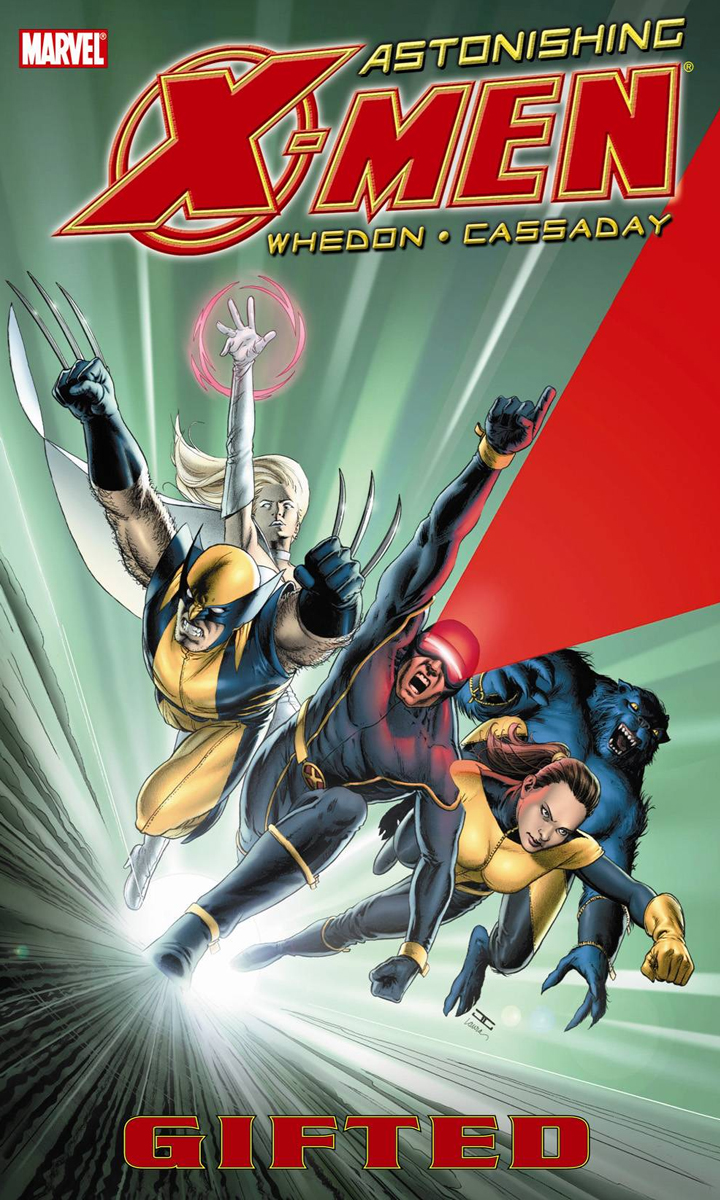
Speaking of jokes, this blog entry wouldn’t be complete without a reference to Joss Whedon’s terrific run on Astonishing X-Men. Start with the first volume, Gifted, or just get one of the omnibus editions. Astonishing follows the premier mutant superteam after the death of founding member Jean Grey, and largely eschews the notoriously complicated X-Men continuity for solid characterization and snarky humor. (My personal favorite moment is when a psychic villain “devolves” several of the X-Men, turning Beast into a growling animal and making Wolverine revert to his childhood self … which seems to be a hilariously naïve and racist Little Lord Fauntleroy. Can a character be hilariously racist? It turns out that Wolverine can … just look for the line, “AND, I met an Oriental!”)

You might notice that DC Comics is conspicuous by its absence from this third method. That’s not intentional, but it is a bit sad. DC has been a lot better than Marvel in recent years at tying absolutely everything going on in its fictional universe to whatever mega-crossover event is being pushed at the moment. There are major ramifications to this. First, almost any good DC storyline requires you to read three or four bad ones just to understand what’s going on. And second, because there’s one of these events every year, the universe changes dramatically all the time … which means a lot of the really good stories don’t have a lot of staying power. Good as they are, there’s no way to explain them to someone who hasn’t been reading DC Comics for years. The few DC stories I considered for this part of the list—mostly James Robinson’s Starman and Mark Waid and Alex Ross’s Kingdom Come—are at least 15 years old, and I felt I’d already filled that slot with Astro City. They’re still good stories, though, and I encourage you to seek them out.

What about you, comic-book readers out there? What books do you recommend to friends who want to read superhero comics for the first time?

And if you say Watchmen, I will do my best to punch you through the internet …

Monday, August 6, 2012

Comic Books You Should Be Reading: Hawkeye (?!)


I’ll admit, I never expected to be recommending a series called Hawkeye in this feature, let alone recommending it after only one issue. But there it is. Marvel Comics’ new series featuring the breakout Avengers hero is a little gem with a lot of very sharp edges.

I’ve never liked Hawkeye. He’s always been the team loudmouth, way too full of himself, and too often played off Captain America just so there was someone to play off Cap. But I picked up Hawkeye #1, partly because I liked the portrayal of Hawkeye in the recent Avengers movie and partly because Derrick Fleece told me to.

Thank you, Derrick.

Here’s a quick recap for the civilians: Hawkeye is generally considered a B-list superhero, a member of most versions of the Avengers over the years but rarely holding down his own title. He was raised by carnies and became a preternaturally good trick shot with a bow and arrow (among other things, but mostly with a bow and arrow). He ran around as a villain for a little while before changing his stripes and applying for Avengers membership. Since then, it’s basically been his job to put an arrow in the bad guy’s eye, call Captain America an idiot when it’s necessary, and in some cases be the only member of the team who uses contractions and/or slang in his dialogue. Oh, and he wears a purple costume, thus dooming him to the fate of almost all characters who wear secondary colors—B-list at best. 

Leap BEFORE you look!
The first issue of what looks to be a new ongoing series by Matt Fraction and David Aja begins with Hawkeye falling out of a building and firing an arrow upward, a lot like that much-ballyhooed shot that made it into the movie trailer. Looks familiar, right? Like you know where this story is going?

Except this time we see Hawkeye land … very hard … on his back … on top of a parked car. Six weeks in the hospital for our intrepid hero. That’s your first clue that this ain’t your granddaddy’s superhero story.  

Hawkeye's physical-therapy regimen.
 As Hawkeye (a.k.a. Clint Barton) points out, he’s the non-super guy on the team of superheroes. He’s out there as backup to Iron Man and Thor, and all he brings to table is, in his words, “a string and a stick from the Paleolithic era.” (He’s quite proud of looking up the word “Paleolithic,” naturally.) The series follows what Hawkeye gets up to when he isn’t being an Avenger, and that seems to be a lot more interesting than what he does when he is one.
Hawkeye's neighbors are so nice, they ignore the purple shirt.
Once he’s out of the hospital, Hawkeye runs afoul of his scummy landlord, who’s trying to evict all the tenants from the building so he can sell the place. Hawkeye seems to like his neighbors (they’re apparently the only people he knows socially who don’t run around in spandex, and most don’t appear to know he’s an Avenger), so he sticks his nose where it’s not wanted and the story goes from there. The rest of the plot involves a run-down casino, a duffel bag full of money, and an incident with a dog that will darn near break your heart. 

Aww, he made a friend. Sort of.
There’s plenty of action and crackling dialogue, but what’s more impressive is what you won’t see in this story. Hawkeye never dons his costume, and there’s not an arrow fired after that first page, but you don’t miss it at all. This is a story about the man under the spandex, and he turns out to be a genuinely interesting and sympathetic guy. He’ll kick his wheelchair into a busy street and break heads in the waiting room of a vet’s office, but he’ll also ask Ivan the landlord not to threaten people with murder in front of their kids, screw up breaking a beer bottle with a penny, and bribe a guard dog with a slice of pizza. He doesn’t have much of a social life outside of the Avengers and this little group of people on a rooftop, but you find yourself wishing you could be one of the people at that barbecue with him. He’s just a fun character to be around, and the comic is all about him, so you know you’re in good hands.

Spandex-free face-punching.
With visual and dialogue tributes to everything from jazz music to seventies action movies, Hawkeye is a fast and stylish thrill ride that never loses track of its heroic heart. Even if you’ve never touched a bow and arrow, even if you don’t care about whether Kang the Conqueror gets a shaft through the eye, you’ll finish this comic caring about Hawkeye, and what he does, and why he does it. And you won’t miss the costume at all. How’s that for a trick shot?

One note to the creative team, though—we’d better see more of that dog … 

"It's okay. I'm an Avenger." Well, that just makes it all better ...

Friday, October 7, 2011

MASKS Commentary Track: Chapter 12

This chapter goes all the way back to one of the stories that got me into graduate school. Seriously.

In 2006, I got an interesting offer from the scholarship foundation that had paid my tuition at USC. They would pay for me to get a master’s degree as well as a bachelor’s—if I could find a California university that would accept me into a master’s program within the next, oh, three months. There followed a completely insane period of midnight research, intensive soul-searching, and frantic test-taking. I registered on Monday for the Graduate Record Examination (like the SAT, but for grad school) and took the test that Friday. My official CD-ROM containing my official test-prep software didn’t arrive until after I’d taken the exam. (Luckily I’m one of those people who naturally test well—yes, we exist, and yes, I agree it’s unfair.) But the only part of the application process that genuinely worried me—not the tests, not the transcripts, not the thousand-and-one forms—was the writing sample. To get into a master’s program in writing, I had to submit professional-quality writing in my intended genre. Because I wanted to major in fiction writing, that meant short stories or a section of a novel.

I can bluff my way through a test. I can bluff my way through an awful lot of bureaucracy, and I can sweet-talk department secretaries until the cows come home. But you can’t con a writing sample like you can con a department, and I didn’t have time to write something especially for the application. I had to pull stories out of my files and polish them up in the hope that they would be judged worthy, and I knew the stories would receive more scrutiny than any other part of my application. Since Masks was the largest, richest, most complex thing I’d ever written, that meant picking the best Masks chapters.

One of those chapters happened to be about the Masked Rider—a short story told in terms of a stack of comic books read by a young boy. Stories from different eras of comics had wildly different takes on the Rider, and the few commonalities between the different mini-episodes explored his character in ways I found interesting. I don’t remember all the details I stuffed in there now, but I do recall that the Teddy Roosevelt sequence also included a cameo by Annie Oakley and a reference to the fact that the Masked Rider limps when he walks, which is why he so rarely gets off the horse. He tells Oakley that he’s had the limp all his life, but it got worse after the Battle of Gettysburg. Make of that what you will …

Oh, and the whole thing was inspired by this letter which I read reprinted in some random old book. The chance to combine T.R. with Buffalo Bill Cody and superheroes was just too good to pass up. And I was quite astonished when I actually got into the program ... especially when I met my fellow students and realized I was almost always going to be the only "genre fiction" writer in any class. It makes me wonder sometimes what the admissions committee saw in my ghost cowboy.

Then we come to Rae’s confrontation with Mike. I’ve heard from readers with two different interpretations of why Rae says these things to him. Some people seem to think that she’s conning him, crying crocodile tears to get him to back off and leave Trevor undiscovered. Certainly the fact that she starts crying so suddenly indicates to me that she’s faking it, at least a little. But I’m mostly in the other camp—I think she genuinely is upset about the way the alpha-track kids are privileged over the normal kids, and she draws on real feelings to scare Mike off here.

Part of that, I’m sure, comes from my own upbringing and the way it worked into Rae’s character. I spent a goodly portion of my childhood in one of the richest counties in the United States—but in one of the less affluent parts of that county. I went to private religious schools, where I was usually on the low end of the socioeconomic scale. My family wasn’t on food stamps or anything, but I was the kid who wore K-Mart clearance clothing instead of name brands, the one who never bought hot lunches because they were too expensive. I was the scruffy one, the one from the blue-collar hometown, and at least among girls, it didn’t matter that I was a probably-certifiable genius—I just never measured up to their standards.

It didn’t matter at first, but as I got older and met classmates who had access to pricey private tutors and extensive test-prep programs, I felt like I had to work twice as hard at my studies to overtake the kids who were far above me on the social ladder. I had to compete with people who, in my mind, got to cheat—so I competed extra hard. I was a straight-A student, the girl who won more academic honors than she could carry, and that was my ammunition in the class wars. “What I did over the summer” essays, for my classmates, were about vacations to far-off places; I would go to the public library, pick a random subject I didn’t know much about, and read every book in that section until I was satisfied. I was the classroom expert on everything from carousel-horse carving to Aztec human sacrifice. It helped that I genuinely enjoyed learning, but when my classmates complained that I blew the curve on tests, I apologized for spoiling their day—and then went and studied even harder for the next test, because unlike them, I couldn’t afford to get a B.

Now, Rae comes from a relatively wealthy family, what with her father being a well-known televangelist, so I applied my class anxiety to her dealings with superpowered heroes. I met enough kids growing up who thought their parents’ money made them my natural superiors that I enjoyed blacking bullies’ eyes; considering Rae’s history with bullies, it only made sense that she’d attack powers snobs with the same ferocity. And so she uses her one real advantage—her intellect—to keep up with the superhuman Joneses. I think she does pretty well.

And then there’s Rae’s missing friend. She’s based on a true story, as it happens, but I think she deserves a blog entry of her own. Maybe someday soon …

This week’s soundtrack is Johnny Cash’s cover of Bruce Springsteen’s “Further On Up the Road”, one of the songs I use as the Masked Rider’s theme. (The other is, of all things, Gordon Lightfoot’s “The Pony Man.” I never said I was sane, guys!)


By the way, guys, time's running out to download "Talisman," the short story I wrote in 48 hours to raise money for some needy kids. I need to actually buy the stuff for them, so the sale will be closed and the story taken down on Sunday night. I have no plans to reprint "Talisman" in any future collections, so if you want to know what Trevor was doing in the middle of the Night Lords' War, or you want to meet his mentor face-to-face, or you just want a bonus Masks fix for this week, you have until the end of the weekend to pony up a whole two dollars for a story twice as long as a typical Masks chapter. All proceeds go directly to buy much-needed school supplies for the children of a needy local family ... who, by the way, don't know yet that I'm doing this, because the teacher who told me about them is going to surprise them with the goodies. :)