Showing posts with label movies. Show all posts

Wednesday, May 13, 2015

Age of Ultron is a B-plus, and here's why.

So I saw Avengers: Age of Ultron on Friday night and much as I liked most of it, and much as I thought I'd never need to say this—Joss Whedon, you need to move on.

I know, I know, Joss is moving on; this is his last contracted Marvel movie, and the Russo brothers (of Winter Soldier fame) will be taking over future installments in the Avengers franchise. But this isn't the sendoff I would have liked. I wanted to miss Joss when he was gone.

Okay. Time to put on my big-fangirl pants and deal. I had very high expectations for this movie and they weren't met, that's all. Most of my disappointment here is that I expected this movie to be as awesome as the first one and it was just kinda goodish. Goodish isn't so bad. It's only bad when you expected better.

For those who want the capsule description, Avengers: Age of Ultron mostly focuses on what happens when the ad hoc superteam of the first Avengers movie has to grow up and deal with the world in a systematic, adult way. Spoiler: it doesn't go well. When Tony Stark decides to use a little evil science to kickstart his world-defending AI system (because what could possibly go wrong with that?), the world pretty much goes to hell in a handbasket and the good guys spend two hours trying to fix it, with mixed results. I'm going to start with the good before I move on to the problematic.

Now, because this is me and I tend to dwell on the things that annoy me, I'll probably have more to say on the negative side of the balance sheet, so I want to establish right up front that as much as I dislike the problematic stuff, I consider AoU a pretty good movie overall. If the first Avengers was an A, this is a B-plus. It's good, okay? You'll have fun. It's just not without its problems, is all. And one or two (or three) of those problems are significant.

All right. Here we go. This is your last spoiler warning ...

The good:

1. This is a really darned good superhero movie. Seriously. Everything you look for in a tentpole popcorn flick is here. And it's all done really well. A lot of stuff blows up. There's a whirlwind tour of the endangered globe. There are moments of real excitement and humor. If there's a checklist for how to make a good superhero movie, this one checks nearly all the boxes. Anything involving the Vision, in particular, is damn near perfect (and gorgeous to boot). It's just a well-made superhero movie by the standards of what makes a good 'un.

2. Nice action sequences. That's an understatement. This movie doesn't just go for spectacle—it pays real attention to how the Avengers would function in combat after some practice together. They use their strengths and compensate for one another's weaknesses. Whether it's Captain America using a motorcycle as both personal transportation and blunt instrument, or Iron Man having a contingency plan for the Hulk losing his few remaining marbles, or Hawkeye doing his mere-mortal schtick in places where the superpowered gods can't go, this movie has everything you want to see in the way of the Avengers in action.

Early on, a bad guy asks his henchman why their defenses are failing, and his baffled henchman replies, "They're the Avengers, sir." And that pretty much sums it up.

3. Hello to the funny. It's a Joss Whedon movie, so this shouldn't be a surprise, but there are more than enough jokes. I'd guess I had to lip-read maybe fifteen to twenty percent of the dialogue because the people around me were laughing so loudly at what had just been said. It's funny, okay? There's plenty of funny.

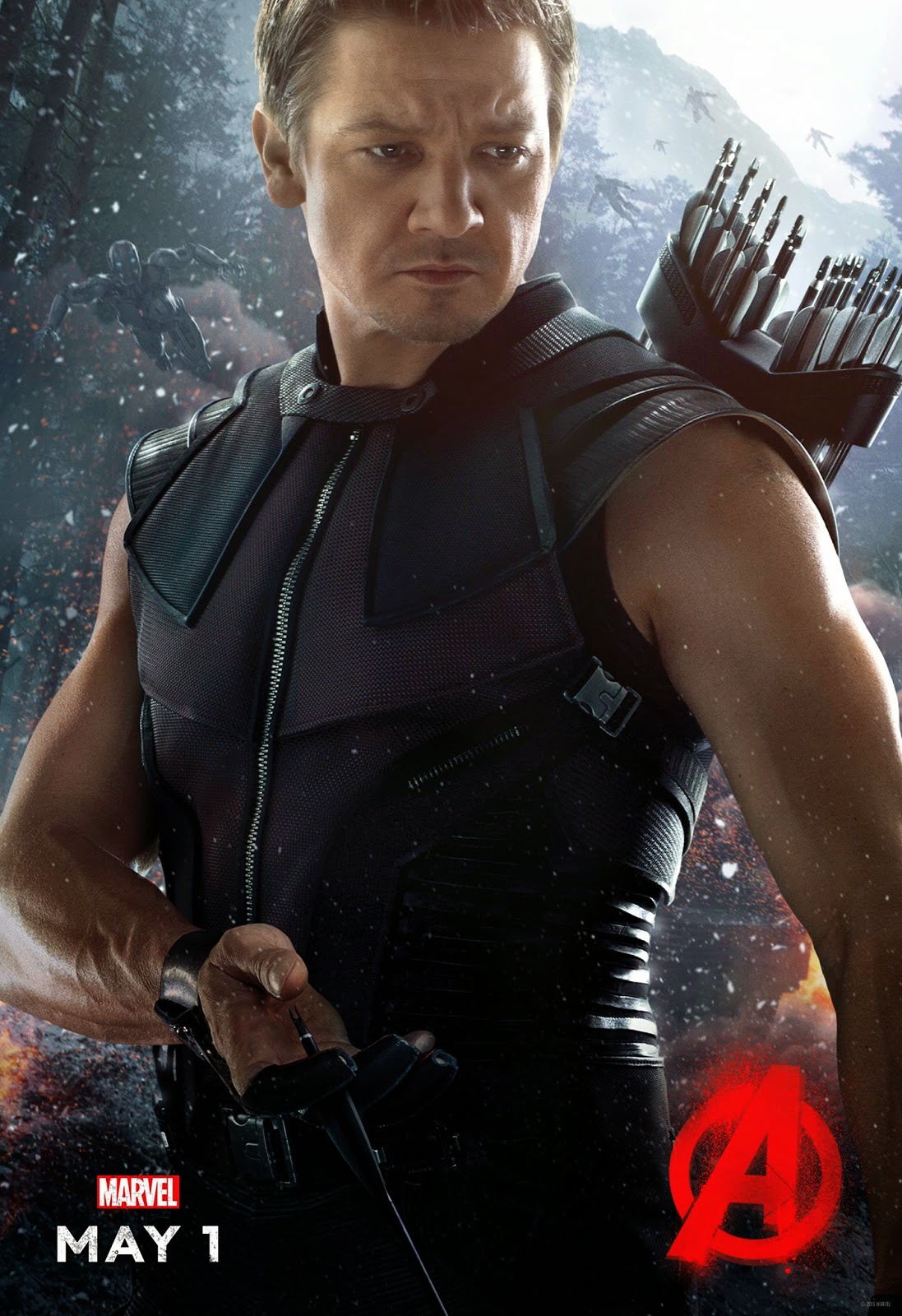
4. Hawkeye! If you felt there wasn't enough Hawkeye in earlier Marvel movies, this movie will be your jam because he's everywhere. He gets a lot of the best action and the best snark. And as the movie delves into his personal life, including glimpses of his home (yes, he has one), he carries a lot of the film's emotional weight, too. And he does it well. Jeremy Renner, I would start a petition to give you your own solo film except that this movie kind of was that film.

5. Ultron is a hoot. James Spader is hilarious. If you've ever snorted a drink out your nose at something he said or did in The Blacklist, you'll be happy here. There's nothing quite like hearing him say, "Stop it!" like the annoyed parent of a toddler after Captain America tries to kick him in the face for the fourth or fifth time. Spader does for Ultron what Tom Hiddleston did for Loki—take a two-dimensional megalomaniac and turn him into something complex, sympathetic, and charming. I don't think Ultron will be getting a fangirl army any time soon, but it's not for lack of effort on Spader's part.

6. Sam Wilson is an Avenger. I repeat, SAM WILSON IS AN AVENGER. Yes. He makes it. Anybody who's been rooting for the Falcon to make it to the big show, you will be pleased. He's in the final roll call, with a new set of wings.

6. NEBBISH! This is a personal thing, but I was delighted (and actually screamed in the theater) to see the return of one of my favorite minor MCU characters. Remember the SHIELD technician who refused to launch the helicarriers? The guy who started the "captain's orders" meme? He doesn't have a name in the canon, but after I saw him in Winter Soldier he quickly became my personal Figwit. I loved the fact that he was obviously scared out of his mind, the last person who should be fighting somebody like Rumlow, and yet he was the first speaking SHIELD agent we saw resisting Hydra's takeover. While everyone else was looking at each other and wondering what to do, this little nebbishy guy proved himself more heroic than Captain America (and nearly got his brains blown out for it, in a nice touch of realism). It was established that a lot of SHIELD agents died when the Triskelion fell, and unlike named characters like Agent 13 and Maria Hill, Nebbish didn't get an epilogue in Winter Soldier. He wasn't important enough to be shown, alive or dead, at the end.

Well, it looks like Nebbish made it out okay, because he's shown (briefly) working for Nick Fury in the climax of the film. And that was probably my favorite part.

Yeah, Nebbish was the best. Because a lot of the other good in this movie was soured by ...

The bad:

1. It's too many movies in one movie. Maybe there's a way to do Ultron and the birth of the Vision and the introduction of Quicksilver and the Scarlet Witch and the foundations of Civil War and build Hawkeye into a fully developed character—but this wasn't it. There was just too much going on—so much that it was hard to care about any one plot thread when the next action scene (however excellent) was barreling at you before you could process. This was about a movie and a half packed into only one flick, and not in the good way.

2. Wait, are there three SHIELDs now? And other plot holes. Let's just say there was insufficient attention to detail, which is a lousy thing to say about a Joss Whedon production. But there are plot holes you could drive a truck through. Like the part where Bruce finds Natasha in the oh-so-secret dungeon in the middle of Ultron's base. How? She was unconscious when she was brought there, so she couldn't have correctly described her location to Clint. How did Bruce find the place? How did he get in there? How did he find her inside a sprawling building? Honestly, would one shot of Bruce creeping down a hallway have been too much?

Similarly, when Nick Fury randomly shows up out of nowhere with a helicarrier, it's a little weird. Seriously, dude, where were you an hour ago? And does this mean that you have your own SHIELD faction now, to replace the two that have been squabbling all season on Agents of SHIELD? How did you suddenly become a slick and well-funded operation again at the end?

And perhaps most importantly, why does nobody notice that smashing robot bodies does absolutely no good in the age of cloud computing? There's nothing to suggest Ultron hasn't backed himself up somewhere online. Breaking the hardware shouldn't do anything of substance. So the movie ends with only token evidence that the bad guy has even been defeated, yet everyone relaxes like they won.

I could go on, but ... seriously, there's just a lot of plot holes. Enough to be distracting.

3. Why is there a romance in this movie? And why is it this romance? One of the things I liked best in the first Avengers movie is that there wasn't much in the way of romance. The whole thing happened over, like, two days, and there was just no time for it. I liked that a lot better than a typical action movie where the love story feels shoehorned in.

Well ...

The big romance in this movie is between Natasha and Bruce. And I don't care whether you ship that or not, but I have two problems with it strictly from a filmmaking perspective. First, Scarlett Johansson and Mark Ruffalo don't have that much chemistry together. Their scenes feel dull and forced. So you're adding a romance that doesn't work, from a strict filmmaking standpoint.

Second, the romance is pretty much all Natasha does in this movie. Seriously, even Bruce gets to weigh in on the creation of Ultron and how to defeat him. Natasha just gets kidnapped and turned into Bruce's damsel in distress. I don't care what your view of Joss Whedon's self-described feminism is—that is a waste of a good character. Why is Natasha even here if this is all she does? You could have swapped her for Betty Ross and gotten the same results.

4. Tony Stark is an idiot. This is the first of many signs that Joss Whedon hates his job. Tony was the darling of the first Avengers movie, the wisecracking scene-stealer who got all the best snark. That is a sign that Joss loves you right there. And he got to make the big dramatic sacrifice to save the world.

This time? Tony is still snarky, but it's pointlessly mean snark—lines like a joke about reinstating prima nocta when he rules Asgard. There were a million jokes Tony could have made while trying to lift the hammer, but somehow we ended up with a rape joke. And yeah, Tony then turns out to be unworthy, which has led a lot of online pundits to suggest that this was Joss trying to undermine Tony's jerkishness, but that's not what bothers me. What bothers me is that Age of Ultron makes Tony out to be the kind of jerk who would make a joke like that. Never mind his development over four previous movies—none of that counts now, because Joss Whedon needs a straw man to tear down.

And then there's the stupidity! In Age of Ultron we get a Tony Stark who is literally unable to learn from his mistakes, even in engineering, which is supposed to be his primary area of genius. Bruce even calls him on it, saying he's "stuck in a time loop" when Tony suggests countering an out-of-control AI with another out-of-control AI, effectively repeating an action and expecting different results. And yeah, it turns out okay this time—but not because of anything Tony did.

Apparently, this movie just couldn't get along without a version of Tony Stark who was so obviously wrong about everything that no rational person could agree with him on anything. That's a terrible way to set up an antagonist for the upcoming Civil War movie. What's the matter, Joss? Couldn't be bothered to write a little complexity and nuance into someone who had to be on the wrong side of the argument?

5. Steve Rogers is unrecognizable. I guess not, because Steve got an even rawer deal than Tony. I noted in my review of the first Avengers that my one major issue was that every one of the Big Six got a serious character arc except Cap, who just kind of piddled around until it was time to punch aliens. When the Avengers Blu-ray came out with a bunch of deleted scenes that appeared to show Cap's arc, all was seemingly forgiven. It was cut for time. Understandable.

I'm not so understanding now.

The Captain America we get in Age of Ultron is nothing like the one we see in the other MCU movies. He's the most hidebound member of the team, primly correcting Tony's casual profanity (and reacting with very little grace when ribbed about it later). This is just dumb. The guy fought through World War II (in the American infantry!) and casually says things like "light the bastards up", but he has a problem with Tony saying "shit"? That's so far out of character that it's a non sequitur.

In fact, there's very little of the Steve Rogers we've come to like in other movies. The guy who tried to drink an entire pub and cried himself hoarse when Bucky died in The First Avenger is now saying things like, "If you get killed, walk it off." The guy who dismantled an Orwellian intelligence organization in Winter Soldier ends up apparently running one. And even when Sam Wilson says he's happier not being an Avenger, Steve goes and makes him one (presumably because he knows Sam can't tell him no). There's no indication that he's still actively trying to find the person he nearly killed himself saving in his last movie; Bucky's not so much as mentioned by name. Even during the downtime on Clint's farm, Steve never seems to pause and reflect on his gaping emotional wounds. He's the Tin Woodsman to Tony Stark's scarecrow—no heart, no brain.

This isn't The Wizard of Oz, Joss. Heartless Steve Rogers is not what I bought a ticket for.

6. Natasha Romanoff is ... I don't even know what. All right, before the whining starts, I am going to be absolutely clear about what bothers me about Nat's role in this film. It's not what happens. It's that this is not Natasha Romanoff.

Let's discuss the elephant in the room—the "monster" line.

At one point, Bruce tells Nat they can't be a couple because he can't have children. Nat replies that she can't either—the "graduation ceremony" in the Red Room was a mandatory surgical sterilization. Okay, fine, bad people do bad things. But Nat then goes on specifically to say that the sterilization was done so she would be a better assassin (because having a hysterectomy makes you a better murderer?) and tells Bruce that he's not the only monster on the team.

And that is where I put down my popcorn.

I'm sorry, but "monster"? Let's be charitably dense and say this isn't what it looks like—this movie saying an infertile woman is a monster because she's infertile. Let's say Nat thinks she's a monster strictly because she's killed a bunch of people. Let's ignore the fact that she was discussing her infertility right before she switched to the topic of monsters, and that she explicitly said she was rendered infertile so she'd be better at doing monster stuff. Let's assume that Joss in no way meant to imply that non-motherhood equals monsterdom, that he never meant to say that a woman who can't have children should consider herself no longer human. Let's even assume that this is not a reflection of the movie's view, just a moment of character for Nat—that she holds this idea, true or not, because that's just how she feels and feelings don't have to be logical or popular with the audience if they work as part of a character's overall arc.

That still leaves the fact that Nat calls herself a monster, on a par with the giant green rage machine that just destroyed a city, and nothing and no one in the rest of the movie contradicts that point of view. Bruce never says, "I don't think you're a monster" (even though the Hulk is shown in a middling positive light in other scenes). No one is shown treating Nat like a hero, unless you count Clint naming his next kid after her (sort of), which was apparently the plan even before the M-word entered the conversation. Steve makes her his second-in-command, but since this is the Steve Rogers who tells hypothetical dead people to walk it off, he might as well be amending "monster" to "useful monster". Of the two people in the movie who appear to care about Nat, in the end, one leaves her and the other is understandably distracted by all the kids he's got.

This is a movie that pretty much lets Nat call herself a monster, entirely or in part because she can't have babies, and replies, "Yup, you are."

And that's about 50% of Nat's role in this film (the other 50% being her damsel-in-distress routine).

Sorry, but that's not the Natasha Romanoff I bought a ticket for. I want to see the version that's slowly discovering she isn't a monster—the consummate spy of Iron Man 2 who became a steadfast best friend in The Avengers and whom Steve Rogers explicitly trusted to save his life in Winter Soldier. I want to see the Natasha Romanoff who's never perfect, but who keeps growing. Who doesn't accept the "monster" label. Who takes her vicious, sexist codename (Black Widow, poisonous man-eater) and shoves it down the throats of everyone who dismisses or underestimates her.

Natasha Romanoff is not resigned to being a monster. And damn you, Joss Whedon, for implying that she is, or should be.

7. I just don't care. Maybe it's the movie overload, maybe it's the fact that several characters went off the rails, but I just wasn't emotionally invested in this movie by the end. I wanted to be. I was sitting in that theater in a superhero hoodie, holding a teddy bear dressed up as my favorite Marvel character, in a row full of friends who were doing the same thing. I wanted to like this movie. I expected to like this movie.

And it had its moments. The Vision was gorgeous and very well done. There were moments of joy and wonder and fear. But when it comes right down to it, a group of characters I loved—had come to consider my friends, in the way really good fictional characters become your imaginary companions—either didn't show up or were treated so poorly that they'd have been better off staying home.

It's a pretty goodish movie. If it were anything other than an Avengers movie made by Joss Whedon with the Avengers in it, it would be an excellent movie. But it's not.

So I give it a B-plus. And after I saw it, I went home and Googled Chris Evans' tweets about filming the next Captain America flick.

Maybe my imaginary friends will show up for that one.

Tuesday, April 29, 2014

Eating crow on Winter Soldier


I’ve decided that if I’m going to devote a long blogathon to, among other things, my predictions about this movie, I’d better check in on whether I was right or wrong now that the movie is out. Honestly, I was shocked at how many of my predictions turned out to be accurate … and that the accuracy rate was slightly higher with the batshit-crazy pet theories. I did not have script access, I swear. Apparently I’ve just got one of those brains. (But you probably knew that.)
So without further ado, here’s a rundown of my predictions from the second, third and fourth days of the blogathon, and how they all turned out. Spoilers ahead, of course.

PREDICTIONS FROM THE VIDEOS (from Day 2):

1. Paranoia and conspiracies abound.
Yeah, I think we can say this showed up. I don’t know about you, but by the end of the movie I was watching every blue uniform out of the corner of my eye.

2. SHIELD vs. SHIELD is officially a thing. Well, considering that Hydra was inside SHIELD, I think we can safely say that one happened.

3. Cap goes on the run. Yeah, he took it on the lam, all right. Bonus points for the sight of Captain America stealing a car … and walking around a shopping mall. The horror. And lying low really did not work out too well for him. Of course, breaking into the Smithsonian didn’t help …

4. Cap maybe falls in love (but probably not). Well, they kissed, but I did call the shot there—they weren’t kissing for the most common movie reason. (It was the second most common movie reason.)

5. The Falcon is Cap’s rock. Yes, yes, and yes. Falcon wasn’t a SHIELD agent (good thing, too), but he was definitely the solid foundation Steve Rogers needed in this story.

6. Peggy Carter returns. Briefly, but yes. And not only was Steve a bit wrecked by that scene, I don’t think I’ve been in a single screening where I didn’t hear somebody sniffling by the end of it. Bravo, Hayley Atwell.

7. Robert Redford is a spook. Eeeeeyup.

8. Nick Fury has a bad day. Oh, hells, yes. And may I just point out that I said before the movie came out that “Fury’s major weakness … is bureaucrats who go over his head to get things done. How high do the bad guys go?” Pretty damn high, as it turned out.

9. The Winter Soldier is a sock puppet, not the main bad guy. Yeeeaaaaaahhh. I’m gonna call that prediction a slam dunk. The main bad guy would be the guy smacking Bucky in the head for misbehaving.

No, not Steve! The first guy to smack him in the head!

10. Black Widow plays a major role. Yup. Though we didn’t get to see as much of her backstory as I would have liked.

All right, all right, I hear you saying. It’s hardly rocket science to predict stuff that is obviously in the trailer. What about the stuff that wasn’t in the trailers?

THE SAFE PREDICTIONS (from Day 3):
1. Agent 13 plays a significant role. I’m going to call this a split decision. She was there, and she was important, but she wasn’t as big a player as I expected, and her relationship to Peggy (if Peggy even was the “insomniac aunt” on the other end of that phone call) was not explored.

2. Agent Rumlow is not to be trusted.
This is a big ol’ check. You definitely can’t trust that guy. He even rocked Crossbones’ crossed-straps-and-horrible-scarring look by the end.

3. Batroc is Batroc. This wasn’t much of a surprise, but check. He even did some leaping. And while he didn’t betray an unscrupulous employer, he did turn out to be (probably) working for the good(ish) guys. Well, Nick Fury. As close as you can get.

4. Hydra is back in some form. Holy hell, yes. Not even “in some form.” Actual Hydra, dumb salute and all. Nice. I hereby pat myself on the back.

5. The Zodiac is involved. Big ol’ miss. Not a word about the Zodiac in this movie. Oh, well. Maybe it’ll show up in Guardians of the Galaxy.

6. Mind-control magic will show up. Well, it certainly didn’t look like the means of mind control was Tesseract-related … though it did turn out that Hydra had Loki’s scepter, and SHIELD had the Tesseract more than long enough for Hydra to power their shiver-inducing brainwashing rig with it. I’ll call this a miss, but it just might be a split decision. We may find out more in the next movie, when Bucky’s set to appear again (and, presumably, Steve’s going to dig into that file).

And interestingly, the movie kept some of the Soviet trappings of the Winter Soldier origin story—Bucky speaking what sounded like Russian during the bridge scene, what looked like a 1950s Soviet soldier in Bucky’s flashbacks, Widow getting the Winter Soldier files from “some friends in Kiev” (you decide whether that means the recently booted Yanukovich government, or the new one that booted him, or whatever the hell Putin tries to put in next) and what looked like a dossier written in the Cyrillic alphabet. So I might be wrong about the Russians being untouchable Marvel movie baddies.

Of course, that last paragraph did include the word “Putin”. So who the hell knows. And here ends my geopolitical rant.

7. Black Widow’s history will be revealed. Miss. We didn’t get much of that at all, except Zola revealing her patronymic and her date of birth (which I totally don’t buy—more on that later) and Natasha mentioning her past connection with the KGB. We got nothing on a possible Red Room past, or whatever she was talking to Hawkeye about when he was babbling about mind control in The Avengers. And she wasn’t running a long con on SHIELD (that we saw). Sigh.

All right, on to the main event …

THE BATSHIT-CRAZY THEORIES (from Day 4):
Honestly, I was surprised at how on-the-mark these were.

1. Robert Redford is the Red Skull (or someone like him). Well, he wasn’t the actual Red Skull, but he was the head of Hydra and he tried to kill Captain America a whole bunch. That’s pretty like the Red Skull. I’m prepared to call this one a hit.

2. The nurse across the hall is Agent 13. Yup. Called it. She was there as a bodyguard rather than as a starter friend, but she was flirting with him, too. Call that a hit.

3. The Steve-Natasha romance ain’t happening. Bingo. The kiss was a fake-out.

4. The Bucky-Natasha romance might happen. Wrong. This was a big miss on my part, but I’m not terribly upset. Like I said up above, I don’t believe Natasha was actually born in 1984 like Zola said. Even if you can’t do the basic arithmetic involved (no more Russian KGB after the early 1990s), here’s a simple illustration: half my friends were born in 1984, by a remarkable coincidence, and if they ever worked for the KGB, they would have to have done it in grade school. Early grade school. I know Natasha “started early” in the spy game, but I’m not buying the notion of her being an experienced and competent KGB agent at five to eight years old. As a result, I think the birthdate Zola gave her was wrong. I still think Natasha has a longer past than she seems, and I still think Bucky’s in it somewhere. Maybe next movie.

5. Fake death(s). Oh, look. A major character faked his death. And another one conveniently disappeared. I’d call that a palpable hit. It wasn’t Bucky under that sheet, granted, but it was a fake death. Point to me.

6. Bucky is a super-soldier. Ding ding ding! And he was apparently supered up before he fell off the train, at least according to Steve’s theory of how Bucky must have survived. It’s pretty consistent with Bucky’s flashbacks, too. Go Steve with the inductive reasoning!

7. Arnim Zola resurrected Bucky. Oh, yes. They even used the same real-life history I cited. If you were in a theater on the evening of April 3 and a random woman punched the air and whooped when the Black Widow said “Operation Paperclip” … yeah, that was me. Sorry for the interruption.

8. The Winter Soldier is working for SHIELD. All right, it might be a bit of a cheat to claim both the “Hydra’s back” and the “Winter Soldier is working for SHIELD” theories as true when he was, in fact, working for the organization that I credit as both Hydra and SHIELD … but it was Hydra inside of SHIELD. I’m calling this a win. Look, it was even Pierce pulling the strings, and he was the head of both Hydra and SHIELD. Stop looking at me like that.

9. Peggy Carter and Howard Stark helped build the Winter Soldier. Okay, I was dead wrong about that one. I’ll have my crow medium well, thank you.

10. The Winter Soldier is a false-flag operative. Yeah, more or less. He was working for SHIELD/Hydra (Healed? Shydra?), but attacked Nick Fury under the guise of being not working for them. Check.

FINAL SCORE (not counting the stuff in the videos and the split decisions): Hits 11, Misses 4. Not bad for armchair screenwriting.

So what did you think of Captain America: The Winter Soldier? Let me know in the comments, while I try to stifle my fannish squealing …

Friday, April 4, 2014

Winter Soldier Review: Mouthguards, throat-cutting, and the hardest thing to do ...


Really, there’s only two things you need to know about my opinion of Captain America: The Winter Soldier.

Thing one: First—and I say this as a huge Bucky Barnes fangirl—it could’ve used about ten percent more Bucky Barnes than it actually contained. Just ten percent.

Thing two: That’s the only negative thing I can find to say about it. It is otherwise perfect. In many ways, it’s better than perfect.

Honestly, if you haven’t seen this movie yet, and you like superheroes enough to read my blog, open a new browser window right-the-hell-now and buy a ticket to see this. I’m not completely convinced yet that The Winter Soldier is better than The Avengers, but it is definitely in the same intellectual, emotional, and all-around fun weight class. This is the big-budget, high-stakes Captain America movie that you saw in your head when you read the Brubaker/Epting comics, and the one you have longed for in your heart.

One completely spoiler-free example? This movie actually gave Bucky’s story a better ending—well, a better ending-for-now, because you know it’s not over—than the comics. Yes, better than blowing up the Cosmic Cube and reappearing at Fort Lehigh. Yes, better than Steve having to convince everyone he knew that Bucky wasn’t dead again. All I have to say about this ending is stay all the way through the goddamned credits, because there is a scene you have absolutely got to see. Remember the shawarma scene in The Avengers? It’s got a sequel, only it tears your heart out instead of making you laugh maniacally. Glue your butt to the seat and watch both credits scenes. You can thank me later.

And then there’s the overall awesomeness that is the Falcon (seriously, his every scene is solid gold) … and the horror of Steve Rogers in an Apple store … and the best car chase in years … and fight scenes that work on every level … and some of the finest character work in any Marvel movie, ever …

Okay, I think I can breathe now. Time to pretend I’m actually reviewing this movie, instead of just gushing my brains out.

Because here’s the really important part I haven’t gotten around to telling you yet—this movie is a lot more than explosions and car chases and Scarlett Johansson kissing Chris Evans. This movie is after your brain, and your heart, and it’s not one you’ll forget in a hurry.

I really can’t spill too much of the plot in this review, not without spoiling some really great plot twists, so I’m going to focus on theme instead. Because it’s a big, big theme, and really the theme is a lot more important than the plot. The Winter Soldier is fundamentally a movie about tackling the biggest question in heroic fiction—the question of sacrifice. And the answer it gives, as much as it gives any kind of answer, is one that simply must be seen. It’s what elevates this movie from a standard superhero punchemup to something people will probably write dissertations about in the next couple of years. And the punching’s damn near perfect.

As we all expected, The Winter Soldier tackles some big issues on the freedom-versus-security front. Pretty much everyone who saw those trailers expected Captain America’s self-effacing, self-sacrificing 1940s ideals to clash with twenty-first-century paranoia and pragmatism … but nobody could have predicted the way that it actually drives the story. In The Winter Soldier, the central conflict is between Cap’s morality and SHIELD’s, but the sides are not exactly drawn up in the usual way. And the actual physical punching-and-kicking conflict, when it arises, encapsulates the moral conflict perfectly—and in a manner even more heartbreaking and thought-provoking than the original comics managed to do.

For years, Captain America has held the moral high ground in Marvel Comics. Thanks to his long record of unquestionably heroic service, he’s the ultimate arbiter of right and wrong; morally conflicted superheroes regularly seek him out for advice. But as a lot of readers have pointed out, giving Cap the moral high ground in a typical comic book is more problematic than it looks; he fought for years in a bloody world war, with all that entails. He’s not exactly pristine. Take that ultimate superhero bugaboo—death.

Unlike, say, Batman, there has never been any question about whether Captain America’s killed people. You can count the number of people Spider-Man’s killed on the fingers of one hand, but Captain America used to walk around with a giant death-frisbee, backed up by a teenager with a machine gun, accompanied by two guys who could light themselves on fire and a perpetually pissed-off sea king who liked ripping Nazis limb from limb and who once tried to drown all of New York City because he had a bad day. They killed a lot of people, is my point. They did things that you do not usually want your superheroes doing, and they were celebrated for it. Now, nobody who’s studied history thinks they were out of line to do those things, of course (there’s a reason Nazis are everyone’s favorite all-purpose movie villains), but it kind of blows a hole in the Captain-America-as-moral-paragon theory to remember that he did his fair share of throat-cutting with that shield.

Well, guess what? He’s not so ruined anymore. The throat-cutting’s still there—oh, my, is it ever still there—but this is not the Steve Rogers you knew.

In an early scene, after Steve complains about SHIELD turning a rescue mission into a black-ops job, Nick Fury brings up this very point—the Strategic Scientific Reserve did a lot of dirty work back in the day, so what’s Steve whining about now? But for once Steve has an answer. Like a lot of good guys doing bad things, he believed he was doing them for the sake of the greater good—so that bad things would no longer be necessary. Not so they could be institutionalized by the organization his friends founded, and certainly not so they could be repeated on a planetary scale. Maybe you don’t agree with him on that—maybe you think an organization like SHIELD is necessary, and you believe you can’t run it without spying on everyone and occasionally assassinating people who get in your way—but from that moment on, you believe that Captain America thinks it’s possible, and you understand why. And you very much want him to be right.

All of a sudden Steve Rogers has his naïveté back, and the audience really wants him to have it. By portraying Steve’s history of violence (and the surprisingly large number of people he kills on missions in this movie) as a deliberate act of self-sacrifice rather than a moral lapse, the movie places him on the moral high ground even as he’s literally trying to scrub the bloodstains out of his clothes. And by embracing that violent edge and going way past it, on a global scale and on a daily basis, SHIELD is devaluing that sacrifice. No wonder Steve is pissed. Instant conflict.

Unlike the 50 years of stories that mostly portrayed Captain America as morally perfect and absurdly claimed that he had never done anything so questionable as killing anyone, this version of Cap has taken a long walk in the darkness, and has gotten a good look at the abyss—and now he’s deliberately standing between it and his spiritual descendants. No matter where you stand on the Patriot Act, the NSA, or any other aspect of the way the world’s been run for most of my life, you understand immediately why Captain America’s doing what he’s doing, and why he considers it worth his life to do it. He is choosing, over and over again, the kind of sacrifice that defines heroism. And you’re going to bloody well root for him if you’ve got a sympathetic bone in your body. That’s the kind of character Steve Rogers is.

So whatever else happens in this movie—and especially in Cap’s inevitable conflict with his brainwashed best friend, Bucky/the Winter Soldier—that tension runs underneath it all. Can Captain America pull the world back from a brink that few people know, or care, is there? Can he do it without having to commit one last dirty deed—killing an innocent who also happens to be his oldest, closest friend? Because even if you’re not going to care about the big abstract questions of freedom and security and surveillance and control and destiny and free will and whatall, you’re going to damn well care about whether Steve, the kid from Brooklyn, has to put his best pal Bucky out of his misery. (Spoiler alert: It’s a lot of misery. I don’t think I’ve ever been so creeped out by a Winter Soldier mindwipe scene. OMG, I wanted to hide under my seat when I saw that mouthguard …) And that’s the real genius of this movie. It’s got a moral conflict on a grand scale … and it manages to play it out on the most intimate human level.

With a fairly clever twist, which I will not spoil because I like you guys way too much, the way in which Bucky is brought back from the dead and the way in which he’s used against Steve perfectly encapsulates the larger question at work. This is something a lot of movies try to do, but few if any do it as well as this one. If Steve can’t stop Bucky from fulfilling his mission, the world burns. But if Steve has to kill Bucky to stop him, Steve will burn in its place. The only way to save the free world and the soul of Steve Rogers is to save Bucky, both as he is now and as he was in Steve’s memories.

And here’s the good bit. Saving Bucky like that is just about impossible.

Did I mention there’s no Cosmic Cube in this movie? No Tesseract? I was right about a lot of my batshit-crazy predictions in the blogathon, but I was wrong about one thing: Bucky is not being controlled by anything like that particular cosmic macguffin. There’s no magical glowing box for Steve to grab and say, “Remember who you are.” If he’s going to save Bucky this time, he has to do it the hard way. And the hard way is a form of self-sacrifice that even Steve Rogers has never had to consider before. He’s not crashing a plane into an ice field now, and he’s not doing his country’s dirty work. He’s … well, I won’t spoil it. But it’s hard for anyone to pull off, and it’s harder still when it’s Steve Rogers who has to do it, and hardest of all when he has to do it while looking into the frightened, confused eyes of Bucky Barnes. (And while Bucky’s trying to bash Steve’s skull in with his metal arm. Because the plot doesn’t stop for angst.)

I’m not saying he does it. I’m not saying he doesn’t. Hell, I’m not even saying the movie actually makes clear whether he succeeds or not—something happens, but it’s kind of open to interpretation. And that’s as it should be, I think. This question is one that’s put to the audience as much as it is to Steve Rogers. Even Bucky gets a say, ultimately, in its answer, but it’s not completely up to him. It’s up to us.

Kind of heavy for a superhero movie, I know. But it’s that weight that makes this movie so very deeply worth the watching.

Okay, that and that one scene after the very end of the credits. Eeeeeeeeeee …

Monday, March 24, 2014

Winter Soldier Blogathon, Day 5: What to Read, Where to Start, and Why to Care


Wow, you made it through! Or you skipped here. Either way’s fine by me. This entry is designed to be a guide to the Winter Soldier’s appearances in the comics. I’ll start with a chronological rundown of the graphic novels in rough order of publication, and then do a short list of the best jumping-on points for this character. I’ll conclude with one last bit of fannish gushing on why you should care about this character, and a little bit of what he means to me.

Be warned—there’s a lot of stuff to cover. Here’s a picture of my personal collection of Winter Soldier graphic novels, in order:

Yes, I can lift the entire stack at once. Barely.
Yeah, there’s a lot of stuff. But I’ll guide you through it. And as always, I recommend used booksellers like abebooks.com and Powell’s Books over paying full price at new-book retailers. Onward!

WHAT TO READ:

What to read: This.
For once, Marvel has made your job easy. If you want to get started on the world of Bucky Barnes/the Winter Soldier and you don’t want to do any hunting, there’s a terrific new hardcover edition of the complete Winter Soldier storyline, put out just in time for the movie. It’s $34.99, and worth every penny. (If that seems pricey for one graphic novel, note that it’s got thirteen issues in it—the equivalent of two trade paperbacks, either of which would retail for about $20. So even in hardcover, it’s a bit of a cost savings.) There’s one issue missing from this book, but it was a one-off “event story” that took place in an alternate universe and had absolutely nothing to do with the Winter Soldier storyline, which I assume is why it’s been omitted. The book does not suffer in its absence. Don’t worry about it.

If you’d rather go the cheaper route, Volume 1 and Volume 2 of the Winter Soldier storyline are available in used paperback form, though they appear to be out of print.

If you like that story and want to keep reading, here’s a short rundown of later volumes in the series:

3 and 4. Red Menace: Crossbones returns, and Steve and Bucky end up in London.

5. Civil War. Cap joins the resistance to the Superhuman Registration Act. Bucky does some skullduggery for Nick Fury. Contains Winter Soldier: Winter Kills, a beautiful one-shot special about how Bucky spends his Christmas. Hint: it involves violence and awkward team-ups with teen superheroes.

6, 7, and 8. The Death of Captain America, vols. 1-3 (The Death of Captain America / The Burden of Dreams / The Man Who Bought America). This three-volume saga covers it all, from Steve’s assassination to the hunt for his killers to Bucky’s transition to life as the new Captain America. Some of the knottiest plotting in all of Ed Brubaker’s run. I cannot summarize this, but if you really like twisty plots and a million reversals per chapter, this is going to be your crack.

9. The Man With No Face. Bucky-Cap faces the vengeful survivor of one of his nastiest Winter Soldier missions. Guest-starring the Sub-Mariner, who adds a lot of comic relief.

Namor reacts to Bucky and Natasha having a moment. Thanks a lot, Namor.
10. Road to Reborn. A more or less random collection of stories, collecting a series of clues leading up to …

11. Captain America: Reborn. Guess what? Steve’s not actually dead! There’s time travel and mad science and oh so much crazy. It’s a fun story, though.

12. Two Americas. Steve insists that Bucky keep the Captain America identity, so Bucky and the Falcon go hunt down an insane doppelganger of Steve Rogers who escaped during a previous story. Imagine Bucky and the Falcon fighting domestic terrorists in rural Idaho. Yeah, it’s like that.

13. No Escape. Baron Zemo, the grandson of the World War II villain who nearly killed Cap and Bucky at the end of the war, decides to avenge his grandfather’s honor and kill Bucky-Cap off. He eventually settles for second prize …

14. The Trial of Captain America. Once Zemo has exposed Bucky’s past as the Winter Soldier, Bucky goes on trial for his decades of Cold War crimes. Meanwhile, the Red Skull’s daughter, Sin, proclaims herself the new Red Skull and goes on a rampage. Bucky must decide whether being Captain America means a) going along with due process or b) stopping a supervillain from blowing up the Statue of Liberty. Did I mention Bucky has poor impulse control?

15. Prisoner of War. Bucky gets off on the U.S. charges, but the Russians demand extradition. Bucky goes to the gulag and gets thrown into a series of cage matches, which turn out to have a motive even more sinister than bad guys just wanting to watch an American superhero fight for his life. The Winter Soldier’s legacy just won’t leave Bucky alone. Psychological games ensue. Meanwhile, Steve and Natasha try to prove Bucky’s innocence. Espionage hijinks ensue.

16. Captain America and Bucky: The Life Story of Bucky Barnes. After Bucky “died” during the not-very-good Fear Itself crossover, the monthly Captain America comic became Captain America and Bucky for a while. The first storyline, “The Life Story of Bucky Barnes”, presents a series of untold tales from Bucky’s past—including his childhood before he met Steve Rogers, a couple of wartime adventures, and a Winter Soldier tale focusing on his romance with the Black Widow. I have not included the next volume of Captain America and Bucky in this list because Bucky Barnes isn’t actually in it. Long story. After that the title became Captain America and Hawkeye, and then fizzled out. This volume is the only one relevant to this timeline.

17. Winter Soldier: The Longest Winter. With Steve finally back in the Captain America costume (and a new Captain America monthly title), Bucky sets off to clean up a few Winter Soldier-related messes. Natasha comes along for the fun and because somebody has to stop Bucky from leading with his face. Romance and a machine-gun-toting gorilla ensue. Also, Bucky meets Doctor Doom and they get along as well as you’d expect. Ha.

18. Winter Soldier: Broken Arrow. A Soviet sleeper agent, trained long ago by the Winter Soldier, is out to destroy the world that replaced his. A key part of his plan involves getting the Black Widow on his side, in more ways than one. Creepy and action-packed, with great twists.

19. Winter Soldier: Black Widow Hunt. The saga of the sleeper agent continues, as our heroes discover some nasty parts of that plan that I won’t spill here. Bucky fights Hawkeye, Wolverine, Daredevil, Cap, and the Black Widow. There’s really an unreasonable amount of fighting in this book. Oh, and it also rips my heart out and crushes it before my eyes, because … well, you should know by now.

20. Winter Soldier: The Electric Ghost. With the Black Widow out of his life, Bucky sets about picking up the pieces of another old mission—one that killed a SHIELD agent and left a little girl named Tesla Tarasova orphaned. Tesla has grown up into the rather frightening Electric Ghost, who can get into Bucky’s head like no one else. This storyline is the only one on this list that Ed Brubaker didn’t write, and it’s also one of the weakest.

Winter Soldier was canceled after the Electric Ghost storyline, so since then it’s just been individual comics not yet collected in trade form. If you want to check them out, there are two series:

21. All-New Invaders. This comic, written by James Robinson (a man who knows his World War II heroes) is a big team-up between Captain America, the original Human Torch, the Winter Soldier, and Namor the Sub-Mariner, among others. Lots of World War II flashbacks and some really good Band of Brothers-style camaraderie in a group of modern heroes whose bond goes all the way back to the 1940s. Right now the plot involves the alien Kree kidnapping Namor for plotty reasons and Namor’s old war buddies invading the Kree homeworld to get him back—largely because Namor’s such a jerk to most people that nobody else wants to rescue him.

22. Winter Soldier: The Bitter March. I wasn’t impressed with the first issue of The Bitter March, written by Rick Remender, but the second has piqued my interest. The story follows a lone SHIELD agent, Ran Shen, trying to smuggle a couple of ex-Nazi scientists out of eastern Europe  in the 1960s so SHIELD can have their magic formula. Chasing Shen is a bunch of Hydra goons and the Winter Soldier. The first issue focused mostly on Shen, and Bucky was basically playing the Terminator, coming after him over and over again. The second issue, however, got into the Winter Soldier’s head a bit more; it’s starting to look like Bucky is trying to retake control of his own brain, and that’s not going to end well for anyone. Seems like things are heating up!

WHERE TO START:
I’ll make this short and sweet. Find the quote that sounds like you and read the answer:

“I want to know what’s going on when I watch the movie, but I only want to read one book.”
Read the Winter Soldier hardcover, or its two trade-paperback equivalents. That’s you sorted.

Pictured: You, sorted.
“I want the best Bucky-Cap storyline.”
Read The Man With No Face. Action, angst, and a pretty good mystery. This is good for the Bucky-Natasha shippers, too.

Oh, look, the cover is a Bucky fashion show!
“I want a little bit of everything—a sampling of the character from different periods in his life.”
Read The Life Story of Bucky Barnes. It’s your one-stop shop.

Also, there's interior art by Chris Samnee. You want that.
“I want the most kickass Winter Soldier action you’ve got.”
Read Winter Soldier: The Longest Winter. Then keep reading if you like what you see.

Including a gorilla with a machine gun. And a jetpack.
WHY YOU SHOULD CARE
Aside from the fact that I obviously adore this character and these storylines, it’s worth pointing out why I adore them. The Winter Soldier storyline was, at the time, one of the most complex ever to appear in mainstream superhero comics—both in terms of plot twists and in terms of its characters’ emotional arcs. It set the pattern for a lot of the really terrific stories that have come out of the Big Two—especially Marvel—in the last decade. It’s not too much of an exaggeration to say that Winter Soldier gave a lot of people permission to break the rules of comics—as long as they produced exceptional stories in doing so. At the same time, it set the bar pretty high. As I said at the beginning of this series, this is one of only two comic books that I hand people in order to make them cry. Its cinematic scope and the neverending gut-punch of its emotional impact cannot be understated.

You will spend the entire storyline doing this. I am not kidding even a little bit.
Don’t believe me? Look at this incredibly short summary:

In Winter Soldier, Captain America finds out that his long-dead kid sidekick, Bucky, is actually a zombie cyborg assassin working for the Russians. Fight scenes and angst ensue.

Pretty much what I thought would happen when I saw this.
Does that sound remotely interesting? No. In fact, it sounds completely batshit insane. I’ve quoted this summary to non-geeks and gotten completely baffled looks. And yet that’s the bare bones of this storyline. What makes it work—what made me and a million other fans care about it—is the way in which that batshit-crazy story was told. This book makes you care about one of the permanent corpses so much that even the most rule-conscious nerd can be persuaded not to care about the rules. Screw Steve Rogers’ angsty motivation and screw the necessity of conflict; by the end of this book, you want Bucky to live and be happy, no matter what it takes. And yet we’re talking about Bucky the dead kid sidekick, butt of a thousand nerd jokes. And yet, when Steve Rogers came back from the dead in 2011, there was significant fan outcry against killing Bucky off because so many people liked Bucky-Cap better than Original Cap. He had earned their allegiance. Nerds almost never shift their loyalties like that—but this storyline got them to do it.
I own the T-shirt of this.
I MADE the T-shirt of this. And people bought it.
On paper, this story should never work. And yet it did, and it still does, and it’s inspired a lot of great work from a lot of other writers.

I promised myself when I started this series that I wouldn’t talk about my most personal reason for being a diehard Winter Soldier fan, and I won’t. It’s not something you need to hear, especially on a blog whose audience includes children, and in any case I probably won’t be able to talk about it in public for a while yet, if ever. But I will say this: For a lot of fans, especially younger ones (by which I mean under the age of 35), there’s something in the saga of Bucky Barnes that resonates. If you’ve ever felt like you couldn’t escape some horrible piece of your past, he’s a character for you. If you’ve ever been expected to measure up to an impossible standard, he’s a character for you. If you’ve ever had to sit and wrestle with your demons in silence because, for one reason or another, you just couldn’t speak up about them to anyone—here’s Bucky Barnes.

This page probably sums up James Buchanan Barnes better than any other.
He’ll match you ghost for ghost, burden for burden, demon for demon, and he’ll still get up again the next morning. He’ll make fun of himself sometimes, and he’ll play the hardened cynic, even though he’s really got a squishy romantic heart that’s far too close to his brittle surface.
Bucky and Natasha go for a walk in the rain. Squishy romanticism ensues.
He’ll never be the hero Steve Rogers is, and he’ll never live up to Captain America’s example, and he knows both those things—but he usually has no idea how deeply he inspires the man he admires most.
Steve works on his eulogy for Bucky, just before finding out Bucky's not dead.
“This is what it is to be human,” Spider Robinson once wrote: “to persist.”

Bucky Barnes persists. Half man and half machine, half monster and half hero, he is one of the most human characters in modern comics. So here’s hoping his movie turns out half as good as it looks.

And hey, would it kill anyone to get Natasha back in the book? Come on!