Showing posts with label Gene Colan. Show all posts

Monday, June 27, 2011

Gene Colan: An appreciation

Gene Colan, who died last Thursday at the age of 84, was the first comics artist I noticed.

I’ve blogged before about how Daredevil was an inspiration to me as a kid, how the adventures of the sightless superhero helped me deal with my own deteriorating eyesight and fears of going blind. And while I’ve always been more into the words than the pictures in comics, Gene Colan was the exception to that rule.

Those first few comics I bought from the used bookseller mostly dated from the 1970s, and I read every word on every page. I read the copyright notices. I read the ads. And I read the letter columns, also known as lettercols. In one early issue, sandwiched between arguments about whether it was appropriate to have Uri Geller guest-star in a Marvel comic book, was a letter asking the editorial staff to bring Gene Colan back on as the book’s regular artist. The letter writer, whose name has vanished from my memory, praised Colan at length, going on about his distinctive, masterful pencils.

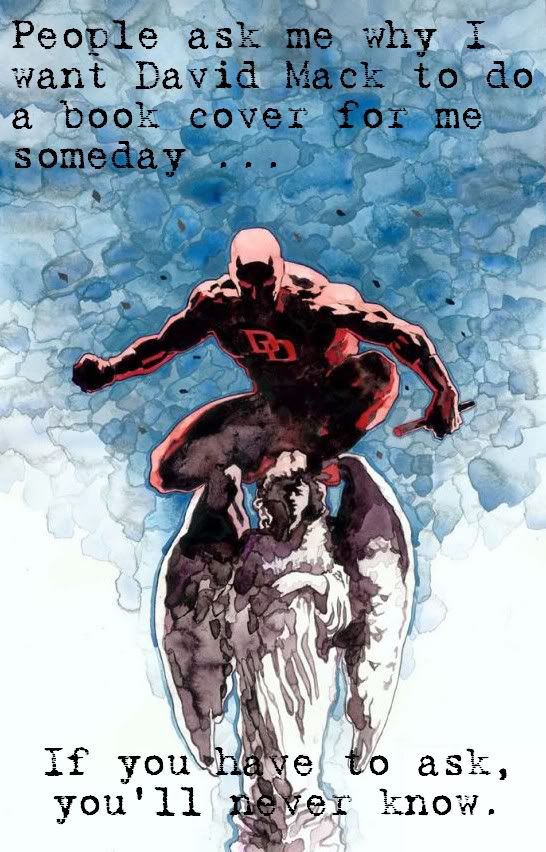
Later, when I found a few Daredevil issues with Gene Colan listed as their artist, I studied his work closely to see what the fuss was about. I noted the way his characters often seemed to emerge from deep pools of shadow. Darkness in Gene Colan’s art was an independent force, alive and vibrant. Where other artists used token shadows to give their pictures a touch of dimensionality, Colan built worlds with it, using shadows to create rich, complex settings and characters. His art looked like nothing else anyone was doing, before or since. A few years after he drew those iconic Daredevil adventures, someone coined a term for what Colan did—“painting with pencil.”

Colan started in comics in the 1940s and drew just about every hero of note at some point. He was best-known for his runs on Iron Man, Daredevil and Tomb of Dracula (and Howard the Duck—yes, you read that right, and the comics were good). He co-created Blade the Vampire Hunter—the guy Wesley Snipes played in the movies. He also co-created the Falcon, a longtime sidekick to Captain America who was the first African-American superhero in mainstream comics (the Black Panther came first, but he was African) and the first black superhero not to have the word “Black” in his name. It was Colan’s idea to make the Falcon black—not for political reasons, but because he enjoyed drawing African-American facial features and found them interesting and beautiful. That was the way he worked, when he was allowed—he drew the things he found interesting, and it made his stories richer.

I learned to draw—as much as I can draw—by copying Gene Colan. My pencils never ended up looking much like his, but I learned a lot about anatomy and a fair bit about the use of light and shadow. When I was stuck on a story, I would often pull out a sketchbook and try to work out a character’s face or costume, sketching my feelings about the story into the shadows in their hair or the cast of a mouth. Somewhere I think I still have one of the sheets where I carefully copied—never traced—every image of Daredevil from one of his comics. I wasn’t an artist, but it taught me to think.

To this day, when I plan scenes in my stories, I think about light and shadow and how it falls on and around my players. When a high-school drama teacher assigned me to block the balcony scene from Romeo and Juliet and keep the lovers apart without a balcony, I placed Juliet next to a candle and forced Romeo to stand outside the circle of its light lest he be discovered. The big fight scene in Masks is blocked heavily around light and darkness, when characters can be seen and when they must materialize out of solid black. In my head, they look like Gene Colan illustrations, emerging out of the shadows to do amazing things.

I met Gene Colan exactly once, at Comic-Con in 2009. I found out at the last minute that he would be attending, and was so flustered that I couldn’t even find any of my Daredevil comics for him to sign—and many of them were so old and fragile that I couldn’t bear to risk them on the train journey. Instead, I grabbed the most recent thing he’d drawn, a 2009 stand-alone issue of Captain America about the hero and his sidekick Bucky fighting vampires during World War II. (Characteristically, writer Ed Brubaker said the story came out of Colan telling him he wanted to draw “World War II, darkness, and rain.”) It was the issue for which he and Brubaker would later win an Eisner Award, comics’ equivalent of the Oscar, for Best Single Issue.

I was with a friend, and told her that we could do anything she liked, see anything that interested her, at the convention—as long as I got to meet Gene Colan. Shortly after lunch, I finally figured out where his table in the artists’ alley was, and approached it with trembling hands, trying not to bend or warp the comic lest I give the impression that I did not respect the gentleman’s work.

He wasn’t there.

A woman was—I believe it was his wife, Adrienne. I explained my situation and how much Gene Colan’s art meant to me, and she smiled politely and offered to sell me an original print that he’d signed earlier. It was a bit north of my budget, but I gladly bought it, well aware that many Golden and Silver Age artists use commissions and con sales to pay their bills because they retain few rights to their earlier work. As far as I was concerned, Colan had more than earned my money. I guess my earnestness showed, because Mrs. Colan suggested I come back at a certain time, when her husband would likely have returned. She said he’d be particularly happy to meet a young woman who appreciated his art—he had few female fans. I gladly agreed, wheedled my friend into letting me come back, and wandered off for a while to kill time.

When I did come back, he was waiting there at the table, a small, slightly hunched man with a white beard and a red baseball cap with the Daredevil insignia on it (which made me doubly happy, of course). He visibly brightened up when Mrs. Colan pointed me out as “the young lady I mentioned.” I gushed incoherently about learning to draw by copying his art, and for some reason made a big deal of never tracing it. He approved, smiled, and said encouraging things. He wore amazingly thick glasses and nearly touched his nose to the cover of my comic when he signed it; the artist who had taught me not to fear darkness was almost blind himself now. I didn’t have the heart to tell him I was really more of a writer than an artist, because I didn’t have a clear way to say what his art had meant to me as a writer. I got so nervous that I completely forgot to tell him I was wearing a T-shirt with my own drawing of Rae Masterson on it (although maybe that was for the best—it really wasn’t a very good drawing, and the colors on the T-shirt had printed strangely).

My friend suggested I take a picture with him, since I was so excited, and I loudly cursed the fact that I’d forgotten my camera at home. My friend gently pointed out that we both had camera phones. I turned bright pink. We hastily arranged a photograph, and Gentleman Gene gamely doffed his Daredevil cap and smiled in the direction of a device he almost certainly couldn’t see. We took the photo, and I thanked him profusely, not wanting to trespass on his time any more than I had to, and beat a hasty retreat. As we walked away, at about 3:00 in the afternoon on my one day at Comic-Con, I turned to my friend and said, “Okay, we can go home now. My day is complete.”


I’ve met movie stars. I’ve met congressmen. I’ve met a couple of my favorite authors, and hope to meet more. I never geeked out over any of them as much as I geeked out over meeting Gene Colan.

He deserved it.

Adrienne Colan died about a year ago. Gene Colan reportedly continued to work on commissions and other artwork up until about a month back. He is survived by his children and legions of fans.

His friend and biographer Clifford Meth, in accordance with Colan’s wishes, has set up the Gene Colan Scholarship at the Joe Kubert School. In lieu of flowers, Meth has requested donations to the scholarship fund, made out to “Joe Kubert School” and sent to:

Gene Colan Scholarship
c/o Clifford Meth
179-9 Rt. 46 West
Rockaway, NJ 07866

I’ll leave you guys with a note from Mr. Colan, supplied by Greg Hatcher via Clifford Meth:
 

Rest in peace, Gentleman Gene.

Monday, March 29, 2010

Everything I need to know I learned from Daredevil comics ...

I finally got to take a break this weekend after posting that plushie pattern, and I spent it on a comic book binge. I was running through my DVD collection while I stitched the Backpack Coyote together, and happened across my all-time favorite movie from when I was twelve. Laugh away—it was Trial of the Incredible Hulk, and at the time it was the only live-action movie about my very favorite superhero. If you ask me, it still is. The Ben Affleck travesty does not count.

I first got into Daredevil around the time I first got into comics. My very first comic books came from a dollar box at the back of a used bookshop (which, incidentally, is why Rae’s secret origin involves one). I would buy as many as I could afford and smuggle them home under my windbreaker so my mom wouldn’t know her honor-roll student had regressed to reading stuff with pictures. At first I bought mostly heroes I knew from cartoons—Spider-Man, the Fantastic Four, Batman, and the like. But Daredevil was the one that stuck.

I ignored the yellowed comics with the guy in the red devil suit until I saw an episode of the Fantastic Four cartoon where they lost their powers and, in some kind of weird lateral-thinking fit, decided that the best guy to help them was a blind lawyer named Matt Murdock. What was he going to do, sue Dr. Doom? Murdock, of course, turned out to be the superhero Daredevil, blinded in an accident but blessed with superhumanly acute senses. (The ninja skills he actually went out and earned.) Daredevil secretly infiltrated the Baxter Building after it was captured by Dr. Doom, and the FF eventually got their powers back thanks to his dogged efforts.

Two elements of that story struck chords in me. The first, and most obviously fascinating, was that Daredevil was blind … and I had a morbid terror of going blind myself. I was born with pretty bad eyesight, and it only got worse as I grew. Most children try to break or hide their first pair of eyeglasses, unwilling to deal with the discomfort and embarrassment; my mother tells me that at age four, I refused to take mine off—I just ran around staring at leaves on trees and birds in the sky for the first time in my life. My vision got worse year by year, requiring ever-stronger prescriptions, and right around the time I hit puberty the deterioration accelerated so fast that the eye doctor could no longer hide his dismay. I would not admit it to my parents, but by age twelve, I was secretly afraid that I would soon go blind. Imagine telling a twelve-year-old bibliophile that she would have to learn to read all over again. I tried to learn Braille, and failed miserably. I dreaded having to survive as a blind girl.

But when I bought a couple of Daredevil’s comics, I discovered that he didn’t just survive being blind. He thrived on it. His stories, I discovered, were a paradox—intensely visual tales about someone who could not perceive the bright colors and splashy compositions around him. Writers made up for that by filling dialogue and captions with references to sounds, smells, textures and tastes—details that were missing from most comic books, and that made Daredevil’s adventures all the richer as readers experienced his world as he did. And even though his hypersenses were at least as much a curse as a blessing (bad guys could effectively paralyze him with an air horn), he found ways to work with that, taking advantage of the secrets he overheard and the scents he could follow and finding workarounds for things like not being able to read computer screens or street signs (he can read print only if he touches it).

The other piece of the cartoon Daredevil that stuck with me was that he was completely outclassed by Dr. Doom. Sure enough, his adventures in the comics were usually street-level tales, pitting him against low-power bad guys and assorted crimelords. Yet he was willing to take on Dr. Doom, supervillain extraordinaire, and get beaten and electrocuted, all for the sake of four powers snobs who seemed to think he was pretty much a nutbar. He set his mind to something, and he worked at it until he succeeded, in spite or maybe because of the staggering odds against him. I could respect that.

So I devoured Daredevil’s adventures wherever I could find them. When the bookshop ran out of Daredevil comics, I used the yellow pages (remember those?) to find a local comic-book store and rode my bike for miles to feed my addiction. I read random back issues by Stan Lee, Gerry Conway, Frank Miller, and Ann Nocenti. I argued continuity with older geeks, most of whom were shocked to see a ponytailed sixth-grader lovingly tucking comics from the 25-cent bin into a cardboard box in her backpack. And as I read, I learned.

Daredevil could read normal print by feeling the raised surface of ink on paper with his hypersensitive fingertips. I tried a few experiments with Magic Marker, found that the idea worked in principle, and began stretching my other senses as far as they would go. I couldn’t hear heartbeats, but I learned to recognize people by their footfalls and the sound of their breathing. I couldn’t track people by scent, but I quickly learned to tell my classmates apart by the smells of their skin, their lunches, and their deodorants. I didn’t have Daredevil’s radar, but a few blindfold experiments taught me that air moved differently around objects than it did through open space, and at age 13 I startled a teacher by walking blindfolded through a jumble of desks and chairs without tripping once. (It really screwed up his object lesson.) I discovered I had an auditory memory—an unpredictable but startling ability to remember random sounds with near-perfect accuracy, which really came in handy when I accidentally memorized most of a history lecture and used the information to ace the test without studying. On a school camping trip, I found I moved faster along a dark trail when I turned off my flashlight, and could not only hear the class bully coming but bluff my way past him by pretending to have a weapon ready in the dark. I found that I could get by without using my eyes—and that there were distinct advantages to not having to depend on them.

And then there was that slogan. “Daredevil—The Man Without Fear!” He wasn’t totally fearless, of course, but seeing the embodiment of my phobia jumping off rooftops and hurling himself into battle with opponents far stronger and better-armed than he (including the Hulk!) did wonders for my own self-confidence. With Daredevil in my head, quietly analyzing or puckishly cracking wise, I could face down classroom bullies and menacing teachers and grouchy comic-book geeks and everyone who said I was good for nothing but doing their homework for them. It gave me ideas.

Six months after I discovered the character, I was writing my own stories about him. Eighteen months after that, I was creating my own fictional universe, so rich in sounds and tastes and textures and smells that my English teachers thought I was some kind of prodigy. My world was chock-full of heroes who were outmatched and outclassed, regularly beaten physically and spiritually but always able to pick themselves up and keep going, against all odds. Mere mortals surrounded by people with powers. Kids in a superhero culture run by adults. Losers and failures and has-beens and never-weres who nevertheless came through, by hook or by crook, to save the day.

When the series went online, I started getting fan letters. I was giving other kids ideas, too.

One of the first graphic novels I bought was Frank Miller’s Man Without Fear limited series, which retold Daredevil’s origin in vivid sensory detail and included Miller’s later contributions, like Matt’s ninja training and his affair with the assassin Elektra. And because I was the kind of kid who read everything (remember, any chance to read with my eyes could be my last), I read Miller’s introduction. While I actively dislike a lot of Miller’s pompous recent work, that intro stayed with me. Miller pointed out that Daredevil, on paper, should have been a bad guy. He was the product of a broken home, bullied and abused as a child, raised in poverty by a washed-up mob thug, and then blinded in a horrific accident. He was smart, a gifted fighter, and he had a nasty temper—someone you would expect to see turn bad, and someone you would dread fighting when he did.

“He’s got every excuse in the world,” Miller wrote. “And within him are the makings. But Matt Murdock is no villain, and no victim … He may never join the holy order his teacher hinted at. But he will do the best he can, this hero. He’ll fight the bullies till the day he dies.”

I loved that.

My vision has mostly stabilized now; I can see fairly well within a foot or so of my eyes, and with newer corrective lenses I can see better than most people with normal sight. I never did learn Braille, but I took up martial arts, where everyone has to come within arm’s or leg’s reach, and found I was good at it, especially when I had to counter my opponent without looking. Rae fights bullies, and stands up to people who can vaporize her, and speaks truth to power. Trevor goes into battle armed with his wits and a rock, and runs across rooftops by night. When I’m doing my job right, the world of Masks sings with the sweet stink of a horse’s breath, the scrape of asphalt against steel and skin, and the lonesome song of a coyote in the distant hills.

And almost every time I hand my manuscript to a new reader, the first few comments I get back include something to the effect of, “Wow, your writing is so visual--it’s like I can see everything that’s happening!”

I never tell them why that makes me smile.