Showing posts with label Joss Whedon. Show all posts

Wednesday, May 13, 2015

Age of Ultron is a B-plus, and here's why.

So I saw Avengers: Age of Ultron on Friday night and much as I liked most of it, and much as I thought I'd never need to say this—Joss Whedon, you need to move on.

I know, I know, Joss is moving on; this is his last contracted Marvel movie, and the Russo brothers (of Winter Soldier fame) will be taking over future installments in the Avengers franchise. But this isn't the sendoff I would have liked. I wanted to miss Joss when he was gone.

Okay. Time to put on my big-fangirl pants and deal. I had very high expectations for this movie and they weren't met, that's all. Most of my disappointment here is that I expected this movie to be as awesome as the first one and it was just kinda goodish. Goodish isn't so bad. It's only bad when you expected better.

For those who want the capsule description, Avengers: Age of Ultron mostly focuses on what happens when the ad hoc superteam of the first Avengers movie has to grow up and deal with the world in a systematic, adult way. Spoiler: it doesn't go well. When Tony Stark decides to use a little evil science to kickstart his world-defending AI system (because what could possibly go wrong with that?), the world pretty much goes to hell in a handbasket and the good guys spend two hours trying to fix it, with mixed results. I'm going to start with the good before I move on to the problematic.

Now, because this is me and I tend to dwell on the things that annoy me, I'll probably have more to say on the negative side of the balance sheet, so I want to establish right up front that as much as I dislike the problematic stuff, I consider AoU a pretty good movie overall. If the first Avengers was an A, this is a B-plus. It's good, okay? You'll have fun. It's just not without its problems, is all. And one or two (or three) of those problems are significant.

All right. Here we go. This is your last spoiler warning ...

The good:

1. This is a really darned good superhero movie. Seriously. Everything you look for in a tentpole popcorn flick is here. And it's all done really well. A lot of stuff blows up. There's a whirlwind tour of the endangered globe. There are moments of real excitement and humor. If there's a checklist for how to make a good superhero movie, this one checks nearly all the boxes. Anything involving the Vision, in particular, is damn near perfect (and gorgeous to boot). It's just a well-made superhero movie by the standards of what makes a good 'un.

2. Nice action sequences. That's an understatement. This movie doesn't just go for spectacle—it pays real attention to how the Avengers would function in combat after some practice together. They use their strengths and compensate for one another's weaknesses. Whether it's Captain America using a motorcycle as both personal transportation and blunt instrument, or Iron Man having a contingency plan for the Hulk losing his few remaining marbles, or Hawkeye doing his mere-mortal schtick in places where the superpowered gods can't go, this movie has everything you want to see in the way of the Avengers in action.

Early on, a bad guy asks his henchman why their defenses are failing, and his baffled henchman replies, "They're the Avengers, sir." And that pretty much sums it up.

3. Hello to the funny. It's a Joss Whedon movie, so this shouldn't be a surprise, but there are more than enough jokes. I'd guess I had to lip-read maybe fifteen to twenty percent of the dialogue because the people around me were laughing so loudly at what had just been said. It's funny, okay? There's plenty of funny.

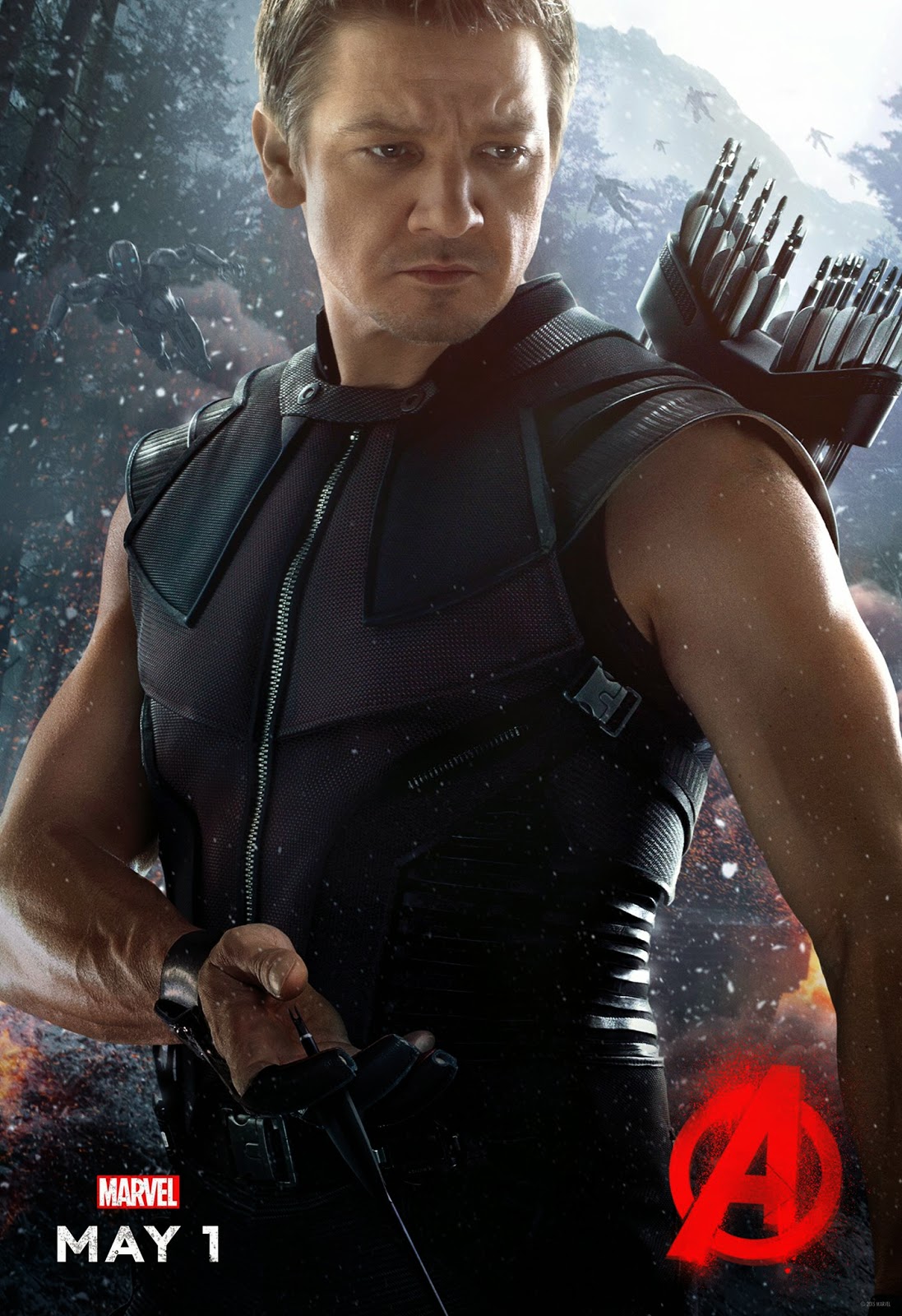
4. Hawkeye! If you felt there wasn't enough Hawkeye in earlier Marvel movies, this movie will be your jam because he's everywhere. He gets a lot of the best action and the best snark. And as the movie delves into his personal life, including glimpses of his home (yes, he has one), he carries a lot of the film's emotional weight, too. And he does it well. Jeremy Renner, I would start a petition to give you your own solo film except that this movie kind of was that film.

5. Ultron is a hoot. James Spader is hilarious. If you've ever snorted a drink out your nose at something he said or did in The Blacklist, you'll be happy here. There's nothing quite like hearing him say, "Stop it!" like the annoyed parent of a toddler after Captain America tries to kick him in the face for the fourth or fifth time. Spader does for Ultron what Tom Hiddleston did for Loki—take a two-dimensional megalomaniac and turn him into something complex, sympathetic, and charming. I don't think Ultron will be getting a fangirl army any time soon, but it's not for lack of effort on Spader's part.

6. Sam Wilson is an Avenger. I repeat, SAM WILSON IS AN AVENGER. Yes. He makes it. Anybody who's been rooting for the Falcon to make it to the big show, you will be pleased. He's in the final roll call, with a new set of wings.

6. NEBBISH! This is a personal thing, but I was delighted (and actually screamed in the theater) to see the return of one of my favorite minor MCU characters. Remember the SHIELD technician who refused to launch the helicarriers? The guy who started the "captain's orders" meme? He doesn't have a name in the canon, but after I saw him in Winter Soldier he quickly became my personal Figwit. I loved the fact that he was obviously scared out of his mind, the last person who should be fighting somebody like Rumlow, and yet he was the first speaking SHIELD agent we saw resisting Hydra's takeover. While everyone else was looking at each other and wondering what to do, this little nebbishy guy proved himself more heroic than Captain America (and nearly got his brains blown out for it, in a nice touch of realism). It was established that a lot of SHIELD agents died when the Triskelion fell, and unlike named characters like Agent 13 and Maria Hill, Nebbish didn't get an epilogue in Winter Soldier. He wasn't important enough to be shown, alive or dead, at the end.

Well, it looks like Nebbish made it out okay, because he's shown (briefly) working for Nick Fury in the climax of the film. And that was probably my favorite part.

Yeah, Nebbish was the best. Because a lot of the other good in this movie was soured by ...

The bad:

1. It's too many movies in one movie. Maybe there's a way to do Ultron and the birth of the Vision and the introduction of Quicksilver and the Scarlet Witch and the foundations of Civil War and build Hawkeye into a fully developed character—but this wasn't it. There was just too much going on—so much that it was hard to care about any one plot thread when the next action scene (however excellent) was barreling at you before you could process. This was about a movie and a half packed into only one flick, and not in the good way.

2. Wait, are there three SHIELDs now? And other plot holes. Let's just say there was insufficient attention to detail, which is a lousy thing to say about a Joss Whedon production. But there are plot holes you could drive a truck through. Like the part where Bruce finds Natasha in the oh-so-secret dungeon in the middle of Ultron's base. How? She was unconscious when she was brought there, so she couldn't have correctly described her location to Clint. How did Bruce find the place? How did he get in there? How did he find her inside a sprawling building? Honestly, would one shot of Bruce creeping down a hallway have been too much?

Similarly, when Nick Fury randomly shows up out of nowhere with a helicarrier, it's a little weird. Seriously, dude, where were you an hour ago? And does this mean that you have your own SHIELD faction now, to replace the two that have been squabbling all season on Agents of SHIELD? How did you suddenly become a slick and well-funded operation again at the end?

And perhaps most importantly, why does nobody notice that smashing robot bodies does absolutely no good in the age of cloud computing? There's nothing to suggest Ultron hasn't backed himself up somewhere online. Breaking the hardware shouldn't do anything of substance. So the movie ends with only token evidence that the bad guy has even been defeated, yet everyone relaxes like they won.

I could go on, but ... seriously, there's just a lot of plot holes. Enough to be distracting.

3. Why is there a romance in this movie? And why is it this romance? One of the things I liked best in the first Avengers movie is that there wasn't much in the way of romance. The whole thing happened over, like, two days, and there was just no time for it. I liked that a lot better than a typical action movie where the love story feels shoehorned in.

Well ...

The big romance in this movie is between Natasha and Bruce. And I don't care whether you ship that or not, but I have two problems with it strictly from a filmmaking perspective. First, Scarlett Johansson and Mark Ruffalo don't have that much chemistry together. Their scenes feel dull and forced. So you're adding a romance that doesn't work, from a strict filmmaking standpoint.

Second, the romance is pretty much all Natasha does in this movie. Seriously, even Bruce gets to weigh in on the creation of Ultron and how to defeat him. Natasha just gets kidnapped and turned into Bruce's damsel in distress. I don't care what your view of Joss Whedon's self-described feminism is—that is a waste of a good character. Why is Natasha even here if this is all she does? You could have swapped her for Betty Ross and gotten the same results.

4. Tony Stark is an idiot. This is the first of many signs that Joss Whedon hates his job. Tony was the darling of the first Avengers movie, the wisecracking scene-stealer who got all the best snark. That is a sign that Joss loves you right there. And he got to make the big dramatic sacrifice to save the world.

This time? Tony is still snarky, but it's pointlessly mean snark—lines like a joke about reinstating prima nocta when he rules Asgard. There were a million jokes Tony could have made while trying to lift the hammer, but somehow we ended up with a rape joke. And yeah, Tony then turns out to be unworthy, which has led a lot of online pundits to suggest that this was Joss trying to undermine Tony's jerkishness, but that's not what bothers me. What bothers me is that Age of Ultron makes Tony out to be the kind of jerk who would make a joke like that. Never mind his development over four previous movies—none of that counts now, because Joss Whedon needs a straw man to tear down.

And then there's the stupidity! In Age of Ultron we get a Tony Stark who is literally unable to learn from his mistakes, even in engineering, which is supposed to be his primary area of genius. Bruce even calls him on it, saying he's "stuck in a time loop" when Tony suggests countering an out-of-control AI with another out-of-control AI, effectively repeating an action and expecting different results. And yeah, it turns out okay this time—but not because of anything Tony did.

Apparently, this movie just couldn't get along without a version of Tony Stark who was so obviously wrong about everything that no rational person could agree with him on anything. That's a terrible way to set up an antagonist for the upcoming Civil War movie. What's the matter, Joss? Couldn't be bothered to write a little complexity and nuance into someone who had to be on the wrong side of the argument?

5. Steve Rogers is unrecognizable. I guess not, because Steve got an even rawer deal than Tony. I noted in my review of the first Avengers that my one major issue was that every one of the Big Six got a serious character arc except Cap, who just kind of piddled around until it was time to punch aliens. When the Avengers Blu-ray came out with a bunch of deleted scenes that appeared to show Cap's arc, all was seemingly forgiven. It was cut for time. Understandable.

I'm not so understanding now.

The Captain America we get in Age of Ultron is nothing like the one we see in the other MCU movies. He's the most hidebound member of the team, primly correcting Tony's casual profanity (and reacting with very little grace when ribbed about it later). This is just dumb. The guy fought through World War II (in the American infantry!) and casually says things like "light the bastards up", but he has a problem with Tony saying "shit"? That's so far out of character that it's a non sequitur.

In fact, there's very little of the Steve Rogers we've come to like in other movies. The guy who tried to drink an entire pub and cried himself hoarse when Bucky died in The First Avenger is now saying things like, "If you get killed, walk it off." The guy who dismantled an Orwellian intelligence organization in Winter Soldier ends up apparently running one. And even when Sam Wilson says he's happier not being an Avenger, Steve goes and makes him one (presumably because he knows Sam can't tell him no). There's no indication that he's still actively trying to find the person he nearly killed himself saving in his last movie; Bucky's not so much as mentioned by name. Even during the downtime on Clint's farm, Steve never seems to pause and reflect on his gaping emotional wounds. He's the Tin Woodsman to Tony Stark's scarecrow—no heart, no brain.

This isn't The Wizard of Oz, Joss. Heartless Steve Rogers is not what I bought a ticket for.

6. Natasha Romanoff is ... I don't even know what. All right, before the whining starts, I am going to be absolutely clear about what bothers me about Nat's role in this film. It's not what happens. It's that this is not Natasha Romanoff.

Let's discuss the elephant in the room—the "monster" line.

At one point, Bruce tells Nat they can't be a couple because he can't have children. Nat replies that she can't either—the "graduation ceremony" in the Red Room was a mandatory surgical sterilization. Okay, fine, bad people do bad things. But Nat then goes on specifically to say that the sterilization was done so she would be a better assassin (because having a hysterectomy makes you a better murderer?) and tells Bruce that he's not the only monster on the team.

And that is where I put down my popcorn.

I'm sorry, but "monster"? Let's be charitably dense and say this isn't what it looks like—this movie saying an infertile woman is a monster because she's infertile. Let's say Nat thinks she's a monster strictly because she's killed a bunch of people. Let's ignore the fact that she was discussing her infertility right before she switched to the topic of monsters, and that she explicitly said she was rendered infertile so she'd be better at doing monster stuff. Let's assume that Joss in no way meant to imply that non-motherhood equals monsterdom, that he never meant to say that a woman who can't have children should consider herself no longer human. Let's even assume that this is not a reflection of the movie's view, just a moment of character for Nat—that she holds this idea, true or not, because that's just how she feels and feelings don't have to be logical or popular with the audience if they work as part of a character's overall arc.

That still leaves the fact that Nat calls herself a monster, on a par with the giant green rage machine that just destroyed a city, and nothing and no one in the rest of the movie contradicts that point of view. Bruce never says, "I don't think you're a monster" (even though the Hulk is shown in a middling positive light in other scenes). No one is shown treating Nat like a hero, unless you count Clint naming his next kid after her (sort of), which was apparently the plan even before the M-word entered the conversation. Steve makes her his second-in-command, but since this is the Steve Rogers who tells hypothetical dead people to walk it off, he might as well be amending "monster" to "useful monster". Of the two people in the movie who appear to care about Nat, in the end, one leaves her and the other is understandably distracted by all the kids he's got.

This is a movie that pretty much lets Nat call herself a monster, entirely or in part because she can't have babies, and replies, "Yup, you are."

And that's about 50% of Nat's role in this film (the other 50% being her damsel-in-distress routine).

Sorry, but that's not the Natasha Romanoff I bought a ticket for. I want to see the version that's slowly discovering she isn't a monster—the consummate spy of Iron Man 2 who became a steadfast best friend in The Avengers and whom Steve Rogers explicitly trusted to save his life in Winter Soldier. I want to see the Natasha Romanoff who's never perfect, but who keeps growing. Who doesn't accept the "monster" label. Who takes her vicious, sexist codename (Black Widow, poisonous man-eater) and shoves it down the throats of everyone who dismisses or underestimates her.

Natasha Romanoff is not resigned to being a monster. And damn you, Joss Whedon, for implying that she is, or should be.

7. I just don't care. Maybe it's the movie overload, maybe it's the fact that several characters went off the rails, but I just wasn't emotionally invested in this movie by the end. I wanted to be. I was sitting in that theater in a superhero hoodie, holding a teddy bear dressed up as my favorite Marvel character, in a row full of friends who were doing the same thing. I wanted to like this movie. I expected to like this movie.

And it had its moments. The Vision was gorgeous and very well done. There were moments of joy and wonder and fear. But when it comes right down to it, a group of characters I loved—had come to consider my friends, in the way really good fictional characters become your imaginary companions—either didn't show up or were treated so poorly that they'd have been better off staying home.

It's a pretty goodish movie. If it were anything other than an Avengers movie made by Joss Whedon with the Avengers in it, it would be an excellent movie. But it's not.

So I give it a B-plus. And after I saw it, I went home and Googled Chris Evans' tweets about filming the next Captain America flick.

Maybe my imaginary friends will show up for that one.

Tuesday, October 23, 2012

A superhero primer (without Watchmen)


Recently, a friend of mine decided that she wanted, at long last, to get into superhero comics. Just because she hadn’t grown up with them, she told me, was no reason to discard an entire genre. Where would I suggest that she start?

About five minutes later, when I came around from my faint …

Where should she start? Where should she start? The first thing to pop into my head was, “Oh, God, don’t let anyone say Watchmen.” I’ve heard way too many comic fans sing the praises of Alan Moore’s admittedly seminal graphic novel, and seen way too many copies thrust into the hands of unsuspecting neophytes. Those are the neophytes who don’t come back. No matter how many bestseller lists Watchmen makes, no matter how many awards it wins, Watchmen is a terrible place to start reading superhero comics. Watchmen is about taking all the tropes and devices of superhero comics and turning them upside down and inside out. It is, in a very real way, the destruction of superhero comics. I’ve long believed that Alan Moore actually hates his own genre, and that Watchmen is a major proof of this.

So after some thought, I decided to write this blog entry—for her, and for anyone else who eventually decides they need a starting point that isn’t Watchmen.

There are, as I see it, three major approaches. You can begin with the basics of the genre—something that will teach you the rules of the game and why the fans love it. Or you can pick a character you already like, or think you might like, and use that character as a guide to comicdom. Or you can just jump into any story that strikes your fancy. Any of these approaches will do. For the record, I entered comics by method two—I saw Daredevil on the Fantastic Four cartoon, liked him, found some of his old comics in a box in the back of a used bookstore, and never looked back. I got deeper into comics by using method three on my local library’s collection of graphic novels. But your results may vary, so do as you please. What follows is a list of likely titles for anyone wanting to use one of those three methods.

Method One: Begin with the basics. For this approach, you want a story that will give you a strong sense of how superhero stories work—what you can expect of heroes and villains and everything else. To my mind, there’s no better primer for this method than Astro City. Kurt Busiek’s multi-award-winning series, published most regularly in the 1990s but still coming out now from time to time, is a love letter to superhero comics and everything we love about them. Using a cast of strange yet familiar heroes—the Superman-like Samaritan, the Batmanesque Confessor, even the Spider-Man-like Crackerjack and Jack-in-the-Box—the series explores “what else happens” while those familiar adventures are going on.

In the very first story, “In Dreams,” Samaritan goes about his usual day, switching between his secret and superheroic identities, fighting bad guys, accepting awards from a grateful citizenry … all while harboring a secret. You don’t find out until the end of the story what that secret is, and how it informs his life as a superpowered crimefighter, but I dare you to read the ending without a smile. The story covers every major superhero trope while remaining surprisingly original.

Similarly, the second volume in the series, Confession (one of my favorite graphic novels of all time and a major influence on Masks), follows a boy who comes to the big city to become a hero and gets more than he bargains for. This book does a great job of subtly teaching the lessons of the superhero genre, this time from a sidekick’s point of view (the boy learns things like how street-level heroes actually investigate crimes, what sidekicks really do, and what motivates the typical supervillain) while keeping its focus on the relationship between the boy and his mentor. I dare you to read this story without crying. That’s how Astro City works—it relies on your knowledge of superhero tropes, and reminds you how they work as it goes along, so that it can tell real, moving, human stories. Superhero comics at their finest.

Method two: Follow a character. The trick here is to find a good story featuring a character you like. Sometimes you can luck out by walking into a comic-book store and asking a friendly employee, “Can you point me to a good beginner story about ____?” But if you haven’t got a comic-book store, or the employees aren’t friendly, here are some starting points.

DC Comics does a pretty good job with its origin stories, and that’s always a good place to jump on with a beloved character. The recent Superman: Earth One by J. Michael Straczynski, which portrays a young Clark Kent arriving in Metropolis and trying to figure out what he’s going to do with his life (luckily an alien invasion comes along to help him with that), is a terrific jumping-on point for readers who want a 21st-century approach to that hero. It introduces the central characters (Clark, Lois, Perry, Jimmy, Ma and Pa, etc.) and the fundamentals of their relationships, and still leaves time for smashing alien death machines. (I also recommend Mark Waid’s Superman: Birthright, for similar reasons.) 

If you’re looking for Batman, I’m afraid he hasn’t fared as well in recent years, but Jeph Loeb and Tim Sale’s Batman: The Long Halloween and Batman: Dark Victory do a good job of picking up just after Batman’s origin and setting up his relationships with most of his supporting cast. They’re also part of the source material for Christopher Nolan’s Batman trilogy, so if you enjoyed those movies, you could do a lot worse.

Marvel Comics isn’t as origin-focused, but you can still find good entry-level stuff for most of their popular characters. If you enjoyed Thor, I recommend Langridge and Samnee’s Thor: The Mighty Avenger. It’s a terrific collection of lighthearted adventures set during Thor’s early days on earth, and has a great balance of humor, domestic drama, and smashing frost giants in the face. Likewise, Brian Michael Bendis’ Ultimate Spider-Man does a great job of retelling a lot of classic Spidey tales with a modern sensibility, and it heavily informed the Sam Raimi movies (including the early ones that sucked less).

Going back to the Avengers, if you enjoyed the Black Widow in The Avengers, you could do worse than pick up Paul Cornell’s Black Widow: Deadly Origin, which handily covers the character’s complicated history (both as a hero/villain and in a series of romances with other heroes). The best Hawkeye stories, by far, are those currently coming out of Matt Fraction and David Aja in their Hawkeye monthly series. Alas, I don’t have a lot to recommend on the Hulk and Iron Man fronts—not because there aren’t any good stories out there but because I don’t follow those characters closely and therefore don’t have any good recommendations. 

There’s a lot of good stuff on Captain America, of course, but the best of it will show up in the next section. For now, I recommend Captain America: Red White and Blue, a collection of short comic stories by various artists. You should find something in there to suit almost any taste. And if you’re a fan of the X-Men movies, try the various X-Men: First Class titles, including Wolverine: First Class, which has nothing to do with the recent stupid film. (It’s actually a hilarious buddy comedy featuring Wolverine and his sidekick—a 13-year-old mutant girl named Shadowcat. Weirdly, it’s still a great jumping-on point.)

I’d also be remiss if I didn’t mention Jeph Loeb and Tim Sale’s Daredevil: Yellow, about the first year of that character’s career (during which he wore a yellow costume, hence the title). It’s the most lighthearted and touching treatment of Daredevil’s origins I’ve ever read, not least because it’s written as a love letter to the hero’s first love interest, now dead at the hands of a supervillain. There’s a sweetness and an innocence to Yellow that makes it a perennial favorite of Daredevil fans, and popular with anyone who enjoys a good romantic comedy with superhero trappings.

Method three: Jump into a story. If you’re not too worried about getting all the previous continuity straight, you might try just jumping into any story that looks good. Superhero comics actually cover a lot of ground, genre-wise—you can easily find good mystery, fantasy, science-fiction and romance stories, to say nothing of the occasional Western and lots of thrillers. A useful guide here is either that friendly comic-shop employee or, sometimes, a list of awards. Usually each year’s Eisner Awards (comicdom’s equivalent of the Oscars) include at least one story worth reading. Check out the awards for best limited or continuing series, best writer, and so on for your best candidates. Then hit up Amazon and read a few descriptions until you find something intriguing. Or just see the list below.

If mystery’s your thing, you might try Peter David’s excellent X-Factor series, about a detective agency staffed by mutants, including former X-Men. Its narrator, a mutant with the ability to create duplicates of himself (and therefore a man with a chronic identity crisis), has a serious case of Raymond Chandler envy, and the results are well worth it as the series covers everything from alternate universes to Norse gods to the question of which duplicate fathered a certain female cast member’s baby. With wacky volume titles like The Invisible Woman Has Vanished, you know you’re in for something strange and wonderful. Start with the first volume, The Longest Night, and watch for Layla Miller, a troubled 13-year-old girl whose mutant power appears to be that she “knows stuff” … which sounds stupid until you find out why she unscrewed the taps from the upstairs bathroom and ordered from three pizzerias at once.

For a good espionage thriller, you’re best off starting with Ed Brubaker’s run on Captain America, which heavily informed the recent movies. (I didn’t list it in the previous method because it’s just a bit too complicated at the beginning to make a real primer.) The story centers on Cap’s work with Nick Fury and S.H.I.E.L.D., but it quickly goes zigzagging off through his World War II adventures and some very modern arcs involving espionage and international terrorism. Begin with the first story arc, The Winter Soldier, and see if you’re hooked by the time it wraps up.

Then there are stories and runs of issues that just stand alone really well, even if they’re not designed as jumping-on points. There’s J. Michael Straczynski’s Amazing Spider-Man, which manages to balance some of the most human Spidey drama ever (including the issue where Aunt May finally finds out how Peter spends his nights) and some fairly cosmic bad guys who will completely rearrange what you think you know about Spider-Man’s origins. The run has some of the best Spidey humor I’ve ever read, too, including a delightful rant about why Spider-Man doesn’t have pockets in his costume. To this day, I can’t hear someone pulling Velcro apart without wanting to giggle.

Brian K. Vaughan’s Runaways is about a group of teenagers who run away from home after they discover their parents are all supervillains. Think The Outsiders crossed with The X-Files and a heaping dose of Buffy the Vampire Slayer. Start with the first volume, Pride and Joy, and feel free to steal lines like, “We’re like one of those multiethnic gangs that only robs people in bad movies!”

Going back to Straczynski—if you liked the movie Thor, you’ll probably love his run on the character. Start with Volume 1 (search Amazon for “Thor volume 1, Straczynski”, and you’ll find it), which picks up after Thor has been killed during the events of Ragnarok. See if it doesn’t blow you away. The run gets weaker as it goes on—Volume 2 is excellent, but wobbles toward the end—but it’s all pretty good stuff.

Likewise, Mark Waid’s current run on Daredevil is justly featured among the Comic Books You Should Be Reading. Taking a normally dark character into what seems like a sunny, happy-go-lucky storyline in which Matt Murdock tries to take himself less seriously, Waid actually manages to build a subtle and ultimately disturbing portrait of a hero who might be losing his mind. And the jokes are first-rate.

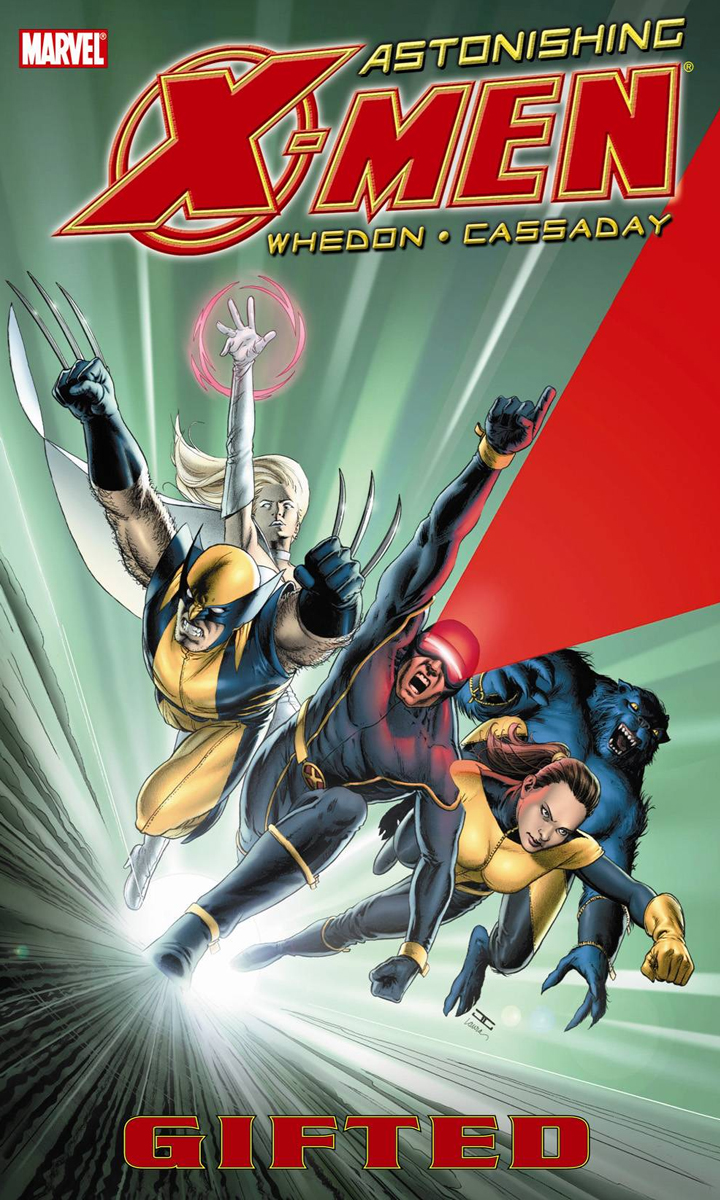
Speaking of jokes, this blog entry wouldn’t be complete without a reference to Joss Whedon’s terrific run on Astonishing X-Men. Start with the first volume, Gifted, or just get one of the omnibus editions. Astonishing follows the premier mutant superteam after the death of founding member Jean Grey, and largely eschews the notoriously complicated X-Men continuity for solid characterization and snarky humor. (My personal favorite moment is when a psychic villain “devolves” several of the X-Men, turning Beast into a growling animal and making Wolverine revert to his childhood self … which seems to be a hilariously naïve and racist Little Lord Fauntleroy. Can a character be hilariously racist? It turns out that Wolverine can … just look for the line, “AND, I met an Oriental!”)

You might notice that DC Comics is conspicuous by its absence from this third method. That’s not intentional, but it is a bit sad. DC has been a lot better than Marvel in recent years at tying absolutely everything going on in its fictional universe to whatever mega-crossover event is being pushed at the moment. There are major ramifications to this. First, almost any good DC storyline requires you to read three or four bad ones just to understand what’s going on. And second, because there’s one of these events every year, the universe changes dramatically all the time … which means a lot of the really good stories don’t have a lot of staying power. Good as they are, there’s no way to explain them to someone who hasn’t been reading DC Comics for years. The few DC stories I considered for this part of the list—mostly James Robinson’s Starman and Mark Waid and Alex Ross’s Kingdom Come—are at least 15 years old, and I felt I’d already filled that slot with Astro City. They’re still good stories, though, and I encourage you to seek them out.

What about you, comic-book readers out there? What books do you recommend to friends who want to read superhero comics for the first time?

And if you say Watchmen, I will do my best to punch you through the internet …

Monday, October 8, 2012

The dust is your life going on.


Sorry, guys.

Life has been … complicated of late. Lots of personal stuff going on, the biggest part of which is my wonderful mom finally retiring from a job where they did not treat her nearly as kindly as she deserves. That’s a bit of a first domino, leading to lots of changes in her life and, consequently, a few changes in mine … which have conspired to put me behind on Masks.

How does that work, you ask?

Well, I don’t handle change all that well. More precisely, I don’t handle slow change all that well. When there’s a loud bang and a scream and the tinkle of broken glass, and somebody has to stop the bleeding right-the-hell-now, I am there, baby. I am very good at rising to the occasion. You’ve got a crisis? I’ve got a utility knife and duct tape. I actually carry a duffel bag in the trunk of my car with food, water, a complete change of clothes, a first-aid kit, a sleeping bag, a camping lantern, some basic tools, and a spare paperback copy of one of my favorite novels. And I think I’ve used every part of that kit at one point or another. I am all about the disaster preparedness.

But slow change? Things that creep up on me and then bite me somewhere sensitive? That I’m not so good at. For some reason, I can manage almost anything on an adrenaline high—but if you give me time to plan for a big event, I will be an absolute wreck. I’ll still plan and probably pull it off, but I will be a frantic, hyperventilating mess anytime I have to sit still and wait for something to happen. The same worst-case-scenario brain that leads me to keep an entire campsite in the trunk of my car makes me very ill-suited to sit and wait for anything important. The longer I have to wait, the more I think things will go wrong. It’s why I can improvise a fake diamond engagement ring out of a paper clip and scotch tape in under ten minutes (long story—we eventually found the real one) but I can’t choose a dress for a party. I once found myself onstage during a production of Our Town, having to improvise an entire monologue because a one of my fellow actors hadn’t bothered to come onstage for his scene. If I’d had a week to prepare, I would probably have started crying backstage before the curtain rose. And my mom’s retirement is a slow-building change … that has just arrived, at last … and is now creating more slow-moving changes. Cue the freakouts.

Freaking out is not so good for writing a story about characters I love and have lived with for half my life. They tend to come out a little flat, at which point I freak out more because I think I’m losing my touch, even though I know it’s just stress …

And so I clean.

When I have to wait, and I don’t know exactly how things are going to shake out, I clean. I reorganize, I vacuum, I dust. This is counterintuitive, as I’m pretty messy by nature and I like it that way, but something about an orderly room sometimes helps me break through writer’s block. (Plus it helps me avoid triggering Mom’s stress-induced asthma.) That bookcase at the top of this blog entry? It hadn’t been properly dusted in a couple of years. And I seriously considered alphabetizing the DVDs on the bottom shelf after I was done chasing dust bunnies.

It’s a funny thing about dust. I’ve been told that most house dust is, in fact, made of people—it’s the skin cells we’re constantly shedding. So as I’m vacuuming and scrubbing and wiping everything down with Pledge, I am, in a very real way, wiping up and throwing out older pieces of myself. And much as I feel better for doing it, I can’t—shouldn’t—erase myself completely. There will always be dust. I am dust. I am coming to terms with this.

I’m working on it, guys. I hope to have something for you very, very soon—both new chapters and good news on the personal-stability front. I have not forgotten, and this transition period won’t last forever. Bear with me, be the friends you’ve always been, and I will soon be back to sharing my joy with you.

I’m trying to remember that great Joss Whedon line:

“Everything is so fragile. There's so much conflict, so much pain... You keep waiting for the dust to settle and then you realize this is it: the dust is your life going on. If happy comes along, that weird, unbearable delight that's actual happy—I think you have to grab it while you can. You take what you can get. ’Cause it's here, and then... gone.”

The dust is my life. I’m grabbing for the happy.

I’ll try to keep you posted, and to avoid spraying myself in the eyes with Pledge.