Showing posts with label Iron Man. Show all posts

Wednesday, May 13, 2015

Age of Ultron is a B-plus, and here's why.

So I saw Avengers: Age of Ultron on Friday night and much as I liked most of it, and much as I thought I'd never need to say this—Joss Whedon, you need to move on.

I know, I know, Joss is moving on; this is his last contracted Marvel movie, and the Russo brothers (of Winter Soldier fame) will be taking over future installments in the Avengers franchise. But this isn't the sendoff I would have liked. I wanted to miss Joss when he was gone.

Okay. Time to put on my big-fangirl pants and deal. I had very high expectations for this movie and they weren't met, that's all. Most of my disappointment here is that I expected this movie to be as awesome as the first one and it was just kinda goodish. Goodish isn't so bad. It's only bad when you expected better.

For those who want the capsule description, Avengers: Age of Ultron mostly focuses on what happens when the ad hoc superteam of the first Avengers movie has to grow up and deal with the world in a systematic, adult way. Spoiler: it doesn't go well. When Tony Stark decides to use a little evil science to kickstart his world-defending AI system (because what could possibly go wrong with that?), the world pretty much goes to hell in a handbasket and the good guys spend two hours trying to fix it, with mixed results. I'm going to start with the good before I move on to the problematic.

Now, because this is me and I tend to dwell on the things that annoy me, I'll probably have more to say on the negative side of the balance sheet, so I want to establish right up front that as much as I dislike the problematic stuff, I consider AoU a pretty good movie overall. If the first Avengers was an A, this is a B-plus. It's good, okay? You'll have fun. It's just not without its problems, is all. And one or two (or three) of those problems are significant.

All right. Here we go. This is your last spoiler warning ...

The good:

1. This is a really darned good superhero movie. Seriously. Everything you look for in a tentpole popcorn flick is here. And it's all done really well. A lot of stuff blows up. There's a whirlwind tour of the endangered globe. There are moments of real excitement and humor. If there's a checklist for how to make a good superhero movie, this one checks nearly all the boxes. Anything involving the Vision, in particular, is damn near perfect (and gorgeous to boot). It's just a well-made superhero movie by the standards of what makes a good 'un.

2. Nice action sequences. That's an understatement. This movie doesn't just go for spectacle—it pays real attention to how the Avengers would function in combat after some practice together. They use their strengths and compensate for one another's weaknesses. Whether it's Captain America using a motorcycle as both personal transportation and blunt instrument, or Iron Man having a contingency plan for the Hulk losing his few remaining marbles, or Hawkeye doing his mere-mortal schtick in places where the superpowered gods can't go, this movie has everything you want to see in the way of the Avengers in action.

Early on, a bad guy asks his henchman why their defenses are failing, and his baffled henchman replies, "They're the Avengers, sir." And that pretty much sums it up.

3. Hello to the funny. It's a Joss Whedon movie, so this shouldn't be a surprise, but there are more than enough jokes. I'd guess I had to lip-read maybe fifteen to twenty percent of the dialogue because the people around me were laughing so loudly at what had just been said. It's funny, okay? There's plenty of funny.

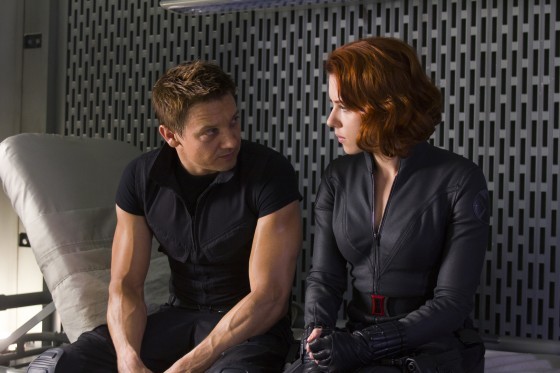
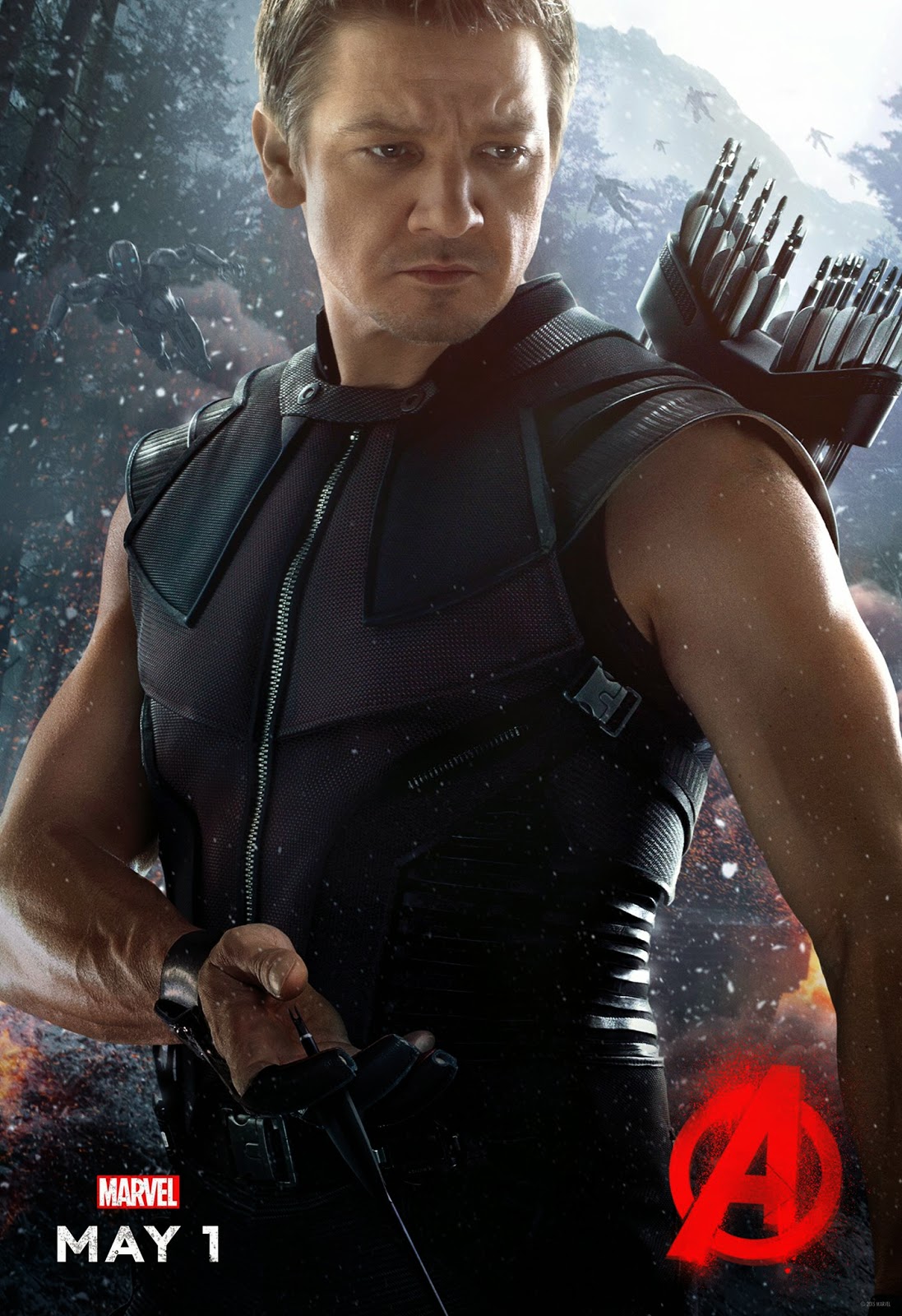
4. Hawkeye! If you felt there wasn't enough Hawkeye in earlier Marvel movies, this movie will be your jam because he's everywhere. He gets a lot of the best action and the best snark. And as the movie delves into his personal life, including glimpses of his home (yes, he has one), he carries a lot of the film's emotional weight, too. And he does it well. Jeremy Renner, I would start a petition to give you your own solo film except that this movie kind of was that film.

5. Ultron is a hoot. James Spader is hilarious. If you've ever snorted a drink out your nose at something he said or did in The Blacklist, you'll be happy here. There's nothing quite like hearing him say, "Stop it!" like the annoyed parent of a toddler after Captain America tries to kick him in the face for the fourth or fifth time. Spader does for Ultron what Tom Hiddleston did for Loki—take a two-dimensional megalomaniac and turn him into something complex, sympathetic, and charming. I don't think Ultron will be getting a fangirl army any time soon, but it's not for lack of effort on Spader's part.

6. Sam Wilson is an Avenger. I repeat, SAM WILSON IS AN AVENGER. Yes. He makes it. Anybody who's been rooting for the Falcon to make it to the big show, you will be pleased. He's in the final roll call, with a new set of wings.

6. NEBBISH! This is a personal thing, but I was delighted (and actually screamed in the theater) to see the return of one of my favorite minor MCU characters. Remember the SHIELD technician who refused to launch the helicarriers? The guy who started the "captain's orders" meme? He doesn't have a name in the canon, but after I saw him in Winter Soldier he quickly became my personal Figwit. I loved the fact that he was obviously scared out of his mind, the last person who should be fighting somebody like Rumlow, and yet he was the first speaking SHIELD agent we saw resisting Hydra's takeover. While everyone else was looking at each other and wondering what to do, this little nebbishy guy proved himself more heroic than Captain America (and nearly got his brains blown out for it, in a nice touch of realism). It was established that a lot of SHIELD agents died when the Triskelion fell, and unlike named characters like Agent 13 and Maria Hill, Nebbish didn't get an epilogue in Winter Soldier. He wasn't important enough to be shown, alive or dead, at the end.

Well, it looks like Nebbish made it out okay, because he's shown (briefly) working for Nick Fury in the climax of the film. And that was probably my favorite part.

Yeah, Nebbish was the best. Because a lot of the other good in this movie was soured by ...

The bad:

1. It's too many movies in one movie. Maybe there's a way to do Ultron and the birth of the Vision and the introduction of Quicksilver and the Scarlet Witch and the foundations of Civil War and build Hawkeye into a fully developed character—but this wasn't it. There was just too much going on—so much that it was hard to care about any one plot thread when the next action scene (however excellent) was barreling at you before you could process. This was about a movie and a half packed into only one flick, and not in the good way.

2. Wait, are there three SHIELDs now? And other plot holes. Let's just say there was insufficient attention to detail, which is a lousy thing to say about a Joss Whedon production. But there are plot holes you could drive a truck through. Like the part where Bruce finds Natasha in the oh-so-secret dungeon in the middle of Ultron's base. How? She was unconscious when she was brought there, so she couldn't have correctly described her location to Clint. How did Bruce find the place? How did he get in there? How did he find her inside a sprawling building? Honestly, would one shot of Bruce creeping down a hallway have been too much?

Similarly, when Nick Fury randomly shows up out of nowhere with a helicarrier, it's a little weird. Seriously, dude, where were you an hour ago? And does this mean that you have your own SHIELD faction now, to replace the two that have been squabbling all season on Agents of SHIELD? How did you suddenly become a slick and well-funded operation again at the end?

And perhaps most importantly, why does nobody notice that smashing robot bodies does absolutely no good in the age of cloud computing? There's nothing to suggest Ultron hasn't backed himself up somewhere online. Breaking the hardware shouldn't do anything of substance. So the movie ends with only token evidence that the bad guy has even been defeated, yet everyone relaxes like they won.

I could go on, but ... seriously, there's just a lot of plot holes. Enough to be distracting.

3. Why is there a romance in this movie? And why is it this romance? One of the things I liked best in the first Avengers movie is that there wasn't much in the way of romance. The whole thing happened over, like, two days, and there was just no time for it. I liked that a lot better than a typical action movie where the love story feels shoehorned in.

Well ...

The big romance in this movie is between Natasha and Bruce. And I don't care whether you ship that or not, but I have two problems with it strictly from a filmmaking perspective. First, Scarlett Johansson and Mark Ruffalo don't have that much chemistry together. Their scenes feel dull and forced. So you're adding a romance that doesn't work, from a strict filmmaking standpoint.

Second, the romance is pretty much all Natasha does in this movie. Seriously, even Bruce gets to weigh in on the creation of Ultron and how to defeat him. Natasha just gets kidnapped and turned into Bruce's damsel in distress. I don't care what your view of Joss Whedon's self-described feminism is—that is a waste of a good character. Why is Natasha even here if this is all she does? You could have swapped her for Betty Ross and gotten the same results.

4. Tony Stark is an idiot. This is the first of many signs that Joss Whedon hates his job. Tony was the darling of the first Avengers movie, the wisecracking scene-stealer who got all the best snark. That is a sign that Joss loves you right there. And he got to make the big dramatic sacrifice to save the world.

This time? Tony is still snarky, but it's pointlessly mean snark—lines like a joke about reinstating prima nocta when he rules Asgard. There were a million jokes Tony could have made while trying to lift the hammer, but somehow we ended up with a rape joke. And yeah, Tony then turns out to be unworthy, which has led a lot of online pundits to suggest that this was Joss trying to undermine Tony's jerkishness, but that's not what bothers me. What bothers me is that Age of Ultron makes Tony out to be the kind of jerk who would make a joke like that. Never mind his development over four previous movies—none of that counts now, because Joss Whedon needs a straw man to tear down.

And then there's the stupidity! In Age of Ultron we get a Tony Stark who is literally unable to learn from his mistakes, even in engineering, which is supposed to be his primary area of genius. Bruce even calls him on it, saying he's "stuck in a time loop" when Tony suggests countering an out-of-control AI with another out-of-control AI, effectively repeating an action and expecting different results. And yeah, it turns out okay this time—but not because of anything Tony did.

Apparently, this movie just couldn't get along without a version of Tony Stark who was so obviously wrong about everything that no rational person could agree with him on anything. That's a terrible way to set up an antagonist for the upcoming Civil War movie. What's the matter, Joss? Couldn't be bothered to write a little complexity and nuance into someone who had to be on the wrong side of the argument?

5. Steve Rogers is unrecognizable. I guess not, because Steve got an even rawer deal than Tony. I noted in my review of the first Avengers that my one major issue was that every one of the Big Six got a serious character arc except Cap, who just kind of piddled around until it was time to punch aliens. When the Avengers Blu-ray came out with a bunch of deleted scenes that appeared to show Cap's arc, all was seemingly forgiven. It was cut for time. Understandable.

I'm not so understanding now.

The Captain America we get in Age of Ultron is nothing like the one we see in the other MCU movies. He's the most hidebound member of the team, primly correcting Tony's casual profanity (and reacting with very little grace when ribbed about it later). This is just dumb. The guy fought through World War II (in the American infantry!) and casually says things like "light the bastards up", but he has a problem with Tony saying "shit"? That's so far out of character that it's a non sequitur.

In fact, there's very little of the Steve Rogers we've come to like in other movies. The guy who tried to drink an entire pub and cried himself hoarse when Bucky died in The First Avenger is now saying things like, "If you get killed, walk it off." The guy who dismantled an Orwellian intelligence organization in Winter Soldier ends up apparently running one. And even when Sam Wilson says he's happier not being an Avenger, Steve goes and makes him one (presumably because he knows Sam can't tell him no). There's no indication that he's still actively trying to find the person he nearly killed himself saving in his last movie; Bucky's not so much as mentioned by name. Even during the downtime on Clint's farm, Steve never seems to pause and reflect on his gaping emotional wounds. He's the Tin Woodsman to Tony Stark's scarecrow—no heart, no brain.

This isn't The Wizard of Oz, Joss. Heartless Steve Rogers is not what I bought a ticket for.

6. Natasha Romanoff is ... I don't even know what. All right, before the whining starts, I am going to be absolutely clear about what bothers me about Nat's role in this film. It's not what happens. It's that this is not Natasha Romanoff.

Let's discuss the elephant in the room—the "monster" line.

At one point, Bruce tells Nat they can't be a couple because he can't have children. Nat replies that she can't either—the "graduation ceremony" in the Red Room was a mandatory surgical sterilization. Okay, fine, bad people do bad things. But Nat then goes on specifically to say that the sterilization was done so she would be a better assassin (because having a hysterectomy makes you a better murderer?) and tells Bruce that he's not the only monster on the team.

And that is where I put down my popcorn.

I'm sorry, but "monster"? Let's be charitably dense and say this isn't what it looks like—this movie saying an infertile woman is a monster because she's infertile. Let's say Nat thinks she's a monster strictly because she's killed a bunch of people. Let's ignore the fact that she was discussing her infertility right before she switched to the topic of monsters, and that she explicitly said she was rendered infertile so she'd be better at doing monster stuff. Let's assume that Joss in no way meant to imply that non-motherhood equals monsterdom, that he never meant to say that a woman who can't have children should consider herself no longer human. Let's even assume that this is not a reflection of the movie's view, just a moment of character for Nat—that she holds this idea, true or not, because that's just how she feels and feelings don't have to be logical or popular with the audience if they work as part of a character's overall arc.

That still leaves the fact that Nat calls herself a monster, on a par with the giant green rage machine that just destroyed a city, and nothing and no one in the rest of the movie contradicts that point of view. Bruce never says, "I don't think you're a monster" (even though the Hulk is shown in a middling positive light in other scenes). No one is shown treating Nat like a hero, unless you count Clint naming his next kid after her (sort of), which was apparently the plan even before the M-word entered the conversation. Steve makes her his second-in-command, but since this is the Steve Rogers who tells hypothetical dead people to walk it off, he might as well be amending "monster" to "useful monster". Of the two people in the movie who appear to care about Nat, in the end, one leaves her and the other is understandably distracted by all the kids he's got.

This is a movie that pretty much lets Nat call herself a monster, entirely or in part because she can't have babies, and replies, "Yup, you are."

And that's about 50% of Nat's role in this film (the other 50% being her damsel-in-distress routine).

Sorry, but that's not the Natasha Romanoff I bought a ticket for. I want to see the version that's slowly discovering she isn't a monster—the consummate spy of Iron Man 2 who became a steadfast best friend in The Avengers and whom Steve Rogers explicitly trusted to save his life in Winter Soldier. I want to see the Natasha Romanoff who's never perfect, but who keeps growing. Who doesn't accept the "monster" label. Who takes her vicious, sexist codename (Black Widow, poisonous man-eater) and shoves it down the throats of everyone who dismisses or underestimates her.

Natasha Romanoff is not resigned to being a monster. And damn you, Joss Whedon, for implying that she is, or should be.

7. I just don't care. Maybe it's the movie overload, maybe it's the fact that several characters went off the rails, but I just wasn't emotionally invested in this movie by the end. I wanted to be. I was sitting in that theater in a superhero hoodie, holding a teddy bear dressed up as my favorite Marvel character, in a row full of friends who were doing the same thing. I wanted to like this movie. I expected to like this movie.

And it had its moments. The Vision was gorgeous and very well done. There were moments of joy and wonder and fear. But when it comes right down to it, a group of characters I loved—had come to consider my friends, in the way really good fictional characters become your imaginary companions—either didn't show up or were treated so poorly that they'd have been better off staying home.

It's a pretty goodish movie. If it were anything other than an Avengers movie made by Joss Whedon with the Avengers in it, it would be an excellent movie. But it's not.

So I give it a B-plus. And after I saw it, I went home and Googled Chris Evans' tweets about filming the next Captain America flick.

Maybe my imaginary friends will show up for that one.

Monday, May 14, 2012

I never thought I’d like Hawkeye better than Captain America. Wtf, Joss?


Yeah, I know, a week after the rest of the country, I finally saw The Movie. I’ve been sleep-deprived, okay? And I wanted to actually enjoy seeing The Avengers.

The short review? I liked it … mostly. And I’m not sure which part of that statement surprises me more.

Joss Whedon, maker of things I like. Canceled things.
I’ve been a fan of Joss Whedon’s since the second episode of Buffy the Vampire Slayer. (I didn’t see the pilot.) As soon as I read the words “spontaneously combusting cheerleaders” in the TV listings, I was in. I loved Buffy. I loved Angel. I loved the two minutes of Firefly I got to see while it was actually on the air (I was living in a place that banned television—yes, really) and all of it that I got to see in reruns and on DVD. I adored Serenity and Dr. Horrible’s Sing-Along Blog. I even gave Dollhouse the old college try. I’m not what you’d call a hardcore Joss fan—I don’t read the message boards, or cosplay, or even stalk him on Twitter—but you slap his name on something and you will have my fannish attention. You slap his name on a comic-book movie the size of The Avengers …

And I will get seriously, seriously worried.

Really, Joss? You’re gonna go there? I mean sure, you write some great superhero comics—you wrote the only X-Men comics I truly enjoyed, and your run on Runaways wasn’t quite as good as Brian K. Vaughan’s, but you did include that bit where an eleven-year-old slugged the Punisher, and that was brilliant. But your stuff is very meta, and The Avengers is very … not.

So I walked into The Avengers prepared to be just a bit bored, and disappointed.

I wasn’t.

Honestly, I was surprised at how much it didn’t suck. I expected to be at least somewhat bored—by the Iron Man sequences in particular, because I’m probably the only person in America who doesn’t find Robert Downey, Jr. funny. And the Hulk? Nobody’s done the Hulk right since the Bixby/Ferrigno days. And the Black Widow in Iron Man 2 was just dull, so why should I expect more from this outing?

But Iron Man was actually kind of funny—mostly when he shared the screen with Thor, but still. I liked the very Whedonesque take on how Banner is controlling his Hulk side now. And the Black Widow got a personality transplant courtesy of her complicated relationship with Hawkeye, who is probably the last character in the movie I expected to like, but holy cow, I like him now. I’m very glad that Trevor’s going to be using a bow in an upcoming Masks story, because Hawkeye has officially made it cool again. I never thought I’d say this, but I’d buy a ticket to a Hawkeye movie. (Well, a Hawkeye/Black Widow movie.) More on Hawkeye in a minute.

See? Told you it was a silly hat.
For those who’ve read all the way through this blog post without any idea what I’m talking about, the basic plot of The Avengers is that Loki, Thor’s evil-ish half-brother from Thor, has teamed up with some generic aliens called the Chitauri (who are sort of like Skrulls, but less challenging) to use the tesseract from Thor and Captain America to take over the wooooorrrrld, all while wearing an impressively silly hat. Standing in Loki’s way is superspy Nick Fury, who has assembled a motley band of heroes to stop Loki—a group including Iron Man, Captain America, the Black Widow, and the freaking Hulk. Thor and Hawkeye come along a little bit later, because Thor’s working his own angle and Hawkeye’s busy at first being mind-controlled by Loki. Cue about an hour of infighting and various members of the team getting trashed because they can’t or won’t play nice together; then a key character gets jossed and they mostly pull together to kick the crap out of Loki and company.

[Side note for non-Whedonites: “to joss” means “to build up a beloved character and then unexpectedly kill him/her off somewhere in the last third of the story.” Yes, it’s a verb now.  Yes, you should be worried about that.]

Cap is okay in this part. Also: Hey. Thor.
99 percent of this movie is amazing. The plot, the characters, the action sequences, the snarky dialogue—all a lovely melding of good popcorn fare and vintage Joss. In fact, there was really only one part of the movie I didn’t like: its portrayal of Captain America. Because this movie picks up shortly after Cap comes out of the iceberg and happens while he’s adjusting to the modern world, it has to deal with what fans have come to call the “man out of time” element. This has been done about a billion different ways—everything from watching him visit a dead girlfriend’s grave to seeing him struggle to operate a cell phone. Joss didn’t have a huge amount of screen time to devote to it, so he mostly just had Cap suck it up and be all about the job. Joss also needed someone to call Iron Man out for being a smartass and an egomaniac, and Cap usually gets that duty in any story, so that was no surprise.

Not shown: Many, many Steve-and-Tony snits.
But I was a bit disappointed in how it was all handled. There were a few Luddite jokes at Cap’s expense, and otherwise he spent about half the story acting like a military grunt from Buffy, storming around barking at people who weren’t doing things his way. Yes, Joss, we understand that this is a guy dealing with loss by not dealing with it. Yes, Joss, we understand that you don’t get to play with a lot of Cap’s arc because that’s presumably being saved for his own sequel. But … I just wanted a little bit more. Making the military guy look stupid is part of your oeuvre. So is making a fool of the jock. But you’re at your best when you surprise us, and there was nothing surprising about this.

Mostly, though I think I’m just mildly annoyed that Joss Whedon got me to like Hawkeye—Hawkeye, for God’s sake, the lesser clone of Green Arrow—and didn’t give Cap a moment. And I think it only bothers me because the rest of the movie was so damn good. Loki was more fun in The Avengers than he was in Thor, and that’s saying a lot. The Black Widow did more than show off her butt, and yet didn’t take over the whole movie as powerful women tend to do in Joss’s work. We saw more of Bruce Banner than we did of the Hulk, and Banner was a genuinely interesting guy to watch. Iron Man made me smirk with some of his one-liners. Thor made me laugh and cheer. And the inevitable property destruction was actually entertaining, even though I usually find my mind wandering during fight scenes.

I really haven’t said enough about how much I liked this movie, and I think I can sum it up by explaining the Hawkeye thing.

Do you see a boxing glove? I don't.
Hawkeye is pretty much Marvel Comics’ version of DC’s Green Arrow—a non-superpowered guy whose superhero thing is that he’s a freakishly good shot with a bow and arrow. Don’t ask me how Movie Hawkeye developed that particular skillset—in the comics, he’s a former circus performer, but I doubt that’s the case here. Anyway, Hawkeye’s main job in the Avengers comics is to be a hothead, to mouth off to Captain America, and to unexpectedly make the perfect shot when it’s most needed and remind everyone that you don’t need powers to be a hero, blah blah blah. Not that interesting, although I don’t think he’s ever sunk to Green Arrow’s level and used an arrow with a giant boxing glove on the end. However, he tends to wear strangely designed purple costumes, which is just wrong.

Anyway, I scratched my head for the better part of a day over the fact that Joss got me to like this guy. It helped that Movie Hawkeye wasn’t the annoying loudmouth that Comics Hawkeye is—in fact, he was so closemouthed I was tempted to nickname him Captain Laconic—but he also spent half the movie as Loki’s sock puppet, so what’s to like? How does a sock puppet come across as simultaneously sympathetic and badass?

Yes, I'm showing the loner with his bestie. Shaddap.
Well, Hawkeye’s established early on as an interesting guy—he’s supposed to be watching a group of scientists work with the tesseract, but he does so from a ridiculously high catwalk above them because he prefers being high up and “sees more” from up there. He makes an observation about the artifact that everyone else seems to have missed, too. This character is clearly a solitary kind of guy by nature, unusual in big government organizations, and yet unlike most movie loners, he still works all right with others and is fairly perceptive. He’s also the first of the people Loki fights that he doesn’t kill—apparently Loki sees something interesting in Hawkeye, too, which is why he zaps him with the mind-control whammy. It’s always nice when a charismatic villain confirms our impression of a character!

Hawkeye doesn’t come across too well for a while after that, though, because he’s basically a sock puppet. So from there, the work of making Hawkeye cool falls to the Black Widow, a kickass super-spy who breaks off a pretty funny interrogation scene (she’s tied to a chair and yet getting the bad guy to tell her everything) because she hears that Hawkeye is in trouble. After one of the most impressive fight scenes of the movie, she’s off to join the good guys and rescue her friend. And throughout the flick, even when she’s playing manipulative mind games with Loki, it’s fairly clear that she respects Hawkeye more than just about anyone else on earth. There’s a bond and a history between these two characters that isn’t discussed too much, but is clearly the engine of their relationship.

Big friendship reunion. With shooting and a third wheel.
And because this is Joss Whedon, this relationship never involves Black Widow going all melty at the sight of Hawkeye or needing him to rescue her. She does her job, she kicks butt—and she’s simply going to drop Loki out of an airplane if she doesn’t get her friend back. Do you have any idea how hard it is to balance a strong female character with her own arc against an interesting male character who can’t talk? I do; I’ve tried it. It’s incredibly hard not to succumb to rom-com clichés, or action-movie clichés. Joss pulled it off. He made me like Hawkeye, and he made me like the Hawkeye/Black Widow combo even more. By the time Hawkeye gets his personality back (after a fight with the Widow, of course), we’re all rooting for them to work out whatever it is that they’ve got going on. And they don’t get a big kissing moment or anything like that—they just go back to work, and they’re uniquely fantastic together. That’s maybe a fifth of the movie right there, and it’s completely satisfying both on its own and as a part of the whole film.

This. This is how you do superhero movies. Especially team movies. Everybody gets an arc, everyone gets a storyline, everyone gets a moment, but no one takes over. The pacing was strong, the characters were solid, and it was a great ride all the way through. I’m actually getting excited about writing Volume 2 of Masks, which has a lot of team dynamics now that the kids are really working together. I’m getting some good ideas.

Not bad, Joss. But next time give Cap a moment, okay?

Friday, November 4, 2011

MASKS Commentary Track: Chapter 16

Moon’s background was one of the surprises waiting for me as I wrote this book. He and Golem were originally created as one-off characters for the background of a scene with a lot of other superpowered kids, but when I rewrote the plot to set much of the action in the tunnels, the two of them emerged as the best candidates for Trevor’s “neighbors,” and quickly developed a shared backstory that let me explore this underground market for young metahumans.

The idea for black-market exploitation of kids with powers came originally from a series of articles I’d read over the years about street children in Los Angeles and other cities—how many of them are fleeing bad home situations, and many end up in even worse states of exploitation. With all the different sources of superpowers floating around the Masks universe (mad science, magic, and more), and considering the large number of comic books over the years about teenagers who unexpectedly sprout superpowers, I reasoned that there had to be some kids who ended up with powers that they didn’t want and/or couldn’t deal with. I’ve known kids who were kicked out of their homes for changing or rejecting their religion, dating the wrong person (or not dating the right person), or doing any of a hundred other things most people would think of as relatively harmless. What would life be like for those kids if their families found out they had superpowers? Particularly if those superpowers got in the way of the lives those families wanted for their kids?

If your parents can’t handle a kid who cross-dresses, how will they deal with a shapeshifter? If they’ve got their hopes pinned on sending you to med school at Harvard, what will they do if you develop bulletproof skin and decide to become a professional superhero? What if you have the ability to read minds, and you find out a family secret? It’s not hard to imagine a kid with inconvenient powers ending up on the street, and after that, you’ve got all the usual dangers for runaway kids, with a new one added on—people who either fear your powers or want to use them for their own ends. It made sense that kids who couldn’t hide their powers (like being made out of rock) would have the hardest time, and be most vulnerable to people like Dr. Maligno.

This provided an interesting opportunity for non-powered masks like Trevor, of course. It’s easy for the guy with no obvious powers and/or reputation to sneak around and get the drop on the bad guys while they’re focusing on his superpowered friends. I’ve lost count of the number of comic-book stories I’ve read where low-powered heroes like Captain America, Daredevil, or Batman flattened big, powerful villains who were too busy pounding the stuffing out of Iron Man or Superman to think about the “little” guys. A lot of the early Avengers stories did this with Captain America in particular—some bad guy would capture all the “important” heroes and assume that anybody could deal with a “glorified acrobat” like Cap. Those stories pretty much always ended with Cap breaking someone’s jaw, and they got me thinking about what it must have been like to be one of the high-powered guys trapped in a stasis tube or tied to a nuclear missile. Were they embarrassed to have a mere mortal saving their skins? Were they jealous that the normal guys didn’t have to deal with so much scrutiny? Wasn’t the ability to be constantly underestimated sort of a power all by itself?

I think this really came to a head when I read a story about Captain America and Iron Man, set shortly after Cap thawed out of the iceberg. Cap was still getting his bearings in modern New York (the story began with him staring in horror at a plaque where Ebbets Field used to be—apparently he was a big Dodger fan), and Iron Man spent the first half of the story pitying the guy and worrying about how he must “feel like a caveman”, so far out of his native time. When a bunch of giant killer robots attacked, Iron Man, worried about his vulnerable colleague, ordered Cap to “stay back and protect the civilians”. Then he soared off to take on the bad guys all by himself, which didn’t work out so well—he got completely thrashed and thrown at an oncoming bus. Just as he was about to make scrap metal out of armor, bus, and helpless passengers, a familiar striped shield spun into frame. Thanks to the shield’s unique impact-absorbing properties, one SP-TANG later, we ended up with a dented bus and a dented superhero, but no casualties. “The civilians are okay,” Cap deadpanned as Iron Man picked himself up.  


Much as I loved that story and rooted for the timelost hero to mop the town with his much more powerful foes, I couldn’t help feeling a little sorry for Iron Man. The world was supposed to belong to guys like him, and instead it belonged to the underdogs, because that made a better story. So it made sense that Trevor, growing up in a world like this, would feel responsible for people who were much more powerful than he, and feel guilty when he failed to protect them. It’s the kind of upside-down mentality that only makes sense if you grow up in a world where the bad guys attack the big guns first … but that’s Trevor for you.

Oh, and then we have Trevor's guesses about Rae's real name! Like Rae's speculations in Chapter 7, these are all references to big-name superheroes, or at least as big-name as female heroes get. "Cassie" is Cassandra Sandsmark, known to Teen Titans fans as Wonder Girl and (for a while) a girlfriend of Tim Drake. "Jean" is, of course, Jean Grey, the X-Men character who went by about a dozen codenames over the years (including Marvel Girl, Phoenix, Dark Phoenix and--off and on--just "Jean Grey"). And "Stephanie" is Stephanie Brown, the only female Robin in the major Batman canon (no, I don't count Carrie Kelley from The Dark Knight Returns, since I think that's been retconned or Elsworldsed away) and yet another girlfriend of Tim Drake. It was a little harder coming up with girl-hero names, but I persevered.

This week’s track, more or less randomly selected off my MASKS playlist, is Gordon Lightfoot’s “Ordinary Man,” for all the wandering mere-mortal heroes out there.