Showing posts with label X-Men. Show all posts

Tuesday, October 23, 2012

A superhero primer (without Watchmen)


Recently, a friend of mine decided that she wanted, at long last, to get into superhero comics. Just because she hadn’t grown up with them, she told me, was no reason to discard an entire genre. Where would I suggest that she start?

About five minutes later, when I came around from my faint …

Where should she start? Where should she start? The first thing to pop into my head was, “Oh, God, don’t let anyone say Watchmen.” I’ve heard way too many comic fans sing the praises of Alan Moore’s admittedly seminal graphic novel, and seen way too many copies thrust into the hands of unsuspecting neophytes. Those are the neophytes who don’t come back. No matter how many bestseller lists Watchmen makes, no matter how many awards it wins, Watchmen is a terrible place to start reading superhero comics. Watchmen is about taking all the tropes and devices of superhero comics and turning them upside down and inside out. It is, in a very real way, the destruction of superhero comics. I’ve long believed that Alan Moore actually hates his own genre, and that Watchmen is a major proof of this.

So after some thought, I decided to write this blog entry—for her, and for anyone else who eventually decides they need a starting point that isn’t Watchmen.

There are, as I see it, three major approaches. You can begin with the basics of the genre—something that will teach you the rules of the game and why the fans love it. Or you can pick a character you already like, or think you might like, and use that character as a guide to comicdom. Or you can just jump into any story that strikes your fancy. Any of these approaches will do. For the record, I entered comics by method two—I saw Daredevil on the Fantastic Four cartoon, liked him, found some of his old comics in a box in the back of a used bookstore, and never looked back. I got deeper into comics by using method three on my local library’s collection of graphic novels. But your results may vary, so do as you please. What follows is a list of likely titles for anyone wanting to use one of those three methods.

Method One: Begin with the basics. For this approach, you want a story that will give you a strong sense of how superhero stories work—what you can expect of heroes and villains and everything else. To my mind, there’s no better primer for this method than Astro City. Kurt Busiek’s multi-award-winning series, published most regularly in the 1990s but still coming out now from time to time, is a love letter to superhero comics and everything we love about them. Using a cast of strange yet familiar heroes—the Superman-like Samaritan, the Batmanesque Confessor, even the Spider-Man-like Crackerjack and Jack-in-the-Box—the series explores “what else happens” while those familiar adventures are going on.

In the very first story, “In Dreams,” Samaritan goes about his usual day, switching between his secret and superheroic identities, fighting bad guys, accepting awards from a grateful citizenry … all while harboring a secret. You don’t find out until the end of the story what that secret is, and how it informs his life as a superpowered crimefighter, but I dare you to read the ending without a smile. The story covers every major superhero trope while remaining surprisingly original.

Similarly, the second volume in the series, Confession (one of my favorite graphic novels of all time and a major influence on Masks), follows a boy who comes to the big city to become a hero and gets more than he bargains for. This book does a great job of subtly teaching the lessons of the superhero genre, this time from a sidekick’s point of view (the boy learns things like how street-level heroes actually investigate crimes, what sidekicks really do, and what motivates the typical supervillain) while keeping its focus on the relationship between the boy and his mentor. I dare you to read this story without crying. That’s how Astro City works—it relies on your knowledge of superhero tropes, and reminds you how they work as it goes along, so that it can tell real, moving, human stories. Superhero comics at their finest.

Method two: Follow a character. The trick here is to find a good story featuring a character you like. Sometimes you can luck out by walking into a comic-book store and asking a friendly employee, “Can you point me to a good beginner story about ____?” But if you haven’t got a comic-book store, or the employees aren’t friendly, here are some starting points.

DC Comics does a pretty good job with its origin stories, and that’s always a good place to jump on with a beloved character. The recent Superman: Earth One by J. Michael Straczynski, which portrays a young Clark Kent arriving in Metropolis and trying to figure out what he’s going to do with his life (luckily an alien invasion comes along to help him with that), is a terrific jumping-on point for readers who want a 21st-century approach to that hero. It introduces the central characters (Clark, Lois, Perry, Jimmy, Ma and Pa, etc.) and the fundamentals of their relationships, and still leaves time for smashing alien death machines. (I also recommend Mark Waid’s Superman: Birthright, for similar reasons.) 

If you’re looking for Batman, I’m afraid he hasn’t fared as well in recent years, but Jeph Loeb and Tim Sale’s Batman: The Long Halloween and Batman: Dark Victory do a good job of picking up just after Batman’s origin and setting up his relationships with most of his supporting cast. They’re also part of the source material for Christopher Nolan’s Batman trilogy, so if you enjoyed those movies, you could do a lot worse.

Marvel Comics isn’t as origin-focused, but you can still find good entry-level stuff for most of their popular characters. If you enjoyed Thor, I recommend Langridge and Samnee’s Thor: The Mighty Avenger. It’s a terrific collection of lighthearted adventures set during Thor’s early days on earth, and has a great balance of humor, domestic drama, and smashing frost giants in the face. Likewise, Brian Michael Bendis’ Ultimate Spider-Man does a great job of retelling a lot of classic Spidey tales with a modern sensibility, and it heavily informed the Sam Raimi movies (including the early ones that sucked less).

Going back to the Avengers, if you enjoyed the Black Widow in The Avengers, you could do worse than pick up Paul Cornell’s Black Widow: Deadly Origin, which handily covers the character’s complicated history (both as a hero/villain and in a series of romances with other heroes). The best Hawkeye stories, by far, are those currently coming out of Matt Fraction and David Aja in their Hawkeye monthly series. Alas, I don’t have a lot to recommend on the Hulk and Iron Man fronts—not because there aren’t any good stories out there but because I don’t follow those characters closely and therefore don’t have any good recommendations. 

There’s a lot of good stuff on Captain America, of course, but the best of it will show up in the next section. For now, I recommend Captain America: Red White and Blue, a collection of short comic stories by various artists. You should find something in there to suit almost any taste. And if you’re a fan of the X-Men movies, try the various X-Men: First Class titles, including Wolverine: First Class, which has nothing to do with the recent stupid film. (It’s actually a hilarious buddy comedy featuring Wolverine and his sidekick—a 13-year-old mutant girl named Shadowcat. Weirdly, it’s still a great jumping-on point.)

I’d also be remiss if I didn’t mention Jeph Loeb and Tim Sale’s Daredevil: Yellow, about the first year of that character’s career (during which he wore a yellow costume, hence the title). It’s the most lighthearted and touching treatment of Daredevil’s origins I’ve ever read, not least because it’s written as a love letter to the hero’s first love interest, now dead at the hands of a supervillain. There’s a sweetness and an innocence to Yellow that makes it a perennial favorite of Daredevil fans, and popular with anyone who enjoys a good romantic comedy with superhero trappings.

Method three: Jump into a story. If you’re not too worried about getting all the previous continuity straight, you might try just jumping into any story that looks good. Superhero comics actually cover a lot of ground, genre-wise—you can easily find good mystery, fantasy, science-fiction and romance stories, to say nothing of the occasional Western and lots of thrillers. A useful guide here is either that friendly comic-shop employee or, sometimes, a list of awards. Usually each year’s Eisner Awards (comicdom’s equivalent of the Oscars) include at least one story worth reading. Check out the awards for best limited or continuing series, best writer, and so on for your best candidates. Then hit up Amazon and read a few descriptions until you find something intriguing. Or just see the list below.

If mystery’s your thing, you might try Peter David’s excellent X-Factor series, about a detective agency staffed by mutants, including former X-Men. Its narrator, a mutant with the ability to create duplicates of himself (and therefore a man with a chronic identity crisis), has a serious case of Raymond Chandler envy, and the results are well worth it as the series covers everything from alternate universes to Norse gods to the question of which duplicate fathered a certain female cast member’s baby. With wacky volume titles like The Invisible Woman Has Vanished, you know you’re in for something strange and wonderful. Start with the first volume, The Longest Night, and watch for Layla Miller, a troubled 13-year-old girl whose mutant power appears to be that she “knows stuff” … which sounds stupid until you find out why she unscrewed the taps from the upstairs bathroom and ordered from three pizzerias at once.

For a good espionage thriller, you’re best off starting with Ed Brubaker’s run on Captain America, which heavily informed the recent movies. (I didn’t list it in the previous method because it’s just a bit too complicated at the beginning to make a real primer.) The story centers on Cap’s work with Nick Fury and S.H.I.E.L.D., but it quickly goes zigzagging off through his World War II adventures and some very modern arcs involving espionage and international terrorism. Begin with the first story arc, The Winter Soldier, and see if you’re hooked by the time it wraps up.

Then there are stories and runs of issues that just stand alone really well, even if they’re not designed as jumping-on points. There’s J. Michael Straczynski’s Amazing Spider-Man, which manages to balance some of the most human Spidey drama ever (including the issue where Aunt May finally finds out how Peter spends his nights) and some fairly cosmic bad guys who will completely rearrange what you think you know about Spider-Man’s origins. The run has some of the best Spidey humor I’ve ever read, too, including a delightful rant about why Spider-Man doesn’t have pockets in his costume. To this day, I can’t hear someone pulling Velcro apart without wanting to giggle.

Brian K. Vaughan’s Runaways is about a group of teenagers who run away from home after they discover their parents are all supervillains. Think The Outsiders crossed with The X-Files and a heaping dose of Buffy the Vampire Slayer. Start with the first volume, Pride and Joy, and feel free to steal lines like, “We’re like one of those multiethnic gangs that only robs people in bad movies!”

Going back to Straczynski—if you liked the movie Thor, you’ll probably love his run on the character. Start with Volume 1 (search Amazon for “Thor volume 1, Straczynski”, and you’ll find it), which picks up after Thor has been killed during the events of Ragnarok. See if it doesn’t blow you away. The run gets weaker as it goes on—Volume 2 is excellent, but wobbles toward the end—but it’s all pretty good stuff.

Likewise, Mark Waid’s current run on Daredevil is justly featured among the Comic Books You Should Be Reading. Taking a normally dark character into what seems like a sunny, happy-go-lucky storyline in which Matt Murdock tries to take himself less seriously, Waid actually manages to build a subtle and ultimately disturbing portrait of a hero who might be losing his mind. And the jokes are first-rate.

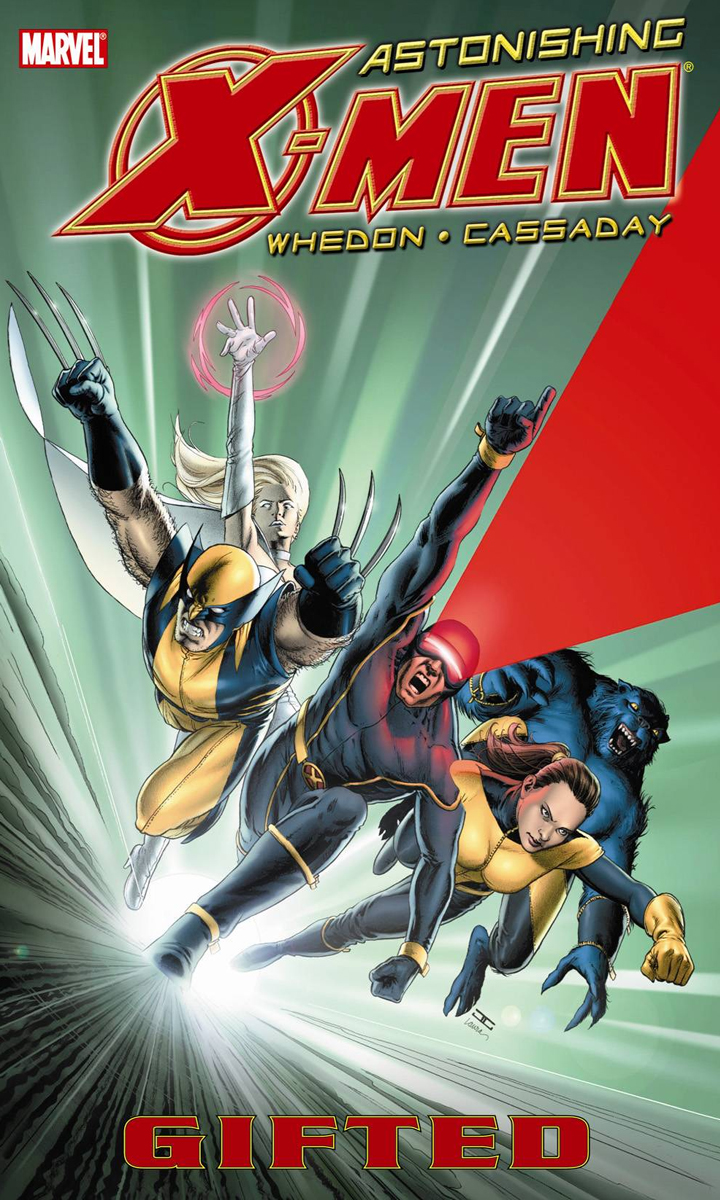
Speaking of jokes, this blog entry wouldn’t be complete without a reference to Joss Whedon’s terrific run on Astonishing X-Men. Start with the first volume, Gifted, or just get one of the omnibus editions. Astonishing follows the premier mutant superteam after the death of founding member Jean Grey, and largely eschews the notoriously complicated X-Men continuity for solid characterization and snarky humor. (My personal favorite moment is when a psychic villain “devolves” several of the X-Men, turning Beast into a growling animal and making Wolverine revert to his childhood self … which seems to be a hilariously naïve and racist Little Lord Fauntleroy. Can a character be hilariously racist? It turns out that Wolverine can … just look for the line, “AND, I met an Oriental!”)

You might notice that DC Comics is conspicuous by its absence from this third method. That’s not intentional, but it is a bit sad. DC has been a lot better than Marvel in recent years at tying absolutely everything going on in its fictional universe to whatever mega-crossover event is being pushed at the moment. There are major ramifications to this. First, almost any good DC storyline requires you to read three or four bad ones just to understand what’s going on. And second, because there’s one of these events every year, the universe changes dramatically all the time … which means a lot of the really good stories don’t have a lot of staying power. Good as they are, there’s no way to explain them to someone who hasn’t been reading DC Comics for years. The few DC stories I considered for this part of the list—mostly James Robinson’s Starman and Mark Waid and Alex Ross’s Kingdom Come—are at least 15 years old, and I felt I’d already filled that slot with Astro City. They’re still good stories, though, and I encourage you to seek them out.

What about you, comic-book readers out there? What books do you recommend to friends who want to read superhero comics for the first time?

And if you say Watchmen, I will do my best to punch you through the internet …

Monday, April 4, 2011

Superhero trailer park


I remember one of Stan Lee’s Soapbox columns from the late 1990s where a reader wrote in to ask which Marvel Comics properties, if any, were being developed as movies. The list old Stan reeled off was truly staggering—everything from big-name properties like the X-Men and the Hulk to relatively small potatoes like the Black Panther and the Sub-Mariner. For those of you not old enough to remember the bad old days, let me provide a little perspective. I used to get together with a couple of friends in junior high school and do weekend superhero-movie marathons—and a good half of the bill was made-for-TV specials of indifferent quality. I grew up pretty much liking the 1990 version of Captain America because it was still a cut above things like Nick Fury: Agent of Shield starring (ugh!) David Hasselhoff.

Now, of course, it’s a whole new world.

I still can’t get over the fact that they made a Daredevil movie (and I’ll never get over how badly it sucked—Mark Steven Johnson, you’re on my list). Seeing X-Men on the big screen made me like the character of Wolverine for the first time in … well, ever. Ye gods, they finally untangled the rights to Spider-Man and made three movies, only one of which stank, and they’re making yet another. And DC Comics hasn’t fared too badly—Superman Returns bombed and The Spirit is the only movie I’ve ever walked out of (and I refunded my companion’s ticket by way of apology), but even the snoozefest that was Watchmen can’t eclipse Christopher Nolan’s Bat-extravaganzas.

This is a long way from a weekend movie binge where top billing was split between The Shadow and The Phantom (although I still like that last one enough that if I can write a role for Billy Zane into Masks, I will).

And now we’re facing what seems like an interminable summer of yet more superhero flicks. So I thought I’d weigh in on what looks good and what I’ll be sitting out. I rate superhero movies on the basis of overall story quality (plot, characterization, etc.), overall movie quality (caliber of writing, direction, etc.), and comic-book correspondence (whether and how the movie is faithful to the comic-book original, and whether that was a good idea). For comparison purposes, Batman Begins is an A+; Jonah Hex is an F.

1. Thor (May 6): Okay, I’ll be the first to admit I’m not a huge fan of the character. Basically, the only Thor comics I’ve read with any relish were written by J. Michael Straczynski, and even those are uneven. But this big-budget Norse mythological extravaganza, about the prince of Asgard being banished to Earth and ending up in the New Mexico desert, looks a bit promising. Chris Hemsworth seems to have real presence even in the face of hokey dialogue, Anthony Hopkins is chewing the scenery for all he’s worth, there’s a lot of wacko hat action going on, and I can’t see anything particularly stupid that director Kenneth Branagh has done with the concept or the script. Bonus points for pretty cinematography and the line in the trailer: “Oh, no. This is Earth, isn’t it?” Projected grade: A-

2. X-Men: First Class (June 3): The trailer they’ve released so far has played things pretty close to the vest, but this movie seems to have wandered a long way from the comics that inspired it. Following the early years of the Magneto-Professor X relationship from X-Men seems like a solid story—the conflict between their philosophies was always central to what made the comic work—but putting kiddie X-Men in the middle of the Cuban Missile Crisis a) screws up the timeline of the later films (Cyclops has only aged, what, ten years by the time the supposedly  near-future X-Men rolls around?) and b) doesn’t seem to add much in the way of character or weight. Projected grade: B-

3. Green Lantern (June 17): I’m calling it now—bad, bad, bad. Ryan Reynolds may be trying to invent himself as the superhero movie guy, but I haven’t yet seen him pull it off. His Deadpool in Wolverine was more irritating than amusing, his Hannibal King in Blade: Trinity just would not shut up, and I don’t see him improving in the role of a test pilot recruited into an alien police force. Judging by the trailer, this movie has a serious problem balancing goofy Ryan Reynolds comedy with kickass cosmic adventure, and the adventure is losing. And is anybody else creeped out by the fact that he transforms into Green Lantern with a pose reminiscent of a subway flasher? Projected grade: C

4. Captain America: The First Avenger (July 22): I am so, so torn about this. On the one hand, I want to smack whoever cast Chris Evans as the World War II wimp turned super-soldier. I saw Fantastic Four, guys—he showed all the acting ability of a plank, and his personality seemed to be set permanently on “lech.” I do not want to see this guy carrying the shield, period. That said, Joss Whedon apparently did a script polish on this one, and the man knows his superheroes, and I’ve heard good things about Hugo Weaving’s sinister Red Skull and generally good things about Sebastian Stan, who plays Cap’s sidekick Bucky (and you’ve all heard me go on about him). So this one gets my dollars, at least at a matinee price, though I may live to regret it. Projected grade: B+

5. Cowboys and Aliens (July 29): Yes, this is based on a comic book. Shut up. On the plus side, they’ve got Harrison Ford in a movie whose whole concept is wrapped up in its title. The trailer looks decently creepy and well-balanced, with an intriguing main character in the desperado (Daniel Craig) who survives an alien abduction. And there’s director Jon Favreau of Iron Man fame. On the minus side … cowboys and aliens? Really? There had better be one hell of a story here. Projected grade: B-

6. Conan the Barbarian (August 19): Not technically a comic-book movie (Conan was a pulp hero first), but close enough. And no, I don’t see this going anywhere good. They’re remaking an Arnold Schwarzenegger flick with Jason Momoa of Stargate Atlantis, and the release date’s been pushed back to August, well-known as the month where summer movies go to die. Projected grade: D