A few tips for aspiring writers who are looking to build their own emergency-medicine knowledge but can’t do EMT training:
A blog about reading, writing, and the nerdy life. Also superheroes, pop culture, science fiction, fantasy, magic, explosions, fur-bearing animals, and anything else that crosses my mind. Supposedly it promotes my writing, including my serial, MASKS. Actually it just lets me run off at the keyboard. Be afraid. But visit me on Facebook and read MASKS on Pocket Coyote while you're at it.
Monday, May 16, 2011
Things You Didn’t Know You Should Know, Part 1: Playing Doctor
A few tips for aspiring writers who are looking to build their own emergency-medicine knowledge but can’t do EMT training:
Sunday, December 12, 2010
Make your own Pocket Coyote!
Pocket Coyote Pattern
Friday, September 3, 2010
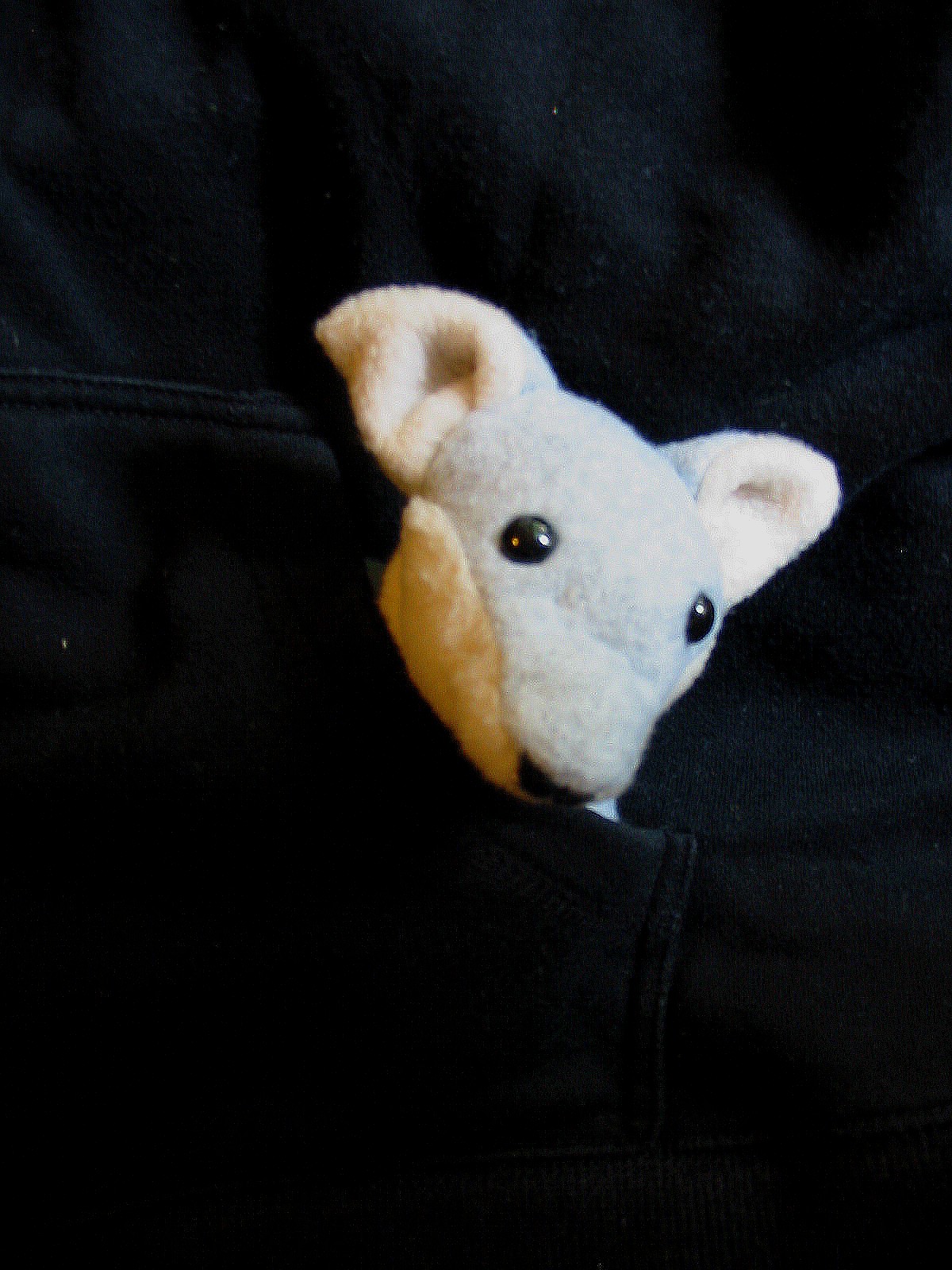
Meet (and win) the Pocket Coyote!
I finally finished making the Pocket Coyote last night. He and his twin will be the prizes in the TWO current contests! That's right, there's two! Did you forget?
You can enter the fan art contest by submitting any kind of fan art--drawings, photos, videos, recordings, whatever. Post the art, or a link to it, on the wall of the Masks Facebook page (there's a link in the column to the right of this blog entry). As long as the art is 1) about Masks; 2) non-obscene (PG-13, please!); and 3) not a violation of anybody else's copyright (no cameos by Superman or the X-Men), it's eligible. The winner of the fan art contest will be decided by a fan vote on this blog ... and yes, you can vote for yourself. Although I'm sure you'd like your friends to vote for you, too ...
Which brings me to the fan recruitment contest! You can win a Pocket Coyote by inviting your friends to "like" Masks on Facebook. When your friends add the page, post their names on the page's Wall (or have them post their names, along with a note saying you invited them). Whoever recruits the most people this way (and isn't Shelley, who won last time) gets a Pocket Coyote!
The Pocket Coyote is 100% machine washable and handmade by the author. No two Pocket Coyotes are exactly alike. If you want to give him to a kid, he's probably safe for any kid that can handle a beanie baby (although he might offer the kid a faustian bargain when you're not looking, so watch for telltale signs of suddenly achieving a superheroic destiny). If you want to keep him for yourself, he can probably be trained to do something, but I have no idea what.Why am I doing all this? The usual explanation applies--the more fans I get on Facebook, the more traffic I get on this blog, and the more attention I get generally, the better the chance that Masks will eventually get published. So if you want to read the book, please help me make some noise, Pocket Coyote or no. I'll probably post the Pocket Coyote pattern eventually, too, for those of you who are into that.
Oh, and did I mention ...
... he fits in a pocket!
Tuesday, August 24, 2010
Wardrobe check, or yet another way I overthink my work …
When you tell people you’re writing a novel about superheroes, there are certain elements of the conversation you can predict. For example, someone will say, “What, you mean like [name of copyrighted superhero]?” and be completely wrong. (Hint: if I were writing a superhero who was just like an existing, copyrighted superhero, I would be in a lot of legal trouble, and also probably bored out of my skull.) Also, the conversation will involve at least one question about when the movie’s getting made. (For the record, there is no movie—at least for now. But I’m open to doing lunch.) And finally, whoever I’m talking to will try to make at least one lame joke about spandex.Aaaaaaargh.
I think I’m a bit more sensitive than most people on the subject of superhero costumes. Long before I discovered comic books, I was sewing my own clothes and accessories on my mom’s sewing machine, so I have some idea of what’s involved in some of those fiddly designs. Because my family didn’t make nearly as much money as most of our neighbors, and because I went to school with a bunch of kids from the rich end of town, my mother worried a bit that I would start begging her for the same designer fashions my classmates wore. She couldn’t afford fancy stuff like that, but fabric was cheap and so she compensated by sewing me any garment I really, really wanted, no matter how questionable my choice of color or design. And once our tastes in clothes really started to diverge (i.e., I discovered black), I began sewing whatever she wouldn’t make for me.
So I know my way around a fabric store. I know how to design and sew clothing that will survive my daily life, which never runs out of ways to be weird. And so I approach the question of how superheroes might dress with, shall we say, a slightly different perspective.
First and foremost, superhero costumes must achieve the basic functions of normal clothing—cover certain parts of the body, protect the wearer from the elements, and perform specific work-related tasks like carrying tools and conforming to a dress code. For superheroes, we can add simultaneously concealing their real identities—Rae doesn’t want anyone seeing who’s under her mask, and Trevor is ferociously paranoid about security cameras—and clearly associating them with their mask identities. (That’s one reason Rae’s Peregrine insignia appears on the back of her tunic as well as at her hip—so police officers and anyone else involved in a crisis don’t shoot her by mistake, even if they’re not looking at her face-on.)
But of course, being a superhero puts some extraordinary demands on clothing. If you have powers, you’d better have a costume that can withstand their use or you’re going to have a real problem every time the Human Torch bursts into flames—or at least, whenever he puts the fire out again. And your costume had better be able to withstand the kind of powers you encounter in others, too—the last thing you need is Mr. Freeze freezing Batman’s utility belt off his body. And then there are the everyday hazards heroes encounter as a matter of course. If your enemies shoot at you, Kevlar is going to be your friend. If you’re not invulnerable, you’ll probably want eye protection; superhero battles produce shrapnel, and an eye injury can be career-ending in the mask world. Freedom of movement is an issue all by itself—if your costume won’t let you throw a spinning back kick, you might die from the lack of one.
But the one thing you do NOT want to put a superhero in, at least in my view, is spandex.
Yes, the skintight costume is easy to draw. That’s the major reason it’s become the industry standard (well, that and it looked futuristic back when Joe Shuster stole it from Alex Raymond and put it on Superman in 1938). But if you look at the people who wear skintight clothing in real life, the only ones who don’t make us all cringe are dancers and Olympic athletes. And you’ll note that the specialized clothing they wear is designed for use under specific, controlled conditions, like a dance performance or a carefully regulated sporting event.
Try finding controlled conditions in a superhero fight! Superheroes need something that will still perform the functions of superhero clothing after Nitro the Human Bomb has gone off!
So here’s how the rules of superhero wardrobe apply to my two lead characters.
Rae Masterson. My first and overriding principle in designing Rae’s costume was that it would have to be something a sixteen-year-old girl could quietly keep with her at school and change into at a moment’s notice. I don’t know about you, but I did not have the self-confidence at sixteen to suddenly strip naked where other people might see me, so a real quick-change was out of the question. She also couldn’t wear the costume under her school clothes, unless her costume looked remarkably like underwear—someone would see it when she changed for P.E. So Rae’s costume had to go over her street clothes. Since she’d have to hide the costume in her backpack, I settled on lightweight fabric that wouldn’t take up too much space. That also meant that Rae wouldn’t be adding too many layers—we couldn’t have our superheroine dropping from heat exhaustion, could we? Unfortunately, light fabric also rips easily, so I focused on a simple design that Rae could replicate easily when her costume got trashed. (That’s also why she wears jeans under the tunic, by the way—they’re harder to destroy!) Tunics and hoods are relatively easy to sew, and making it loose-fitting allowed freedom of movement while simultaneously saving Rae sewing time she’d otherwise spend on fine-tuning the fit. A bulky, pocket-heavy costume would carry Rae’s toolkit, but wouldn’t squish down in her backpack, so I settled for a sash she could tuck things into. I took the overall look of the costume from a couple of different manga characters—an area Rae might look to for inspiration, since there are plenty of anime cosplayers in California. Finally, the gloves were inspired by the heavy muleskin gloves I wore as a kid to pick berries in my grandmother’s patch. They were the toughest hand protection I’d ever come across, and I figured Rae could find something similar without too much trouble. The brooch I figure she made in her high school’s metal shop—and yes, some but not all of the edges have been sharpened.
Trevor Gray. My big idea in designing Trevor’s costume was that he’d been around superheroes all his life, so he wasn’t married to the spandex idea, and because of some of the shadier parts of his past, he places a premium on disappearing in a hurry when he has to. Trevor got the eye-protection memo that Rae missed, too, so his mask includes shatterproof goggles. The major feature here, though, is Trevor’s idea of the quick-change. The mask can be kept in one of the jacket’s many pockets and the jacket itself reverses to a more normal, civilian-style garment, allowing him to switch identities in seconds. (Fun fact: as a native Chicagoan far from home, Trevor had the logo of the Chicago Cubs put on the back of his “non-super” jacket. He really is a glutton for punishment!) He’s also got access to fancier materials than Rae, so he’s got some padding and reinforcement in the mask to cut down on concussions, and the gloves are tougher than they look. Other than that, his outfit is 100% off-the-rack, allowing him to blend into the crowd at a moment’s notice. Trevor is also more concerned than Rae is about disguising his real appearance at all times—he remarks at one point in Masks that he really hates having such dark eyes and such light hair, because it makes him instantly memorable, and that’s the worst thing to be when you’re trying to be stealthy. That’s why his mask covers his hair, and why his goggle lenses are polarized to slightly alter the color of his eyes. Many people looking at him with his goggles on assume that his eyes are brown, and that’s just how he likes it. His mask is also a lot more secure than Rae’s, which is basically a bandana tied around the lower part of her face, and covers a distinctive scar near his hairline that he picked up in Chicago, as well as a break in his nose he got when someone punched him in the face in Kiev. And finally, in case anyone’s interested, Trevor wins the cargo-capacity stakes; his pockets carry a lot more tools and weapons than Rae’s sash, and he uses all of them ably.
I still think he ought to invest in a helmet, though. One of these days, to borrow a phrase, he’s going to wake up in a coma …
Monday, August 16, 2010
Two contests for the price of one! Well, actually for the price of two ...
While I’m slaving away over the second short story, I think I’ll put my wonderful readers to work. That’s right, it’s time for another contest! Or, in this case, TWO contests!One of the most interesting aspects of running Masks as a monthly web serial back in the day was the fan art I’d get. Some of it was pretty darn cool, and some of it made me laugh, and occasionally it made me wonder what kind of medication my readers were taking, but it was always entertaining. I’ve gotten a little bit of fan art while I’ve been hyping the book, but I kind of miss the zaniness of seeing my universe through others’ eyes.
So for the next six weeks, I will be accepting fan-art submissions for the new contest. The fan art can take pretty much any form as long as it produces an image—drawing, painting, photograph, video still, whatever. The art can draw on existing Masks characters and stories, or expand the universe in some way (hint: dozens of masks died in the superhero purge ten years ago—and I’ve only named about ten of them so far!). If you’re not comfortable with a pencil, go crazy with the contents of your closet and take photos. Paint up an action figure like Guillermo did in “Zephyr Street.” Use screen captures from an MMO like Erik Johnson did for his Masks project in City of Heroes. If you're musically inclined, post a video of a song! Wacky videos are acceptable, as long as you made them yourself and you don’t mind my sticking a screen capture in the album for reference. I’m not looking for Hollywood-caliber production values here—anything that’s fun and superheroic (or supervillainous) is fine by me.
Pretty much any kind of art will do as long as a) it stays PG-13 (no profanity, nudity, sexual content, or racial slurs, please); b) it’s not going to get me in trouble with the copyright monkeys (no Superman or Dr. Horrible—but your own original character is fine); and c) people looking at it can tell it’s associated with the book somehow. Feel free to plaster the title on the image.
Submit the art to this blog or the book’s Facebook page on or before September 27—I’ll be developing an album on the page so everyone can see what gets turned in. After the submission period closes, I’ll post a link so the fans can vote to choose the best submission. Ah, democratic anarchy!
And oh, yeah, there’s a prize! The best submission wins a bloodthirsty animal sidekick with which to battle the forces of evil. That’s right, the Pocket Coyote is finally coming along … and the best fan art wins one, handmade by yours truly! Photos of it soon.
But wait! I hear you saying, “Rebekah, I have the artistic ability of a poleaxed goat. I can barely hold a crayon, let alone a needle or a camera, but I want to win a Pocket Coyote, too!” Well, never fear, because there’s a contest for you as well! We’re having another fan drive, something like the last one.
Invite your friends to Like the book’s Facebook page OR sign up to follow this blog (that’s right, if they do both it counts TWICE), and comment on the blog or the page to identify who invited whom. Whoever gets the most new fans between today and September 27 (i.e., fans that join or follow between now and then) gets a Pocket Coyote of their very own in the mail. I'll send the thing to any location the postman can find in the United States or Canada.
Unless it’s John K, who won last time. Fair’s fair.
Ready? On your mark … get set …
Thursday, May 13, 2010
First it killed the Romans ...
I have a confession to make. I have a nasty case of Latin punning.I first learned the horrid Latin pun “semper ubi sub ubi” from my older brothers, who took Latin in college. (Note: my eldest brother is seven years older than I am and was eight years ahead in school, so he started college the year I started fifth grade. You can imagine how his sense of humor interacted with mine.)
The pun works like this. Semper is the Latin word for “always,” as in “Semper Fi,” the Marine Corps motto that’s short for “semper fidelis,” “always faithful.” Ubi is the Latin word for “where,” as in, “Where is it?” It’s the root of the English word “ubiquitous.” Sub means the same thing in Latin that it does in English—“under,” as in submarine, subterranean, etc. Semper ubi sub ubi. Replace each Latin word with its English equivalent and sound it out. I’ll wait.
Yeah. It’s that bad. In my defense, I was eleven at the time. And for the record, it makes no sense whatsoever in Latin—it’s funny only to those who speak English too.
A few years later, when I was writing Masks as a serial, I kept in touch with my fans via an ancient device known as a letter column, or lettercol if you’re really into fandom. My readers would write me letters (primitive communications consisting of ink stains on paper, delivered by uniformed couriers), and I would reprint their contents on a designated page of each issue, including my response to each. This required me to step outside my normal authorial voice and speak more or less as myself. I have always been a little uncomfortable with this practice, as I started writing stories in part because I really didn’t have much to say to people otherwise, but it seemed to make the fans happy, and I am all about making fans happy. So I experimented with different writing styles in my lettercol responses.
And then one day I discovered Stan Lee.
You might remember him. He invented about half of the comic-book characters you like. Spider-Man, the X-Men, the Fantastic Four, the Incredible Hulk, my own beloved Daredevil … if Marvel Comics publishes it and you like it, chances are Stan Lee tinkered with it at some point. Now, Stan’s personality could fairly be compared to an exploding cigar. He never met an exclamation point he didn’t like, and his alliterative headlines still give me nightmares. (For my money, the most daunting was, “A Quaff of Quixotic Quips and Quotes to Quench Your Quakes and Quandaries!”) But his style in interacting with fans was very personable and folksy, if hyperbolic, and it did manage to be amusing.
So one day, when I’d run out of other ideas, I did the lettercol in Stan-Lee-esque terms. Every sentence ended with an exclamation point, I alliterated wherever I could, and all my responses sounded like they should be read by one of those shouting announcers in car-lot commercials. It was fun.
And then, at the end, I had to come up with some kind of take on Stan’s trademark signoff, “Excelsior!” Well, I didn’t have a whole lot of Latin at my disposal, so I went with my trusty standby, “Semper ubi sub ubi!” It seemed to work, and I included a little note about its translation. It seemed particularly appropriate for a serial about people who sometimes wore their underwear on the outside. And I used it for a few months, then dropped it.
At which point I began getting letters about it.
“Where’s my semper ubi sub ubi?” “I need my semper ubi sub ubi!” “I haven’t gotten my money’s worth if I haven’t seen my bad Latin for the month!” (Money’s worth? The serial was free!) So I brought it back as the signoff. Soon the fan letters were including it. When Masks got a web archive, the domain name included the phrase. Sometimes it was shortened to its initials—SUSU. I appliquéd it on my laptop bag because, well, nobody else was going to have a bag like that, so I’d always know which one was mine.
And last month when Derrick texted me to ask what slogan Rae would have on her T-shirt, I couldn’t think of anything else to say. So there it is, rearing its punnish head once more. I don’t think it can be killed now. But at least it’s back to being an in-joke for everyone.
Oh, right, I should explain the blog title. It’s taken from a bit of doggerel almost every Latin student learns (and is, in fact, the title of a chapter in Masks where Trevor unexpectedly finds his life depends on his Latin skills):
Latin is a dead language,
Dead as it can be;
First it killed the Romans,
And now it’s killing me.
Saturday, March 27, 2010
Introducing the Backpack Coyote!
Backpack Coyote Pattern
Tuesday, January 12, 2010
How to make a last-minute Christmas gift--with ears!
During the summer, I used some fleece scraps to construct a coyote hat—ears and all—similar to the cat-eared “kitty hats” popular among anime fans. The hat was something of a hit, and got quite a laugh from my friends one chilly night recently when I wore it on an expedition to look at Christmas lights. It also kept my ears warm.
So here’s how to make your very own eared hat—bunny-eared, cat-eared, or—if you’re inclined to show your Masks spirit—coyote-eared. I recommend gray for that, because people don’t believe in brown coyotes.
1. Buy a half-yard or so of fleece from your local fabric store. You can probably get it as a remnant, or odd end of an old bolt of fabric, which is cheaper than buying it off the bolt. Get a color you can stand—you do have to wear this thing. I recommend “anti-pill” fleece rather than “blizzard” fleece—it’s a bit more expensive, but after you’ve washed your hat a few times, you start to notice the difference. Get some thread in a suitable color. You’ll also need a needle and some straight pins.
2. Measure your head. Wrap a tape measure around your cranium at about where you want the bottom of the hat to rest. If you want your hat to cover your ears, wrap the tape around your ears when you make the measurement. Measure from the top of your head to the bottom of your planned hat so you know how tall your hat will be. I like to pull mine down to my eyebrows when I’m cold, but your results may vary.
3. Go to http://www.wildginger.com/products/wildthings.htm and download the “Wild Things” freeware program. The program lets you make lots of simple hats, bags, accessories, etc, but what you want here is the Baseball Hat program. Select the Baseball Hat, input your head circumference and intended height of your hat (minus the width of your band—see step 5), and generate a pattern. You will see, among other things, a bunch of pattern pieces shaped like pie slices. Print out one of those pie slices and cut it out of the paper.
4. Choose the “right” and “wrong” side of your fabric. There’s no right or wrong way to do this (ha), so pick which side of the fabric you want to be on the outside of the hat. That’s your “right” side. Cut six pie slices from your fabric, with the pattern on the right side. NOTE: The pattern will include a seam allowance—a dotted line that shows you how far into the fabric you will be sewing your seam. Make sure you can live with that seam allowance. If you think you need a bigger one, cut the pieces bigger, but be consistent.
5. Cut out your hat’s headband. This will help the hat maintain its shape. Decide how wide you want the headband—I like three or four inches—and then cut a strip twice that wide and as long as your head circumference, plus seam allowances all around the piece.
6. Make your ears. Draw your ear shape on a piece of paper and cut it out. Cat ears, coyote ears, ears with notches, whatever floats your boat—just draw the ear, draw your seam allowance around it, and then cut the piece out of the paper. Cut four ear pieces from your fabric. NOTE: If you want a contrast lining—where the inside of the ear is a color different from the color of the outside—cut two of your four ear pieces from the contrast fabric.
7. Sew your ears. Each ear is made from two ear pieces (or one regular ear piece and one contrast ear piece) sewn together with their right sides facing each other, leaving the bottom edges open. Sew each ear in this way and then turn your ears inside out. BONUS POINT: Hold the ears to your head at this juncture and run around the house making “rawr!” noises. This will encourage people to leave you alone while you sew the rest of the hat, as you’re obviously out of your skull.
8. Sew the two halves of your hat. Each half is made of three pie slices, sewn together at the sides so that the points come together at the top. Sew the pie slices with their right sides together. This way, when you turn your hat right-side out, the seam allowances will be on the inside and the outside of your hat will appear smooth.
9. Attach your ears and sew your halves together. As you fit the two halves of your hat together (right sides together), position your ears in the seam and pin them there if necessary. Remember, the bottom of each ear should be sticking into a seam and the top of each ear should be on the inside (right side) of the hat when the hat is inside-out for sewing. So while you’re sewing this hat, you see only the bottoms of your ears sticking into your seam. Stitch the front and back of your hat together. If you have contrast ears, make sure the contrasts on the two ears are both facing the same direction—toward the forward side of your hat. BONUS POINT: To add dimensionality to your ears, fold one side in just a bit so that the fold is toward the crown of the hat. This will make your ears stick out more and appear to be listening forward or out to the sides.
10. Make your hatband. Sew the ends of the band together (right sides together again) to make a loop with the same circumference as your hat.
11. Attach your band. Center the seam in your loop on the back of your hat (it should end up in the middle of the center back piece), and then pin the band in place there—right sides together. Work your way around the hat, pinning the band with the right sides together, to make sure everything fits. Stitch the band in place.
12. Turn the band right-side out (you should see a smooth seam where the band joins the pie slices). Now fold the band in half and tuck the other side into the inside of the hat. Pin the free side in place just like you did the previous side. Stitch your hatband to the inside of your hat. If you want to fold your edge under and stitch right-sides-together again, go ahead, or just attach it any old way you like as long as you don’t make too big a mess visible on the outside of the hat.
13. Turn the hat right-side-out and stitch on any accessories you want, like eyes or scars or fangs or other shapes, preferably cut from fleece. Painting designs on fleece is hard, embroidering them isn’t worth your time, and while felt is cheap and tempting, it doesn’t wash well, and you will eventually want to wash this hat. I plan to sew fangs on my next coyote hat after hearing several people remark that it appeared to be eating my head.
14. Tug your hat onto your head, or wrap it up to present to the animal in your life. If you’ve had the good taste to make a Masks coyote hat, go howl at the moon!
I can make one of these suckers by hand in two or three hours. I assume it’s faster on a sewing machine. The fabric and thread generally come to less than ten bucks—less than five if I use coupons or poke around the right stores. These hats generally sell for about thirty bucks at conventions, so with a little ingenuity it’s not hard to be the envy of your fandom.
Best of all, fleece does not fray out like most fabrics, so you can expect your hat to look good and keep your head warm for a long time. At least until a hungry coyote steals it off your head.