Showing posts with label research. Show all posts

Monday, June 4, 2012

My life as a research monkey


Say what you will about us writers; we were readers first. Most of the writers I know got into it out of a love of the written word—sometimes a desperate one, as in my case. I began writing my first novel at the age of eight because I was burning through the children’s room at my local library entirely too fast, and I was afraid that I would run out of books to read if I didn’t start making some of my own, stat. So reading comes naturally to us, and we love it.

Which is a good thing, because ye gods, do we have to do research.

Masks is set in modern-day Los Angeles, my lifelong home, so a certain amount of the research is done for me. I know what the hills look like in summer, how a Santa Ana wind smells, where to find an abandoned aircraft hangar or an empty flood-control channel. I have a working vocabulary of curse words in four or five languages spoken by the locals. I can describe the subway without pausing to look anything up, and I know what it’s like to be packed into a Rapid bus hurtling down Wilshire Boulevard at foolhardy speeds.

At the other end of the spectrum, the world of The Novel is completely made up. I’ve devoted many hours to figuring out how the weather patterns work, and the literacy system, and the technology, and even what kind of birds you’d find in certain bushes. And I’m the ultimate authority on all of that. All that information is sitting inside my head or in my notebooks, and because no one else has lived in my fictional world, no one can correct me unless I get the real-world science wrong—make the rain fall up instead of down, put the wrong kind of birds in the wrong kind of ecosystem, that sort of thing.

In the middle falls the Street of Bakers project, and an awful lot of research.

While Street of Bakers has strong elements of science fiction and fantasy—it is steampunk—it’s also firmly rooted in a real time and place. Victorian London really existed, and modern London exists today. Millions of people have visited or lived in the places I’m writing about, an ocean away from me, and know millions of details that I don’t. I’ve never been out of my own country—I didn’t even have a passport until I was in my late twenties, and I’ve never used it. (This isn’t the American snobbery you’ve heard so much about, by the way—I don’t actually ignore other countries, or assume I wouldn’t get anything out of visiting them. I’ve simply never had the money to travel for pleasure, and I never get more than a day or so off work at a time, which makes it tough to travel to anywhere other than Mexico. Someday, though …) So I do research.

I haunt a nearby university library for books of maps so I can build up my knowledge of London’s geography. I’m reading my way through Liza Picard’s Victorian London, learning about sewers and velocipedes and corsetry and whatall. And then there are the websites—costumers’ sites for fashion tips, archive websites for street-level maps, even a botany website that can find me a white willow tree in modern London at two in the morning. (An early plot point requires Watson to get hold of some willow bark in a hurry.) It’s a good thing I’ve got that writerly love of reading; otherwise I’d never get through all this.

In some ways, though, I’m glad I’m doing it. I probably haven’t read this much reference material since I was in college, and I’m rediscovering the quiet joy of reading books I never would have discovered on my own. Ever since I was little, I’ve enjoyed stuffing my brain with seemingly useless but interesting information, and this project is giving me a magnificent excuse. I’ve recently discovered an urgent need to re-read Harry Houdini’s book on stage magic; how often can I pass that off as work? And that’s not even counting the sheer joy of Sherlockiana—from a deep re-reading of Doyle’s canon to modern pastiche collections like Michael Kurland’s Sherlock Holmes: The Hidden Years to outliers like Anthony Boucher’s The Case of the Baker Street Irregulars and Fred Saberhagen’s The Holmes-Dracula File. How many people can legitimately say they’re doing research by reading a novel about Sherlock Holmes teaming up with Dracula? I haven’t had this much fun since I regularly had to study smallpox vaccinations and ancient Greek statuary.

And it seems to be paying off, at least a little. Recently a beta reader on an early chapter of the project complimented me on my portrayal of a completely made-up part of the London Underground; even though the design of the car was entirely fictional and the line I described didn’t open until a couple of years after the story is set (I added a historical event that moved up the opening date), she was impressed with how clearly I described the sounds, smells, and sensations of a short Tube trip. “How long did you live in London?” she asked me.

I just smiled.

Monday, May 7, 2012

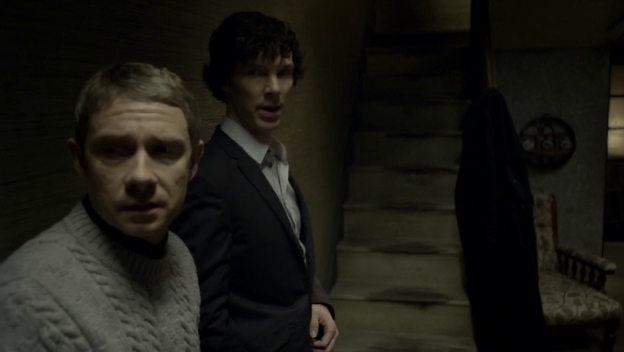
Point of view, and watching Martin Freeman's butt


All right, I just put the word “butt” in the title to get your attention. But this is a serious-ish post, about a fiendish little experiment I conducted recently whose results surprised me.

I love my local public library. It has comfy chairs, wi-fi, and (most importantly) lots and lots of books I love to read. It also has a nice little auditorium with lovely acoustics and a Thursday matinee screening series. This month, they’re screening Sherlock Holmes flicks, beginning with “A Study in Pink,” the pilot episode of Sherlock. (Yes, purists, there are more traditional Sherlocks in the series, as well, including Jeremy Brett and Basil Rathbone.) I was quite excited when I heard about this, and rearranged my work schedule so I could attend. Not, mind you, because it was such a treat to watch “Pink”—I own the DVD and have seen it so many times I’ve accidentally memorized it—but because this was a chance to watch the episode in a room full of people who had never seen it before.

Why does this matter? One word: research! 

Okay, AND the chance to watch these guys on a big screen.
I first saw “A Study in Pink” online, ruthlessly edited down and streamed through the PBS website. Later, I bought the DVD and inflicted it on most of my friends, but I was always sitting right there next to them, nudging them and saying things like, “Okay, watch this bit, it’s the best part ever until the next best part!” We were also able to pause the episode whenever we liked and argue about what was really going on, which cut down on a lot of the confusion when Sherlock deduced things at a million miles an hour and someone needed the Cliff’s Notes.

Now that I’m planning the Street of Bakers project, however, I’ve realized that I lack what might be called a normal person’s perspective on the story. Remember, when I was a kid reading the canon, I identified with Sherlock Holmes, even though Watson’s supposed to be the POV character. I might enjoy the living hell out of those stories, but I don’t necessarily have a firm grasp of what everyone else likes about them. It’s a bit like going to a football game and admiring the marching band instead of watching the players. Maybe you’re having just as much fun as everyone else, but you’re not going to understand what makes football appeal to people who aren’t you. That’s okay if you’re just watching football, but when you’re trying to write a book for people who aren’t you, then it’s a real drawback. 

They're looking at a marching band, I swear.
So my goal in attending the screening wasn’t to watch the episode—it was to watch the audience. I wanted to see which moments made them laugh, or gasp, or blink. And I made a rather surprising discovery.

I couldn’t exactly listen to the audience’s thoughts, so I watched their faces instead, and listened for the telltale sounds of fidgeting in the dark auditorium. (Remember those lovely acoustics? They were a big help.) Everyone seemed deeply drawn in by the first meeting between Holmes and Watson; those characters’ big plot moments were attended by total silence as everyone held still and focused on the screen, momentarily forgetting to check their phones for messages or rummage in their bags for smuggled snacks. 

But their attention wasn’t evenly split. As brilliant and charismatic as Holmes was, and as well as Benedict Cumberbatch played him, he wasn’t nearly as likely to hold their focus as Martin Freeman, the actor playing Watson. Even at the climax of the episode, when Holmes was staring down the barrel of the serial killer’s gun, there were occasional rustles as people searched their pockets or crossed and uncrossed their legs. But a five-second scene where Watson pulled up in a cab outside the building where the confrontation was taking place? I swear I heard them stop breathing. That focus remained as the episode shifted back to Holmes and he deduced the killer’s motive, but I could feel the stillness around me grow every time the camera shifted back to Watson running through the building, searching for his friend, the camera following along behind him. It didn’t matter whether they could see his face, or whether he was talking. If Watson was on screen, and moving at all, the audience was glued to him.

Look! A guy with a cab! Everyone hold your breath!
Seriously. I don’t think I’ve seen this many people staring raptly at an actor’s backside since I walked in on a couple of preteens watching an Orlando Bloom movie.

The point of all this? Once the audience identifies with a character strongly enough, they’ll watch that character do almost anything, even if it’s just getting out of a cab. Steven Moffat went to a lot of trouble to make Watson sympathetic and heroic early in the episode, before Sherlock Holmes even appeared—he showed Watson’s military service in a flashback, showed him trying to put on a brave face in a therapy session, and then used Stamford to show that Watson had once been the sort of friend you’d recognize and call to across a park even if you hadn’t seen him in years. Even in the first Holmes-Watson scene, Watson shows himself to be both tolerant (going along with Stamford’s crazy roommate suggestion) and polite (lending Holmes his phone without being asked). 

Would you trust this guy with your phone? I wouldn't.
By the time Sherlock Holmes first dazzles the audience with his deductions about Watson’s past, we already feel like we know the guy we think of as the hero—and we’ll follow him even when Holmes is acting like a jerk. I talked to a couple of audience members after the screening and discovered that several of them had hearing problems and couldn’t understand what Holmes was saying; Cumberbatch talked too fast, and his British accent was a little too hard on damaged American ears. But Martin Freeman’s voice and body language carried so much of the story that they were riveted to the sight of him getting out of a car. Now that is audience identification.

This shot is only in here because it's awesome. Carry on.
Now, most of these viewers were considerably older than the prospective readers of Street of Bakers—I think I was the youngest person in the room, except perhaps for the young librarian running the projector. I’d like to repeat the experiment with younger viewers and see whether the results hold. But all in all, it’s a very promising bit of data. I have big plans for my own Watson …

Monday, November 15, 2010

What I learned from accidentally stabbing myself in the leg.

Okay, I’m an idiot, I’ll admit. I grew up around knives, I am cautious in the extreme, and yet I failed to pay attention for a couple of seconds and managed to stab myself. You may all laugh; in fact, I’ll be leading the laugh-in, because I showed up at the ER Sunday morning having changed my shirt for the occasion. I wore the T-shirt I made for Halloween as part of my three-dollar costume. That’s right, I showed up to the ER with a stabbed leg and over a thousand pages of reading material (I hate being bored in waiting rooms, so I brought American Gods and Dune), wearing a T-shirt that said (NINJA). With the parentheses. The ER docs said it showed a healthy sense of humor about the whole thing, so at least that part of me is healthy.

So, to answer the immediate questions first:

1. My life was not in any particular danger. The stab in question was more of a poke with the tip of the knife blade, about as long as my pinky fingernail is wide and about that deep. It went into the meat of my lower thigh, not very close to the knee and not close to any major blood vessels. I managed to soak about a quarter of a balled-up Kleenex with the blood before I got the thing properly dressed. After that, it took about five hours for a dime-sized area on the top of the gauze pad to turn pink. I only went to the ER at all because my dad took a look at it and said, “Hmm, I think you’ll need stitches.” (The ER doc later told me it would have been one stitch, tops, and not even that because I didn’t bother to come in until the morning after.)

2. I am not going to be crippled. I am limping slightly, mostly because I wear a lot of boot-cut jeans that are narrow in the lower thigh and knee, and therefore tend to rub the bandaged area. According to the nice ER docs, I did an excellent job of cleaning and bandaging the poke myself, and about the only thing they had to offer was a tetanus shot in case the knife wasn’t as clean as I thought it was. (It was my best knife, and I use it for food prep sometimes, so I clean it regularly with soap and water.) I got a flu shot while I was at it, because I hate getting shots and I figured there was no point in ruining two mornings when I could combine all the poking and stabbing into one pointy occasion.

3. I’m an idiot. We are in agreement on that. But I like to think I’m a classy sort of idiot, because once I figured out I was going to be limping all day, I began doing Martin Freeman impressions to amuse the friend who drove me to the ER. (The bandages I applied to stop the bleeding were tight enough to restrict the motion of my knee, which would have made driving … interesting.) Martin Freeman, for those of you not in the know, is the actor who plays the limping Dr. John Watson in the BBC’s excellent series Sherlock, and he spends most of each episode hobbling around after Sherlock Holmes, yelling at him to slow down and stop being a git.

And now, because one of my stupid human tricks would not be complete without a) a blog entry and b) an application to my writing, I’ll tell you what I learned from the experience.

First, I learned that I still remembered high-school health class and my time hanging around with EMTs well enough to cleanly and correctly dress a wound. (I was happy to relay this experience to my tutoring students today, ending the lecture with, “So pay attention in science class, kids, because you never know when you’ll get stabbed in the leg and have to quickly figure out whether you nicked an artery.”) I make a point of researching the real-world science behind my writing, so when Trevor sews up his own arm in Chapter 7 of Masks, you can be assured that the suture kit he uses actually exists and he’s doing it more or less right. It’s always gratifying when that research and background knowledge tests out well in the real world, although of course I’d prefer not to get stabbed in the process if I can help it.

Second, I learned that my freakish crisis reflex is still in place. I have no better way to explain it than this—I can dress a knife wound, but I cannot dress for a party. If I am invited to a friend’s party, I will stress out like crazy over what I’m supposed to wear and how I’m supposed to act lest it reflect badly on my friend. (I never care much about it reflecting badly on me—if people think I’m weird, it just means they’re perceptive.) But as soon as there’s blood, or screaming, or some kind of actual crisis involved, I get very calm and can usually handle things okay. I used to think that everyone was like this—and indeed, many people are—but it was fascinating to see the range of reactions from other people upon being told that I’d stabbed myself. A good half of them freaked right out, even after I told them that the injury was small and I’d taken care of it effectively. A client who had a meeting postponed due to the ER run seemed to think I was going to lose my leg. I, meanwhile, went all out cleaning and bandaging the thing because I’m not THAT stupid and infections are no fun, but I also took mental notes on what the inside of my leg looked like just in case I needed to know someday, and then kicked back and read comic books for a couple of hours while keeping the area elevated. Even putting on a funny T-shirt, however, didn’t seem to dent the general anxiety. (Interestingly, my brother calmed right down when I told him the bleeding had stopped, and the ER doc who looked at the injury wondered aloud why I’d even come in—until I told her I worked with kids and wanted to set a good example by going to the doctor when I was hurt instead of trying to tough it out.)

And third, leg wounds are absolutely hilarious. Really. It’s all a matter of perspective. So I feel quite justified in including a slightly morbid line of dialogue in the scene where Rae watches Trevor stitching up his gashed arm. When Rae looks uneasy at Trevor’s comfort with blood and surgical tools, he tries to lighten the mood by saying, “Hey, it could be worse. I could be amputating it.”

Rae laughs.

What can I say? They’re made for each other …