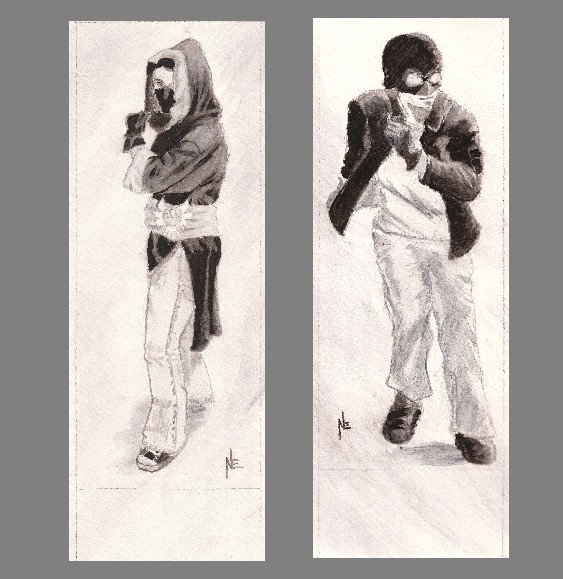
Things went a
tad off the rails last week. I got most of my planned paintings done, but a
couple of them went wrong, and one was for that week’s chapter … yeah, it’s
getting fixed. Sorry. But hey, look! It’s the Black Mask!
In the meantime,
I was wondering what to blog about this week, and it occurred to me that I
haven’t actually talked much about what’s in Teh Novel, which is currently
working-titled The Resurrectionist’s Song.
That’s deliberate, of course; I don’t want to give everything away, especially
when things might get drastically changed once I start working with agents and
editors and people. (Please note: I don’t actually have an agent or an editor at the moment. But if I manage to go the
traditional publishing route on this book, I will, and I do have to think about
them now.)
But I am
spending an awful lot of time in that world right now, and it seems only fair
to give you guys a little taste of what’s making Masks turn up late from time to time. So while I can’t go into the
whole plot of the book, I can give you a little taste of a central piece of the
story, one that’s unlikely to change much in the rewrites—its protagonist and
narrator, named …
Well, there’s my
first big problem. He hasn’t got a
name.
 |
| He cut his hair off with scissors. Really. |
For my own convenience,
I’ve been calling him by his nickname, Butterfly. And if that sounds to you
like the worst name ever for a
seventeen-year-old boy, you’re not alone. Still, it’s probably the most
accurate name he could have. You see, the reason Butterfly doesn’t have a
proper name of his own is that the people who made him (more on them in a
moment) don’t consider him worthy of a name. He’s not a person, as far as
they’re concerned. He’s a human experiment who has lived his entire life in a
laboratory, surrounded by people who regard him as about half a step above a
white rat.
There’s one
person who doesn’t think of Butterfly
as an animal—his handler, a rather strange man named Holland. Holland is a semi-evil
genius who was originally given charge of Butterfly because Butterfly wasn’t
expected to live long, or produce very important results. Basically, somebody
handed a sickly infant to him to keep him busy. But something unexpected
happened. Holland bonded with the kid and saw him as a little brother, or
possibly a son. He took such good care of his young charge, including giving
him the social interaction that none of the other experiments got, that
Butterfly survived and grew up to produce some very interesting results indeed.
Results that prompted Holland to give Butterfly his nickname.
Going into the precise
nature of Butterfly’s experiment would spoil one of the main plot twists, but
the way it all shook out is that Butterfly has the power to warp probability.
Like the eponymous butterfly in chaos theory, he excels at making small moves
that will produce big effects. A popular illustration of chaos theory describes
a butterfly flapping its wings, causing ripples of air that eventually build
into a storm system halfway across the world. A butterfly lands on a flower in
Tennessee, and a typhoon flattens Singapore. Our friend Butterfly can, if asked
to flatten Singapore, find exactly the right butterfly and poke it at exactly
the right moment to make it flap its wings in exactly the right way. He doesn’t
understand how poking a bug will
cause a storm—just that it will. That’s a useful talent if you want to, say,
raise the price of corn futures. Or start a war.
Now, Butterfly
is mostly ignorant of all this. He knows that his talent works, and he knows
that periodically he’s given assignments to complete or gets stuck with needles
by people trying to find out what makes him tick, but the whys and wherefores
don’t interest him very much—that is, until he gets an assignment that’s a
little out of the ordinary. We don’t find out exactly what happens until fairly
late in the story, but something Butterfly does has an unintended effect, and
Butterfly—a sweet-natured, wisecracking, rather naïve teenage boy whose
greatest pleasure in life is reading a new book in the library of the tower
where he lives—discovers that his actions have put a little girl in terrible
danger. He’s never met her, doesn’t even know her name, but he knows that she
will die and it will be his fault unless he does something to fix his mistake.
So he does what any sensible boy who’s lived his entire life in a laboratory
would do.
He runs away.
Butterfly runs
away, out into a dirty, complicated, wildly dystopian outer world he knows almost
nothing about. He meets lots of interesting new people, many of whom try to
kill him. And he follows his talent into the middle of nowhere, where he knows
he’ll find this mysterious girl. The quiet, sickly boy with the magical talent has
to learn how to drive a truck, cross a desert, win a knife fight. He has to
learn how to deal with people, too which is considerably harder than any of the
other things. He has to find the girl, and save her. And he has to do it all in
just fifteen days, because one way or another that’s all the time he’s got.
You see,
Butterfly’s a very complicated sort of lab rat. Every day of his life, he’s had
to swallow pills and take injections and in general get medicated to the gills
just to stay alive. Nobody’s supposed to have the kind of talent he does, and
it’s all his creators can do to keep his body from rejecting it like a
transplanted organ. When he runs away, the clock starts ticking. He’s running
out of time. Holland goes after him, determined to save the only person in the
world whom he loves, and who loves him, but Butterfly has his own plans and his
own timetable. Holland did too good a job of raising this kid—so now Butterfly’s
got a moral center that not even his “father” can shake. He knows that Holland
will never let him do what he has in mind, he knows he’s going to get sicker
and sicker and eventually drop dead, and he’s okay with that, because some
things are more important than staying alive. He’s carrying a secret that the
little girl can’t live without, and he chooses her over himself. Despite the
best efforts of everyone around him, Butterfly is a hero.
Of course, then
he actually meets the girl. And as
anyone who’s read my stories can predict, she’s not quite what he expected.
There’s an old military saying that no battle plan survives contact with the
enemy; Butterfly’s plan won’t survive contact with the person it’s designed to
save. Not least because of what happens on the day that they finally meet …
Why is this
story called The Resurrectionist’s Song,
you may ask? Well, aside from the fact that I had a devil of a time coming up with
any title at all, I eventually settled on this one because there are two
characters in the story who resurrect the dead, or do something like it.
Butterfly is one of them, with his near-miraculous talent for changing the
future (though he can’t change his own. He learns early on how his talent can
bring death; his arc in the novel involves learning how to give back life,
whether it’s to the girl or anyone else. As for the other … well, I’ll get to
that later.
Oh, and then
there’s the Song part. Butterfly has
had very little exposure to music, and none at all to human singing, before he
runs away. Combine that newborn fascination with his most prized possession—a mysterious
book of poems that he plans to give to the girl—and you begin to see why songs
will matter …