A blog about reading, writing, and the nerdy life. Also superheroes, pop culture, science fiction, fantasy, magic, explosions, fur-bearing animals, and anything else that crosses my mind. Supposedly it promotes my writing, including my serial, MASKS. Actually it just lets me run off at the keyboard. Be afraid. But visit me on Facebook and read MASKS on Pocket Coyote while you're at it.
Okay, there's no way to explain everything you might possibly need to know about Daredevil before April 10, but this blog entry should cover the basics. For more of everything here, I recommend you check out the awesome fansite The Other Murdock Papers. Tell Christine I sent you, and be nice.
How about a nice trailer, huh?
Now, to answer the most pressing questions ...
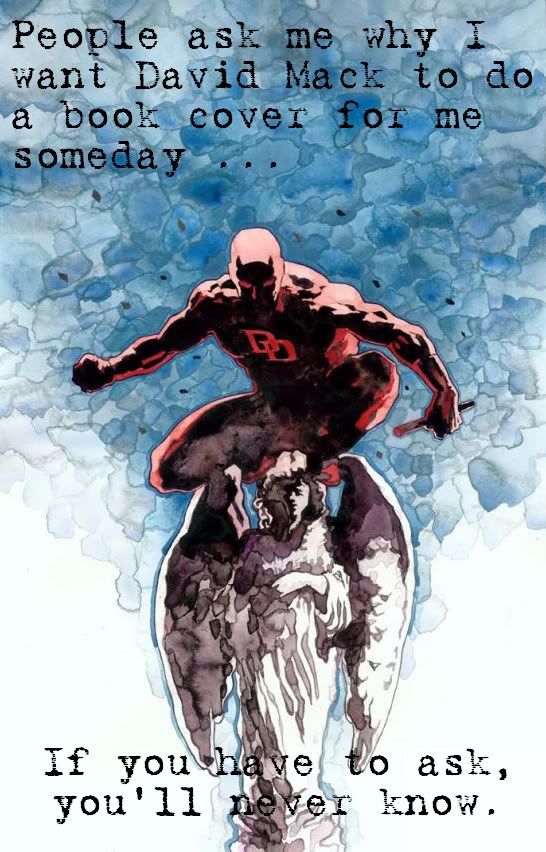
1. Who is this Daredevil guy? Short version? Daredevil is a Marvel Comics superhero created by Stan Lee and in print since 1964. His origin is weird, even by the standards of the mid-sixties. As a boy growing up in poverty in New York's Hell's Kitchen, Matt Murdock was struck in the face by radioactive waste and blinded for life. In true comic-book fashion, he developed superpowers instead of cancer: all his other senses are now cranked up to eleven. He can hear heartbeats, finger-read ordinary print like it's braille, identify even the most subtle smells, and ... well, his sense of taste is equally awesome, but all the examples are stupid. He also has a kind of crude "radar sense" that tells him where things are and some rough details about them. After training with ninjas (yes, really) and surviving his boxer father's murder by mobsters, he is now working as a criminal-defense lawyer. He upholds the law by day and breaks it by night as the vigilante protector of Hell's Kitchen.
Daredevil is a big deal for a lot of reasons, including the unusual level of artistic experimentation that's gone into his stories over the years and his status as one of the first mainstream superheroes to have a serious disability. In the new series, he's played in and out of the courtroom by the usually suave Charlie Cox.
2. So it's basically a superhero legal drama? Well, no. The thing I keep trying to explain to non-comics readers is that comic books are not a genre. They're a medium, like TV or movies or novels or plays. Any medium can tell stories in multiple genres, and this is especially true of comics. Although the basic setup of Daredevil's world—blind crimefighter who's also a lawyer—lends itself to legal hijinks, surprisingly little of the comic's time is spent in the courtroom. (This may be because most of the people who've written it over the years know very little about how the legal system works. Oops.)
The early stories written by Stan Lee were standard colorful superhero goofery with a side order of soap opera. The early to mid-1970s saw more outré villains and kind of a disco feel. Then, in the late '70s and early '80s, a hot young writer named Frank Miller came along and began deconstructing the B-list hero piece by piece. Miller's stories delved into Daredevil's origins, adding the mysterious blind ninja master Stick as Matt's teacher. He also explored Matt's relationship with his father, his ambivalence toward the law, and his complicated lifelong dance with Catholicism. Miller retconned in Elektra, an assassin who was Matt's first love and in some ways the defining archetype of his love life. As the stories went on, Miller's run delved into psychodrama and some insanely gritty crime fiction.
Also some kung-fu movie cliches like the staff to the head.
That last thread was picked up by later writers, and for much of the 1980s and early 1990s Daredevil was basically living in a Tarantino movie (or sometimes RoboCop—also created by Miller, by the way). In the late 1990s and early 2000s, a series of writers tried various approaches—funny, tragic, metafictional—but nothing really stuck until Brian Michael Bendis came along and made the entire comic the grimmest political and crime drama you've ever read in your life. Follow that up with Ed Brubaker (yes, the man who turned Bucky Barnes into the Winter Soldier, and one of my all-around favorite comic writers), who fused his career-long fascination with noir with a deep insight into Matt's broken psyche, and you have one hell of a ride.
It looked like this.
Then there was some nonsense with ninjas (it was called Shadowland; don't read it) and the whole comic was rebooted by Mark Waid, who has taken a brighter, cheerier, but still very humanistic approach to our favorite blind superhero.
So really, a Daredevil series could occupy any genre. The best material has been crime-infused, noirish, occasionally mystical and deeply psychological, and that's where the Netflix series looks to be headed, but there have also been stories where Daredevil fought circus clowns and made psychic connections with Old West vigilantes like the Two-Gun Kid. And a few stories involving actual courtrooms. So the field is wide open.
3. Welcome to Hell('s Kitchen). No description of Daredevil and his world would be complete without the neighborhood he inhabits. For most of his publishing history, Daredevil has been firmly rooted in the working-class (now somewhat gentrified) New York neighborhood of Hell's Kitchen. The place has changed a lot over the last half-century, obviously, but Marvel held on for way too long to the mid-century image of the neighborhood as a working-poor district heavy on Irish immigrants and their kids and noticeably lacking in residents of color. By the late 1970s and 1980s, the Kitchen was portrayed as a crime- and drug-ridden hellhole, in keeping with a lot of mass-media portrayals of inner cities at the time. Only in the last couple of decades has the fictional Kitchen slowly caught up to the real one. But basically, imagine a stereotypical working-class slum, populated by immigrants, poor people, drug dealers, organized-crime figures, and anybody else you might find walking around a crime novel. Add more shadows than usual, and you've got Matt Murdock's home turf.
The Netflix series appears to have gone for the grimmest, grittiest Kitchen imaginable. Watch where you step.
4. Foggy Nelson for the defense. No hero can be without his supporting cast, and in Daredevil's case, that list (somewhat unusually) starts not with a sidekick or a love interest, but with Matt's lovable, bumbling law partner. Franklin "Foggy" Nelson met Matt when they were freshman roommates at Columbia University, and they've been almost inseparable friends ever since—in spite of the fact that Matt kept Foggy in the dark about the whole superhero thing for decades. Foggy is Matt's best (often his only) friend, and his defining characteristic is his unshakable loyalty to a man who often doesn't deserve it. Foggy is the voice of the ordinary man in the story, the reality check. He's sometimes the comic relief, too, but more and more in recent decades he's been the story's heart. Matt's a classic obsessed hero, and all too often it's Foggy who pulls him back from the edge—or, in a few memorable cases, goes bungee-jumping off it to save him when he's already fallen.
We haven't seen much of the Netflix Foggy, played by Elden Henson, but he is there and the fans have high hopes for him.
5. Karen Page. Matt's dated a lot of women over the years, including the Black Widow (yes, imagine Charlie Cox snogging Scarlett Johansson), but somehow his original love interest, Karen Page, holds a special place in the fans' hearts. Karen started out as a generic pretty secretary, the receptionist at Matt and Foggy's law firm, and the angsty point on the comic's awkward love triangle. It worked like this: both Matt and Foggy had the hots for Karen, but Karen only had eyes (no pun intended) for Matt. Matt, meanwhile, had to keep pushing Karen away, partly because of the complicated life of a Marvel superhero but also because, in a bit of not-at-all-funny retrospective comedy, he didn't want to "burden" a nice girl like Karen with a blind boyfriend.
Yeah, that's right. As big a deal as Daredevil is to visually impaired comics fans—and as a reader who dealt with her secret childhood terror of deteriorating eyesight by reading Daredevil comics, I can tell you he is a big flippin' deal—he also engaged in some pretty spectacular ableism. He routinely assumed he couldn't be accepted or loved simply because his eyes didn't work. Handsome, well-educated, wealthy, successful, superpowered—none of that was enough for Matt Murdock. He couldn't pursue Karen because he just wasn't "man" (read: sighted) enough.
Because DRAMA.
Karen eventually got sick of waiting and left the book to become a Hollywood starlet. She returned a few years later during Miller's classic "Born Again" storyline, where she appeared as a heroin-addicted porn actress who sold her ex-boyfriend's secret identity for a fix. (This may be the most Frank Milleresque sentence I've ever typed.) Karen stumbled back into Matt's life after his enemies destroyed it, and the two rebuilt each other over the next 15 or so years of comics.
Karen was killed off by one of Matt's recurring foes, Bullseye, in the late 1990s. The Netflix version, played by Deborah Ann Woll, looks to be a cross between the original sweet Karen and her tougher, more streetwise later self. It's also worth noting that Woll has a more personal stake in the project than a lot of performers—her boyfriend, EJ Scott, is legally blind and apparently something of a Daredevil fan.
Night Nurse being awesome and showing Dr. Strange a few things.
6. Night Nurse? There's a character called Night Nurse? Yes, and she's awesome. A revamped version of a 1950s Marvel romance character, Night Nurse is (in the comics) the major healthcare provider for superheroes who don't want their secret identities to show up in an ER with unexplained gunshot wounds. When you get injured as often as Matt Murdock and you can't really explain acid burns to your HMO as a byproduct of your law practice, you're a Night Nurse regular. On Netflix, she's played by Rosario Dawson and looks to have a big role. Sounds like Matt's going to take a lot of beatings.
7. Bring on the bad guy. By now, you've heard Vincent D'Onofrio's voiceover and, if you're anything like me, you've noticed how much he sounds like he could be the gritty hero of the series. That's no accident. Wilson Fisk (also known as the Kingpin) has a lot in common with Matt Murdock. They faced similar levels of poverty and violence in childhood, and both have been tempted by the wrong side of the law. The difference is, Matt had a caring (if occasionally abusive) father who insisted that he study hard and better himself, while Wilson was the son of a hapless career criminal who brought young Willy into the family business. Both men discovered they were very, very good at their chosen occupations, and both men thrived in them—right up until they ran into each other. Wilson Fisk at one point had pretty much all of New York's crime families under his thumb, and Matt at various times had a successful law practice and an Avengers membership (though not simultaneously). But they've also taken each other apart a couple of times each. Matt's lost his money, his identity, and his sanity to the Kingpin's operations, while Wilson's lost his U.S. citizenship, his criminal empire, and his wife, Vanessa, to Daredevil's adventures.
I would say that by now, the antagonism is a personal one, except that it basically started being personal five minutes after these two met. Short version? Matt Murdock sees himself as the protector of Hell's Kitchen, Wilson Fisk sees himself as its king ... and each man thinks he owns it. This will get messy.
8. Who the hell is the Purple Man?! Wait, is there really a supervillain named the Purple Man, and is he really played by David Tennant? Yes, and yes, and be afraid. The Purple Man is a silly-sounding villain who is absolutely terrifying in the right hands. He has one bit of schtick—mind control. Thanks to exposure to an experimental nerve gas (oh, Marvel and its appalling lab security), Zebediah Killgrave began emitting pheromones that make anyone in the vicinity susceptible to his verbal suggestions. Basically, he's got hypnotic body odor. Sounds dumb, right? Especially when Daredevil's physiology is so weird that the pheromones don't actually work on him? Well, it gets scary. For one thing, Killgrave's powers can affect almost everyone around Matt—so Killgrave can do things like tell Karen and Foggy to jump off different roofs and force Matt to choose whom he's going to save, or just start a riot and get the mob to attack Daredevil.
But it gets much more sinister. At least twice, Killgrave has kidnapped people and subjected them to long-term enslavement, usually with a sexual component. (In fact, he has about half a dozen kids with different mothers, all fathered under the influence of his mojo.) Imagine all the awful things that can happen when the bad guy can make just about anyone do just about anything ... and he's getting increasingly frustrated by a random blind guy in a devil suit beating him up two or three times a year. One of Killgrave's best-known long-term victims was a minor superheroine named Jessica Jones, a.k.a. Jewel, who's getting her own Netflix series soon. Jess probably suffered more torment at Killgrave's hands than anybody else before he sent her to kill Daredevil, and her inclusion in the Netflix corner of the MCU suggests that her terrifying version of the Purple Man is the one we'll be seeing.
Now imagine David Tennant in that role. And if you don't know why that should creep you out, do a quick Google search on the phrase "Time Lord victorious" and see what comes up. Enjoy the nightmares.
Which seems as good a segue as any into ...
9. Oh, my God, so much violence! Yes, those trailers—and by all early accounts, the series itself—feature staggering amounts of screen time devoted to guys whumpin' on each other. And it's not the pretty, almost balletic violence you'd expect from a character whose fight training is heavily influenced by boxers and ninjas. Daredevil violence comes in two flavors—graceful and appalling. And it's usually the second one.
There are a lot of reasons for this. First and foremost is the way the stories have to be told. Although comics are a visual medium, the stories' narrator literally can't see what he's doing. He perceives the world through sound, touch, smell, taste, and radar. If the visuals overwhelm the narrative, it doesn't feel like a story about a blind superhero anymore. That means the fight scenes have to be narrated non-visually—think of things like the crunch of breaking teeth, the coppery scent of blood, the buzz and spin of a concussion. That's the only way Daredevil can perceive a fight, so his fights must include those visceral elements. The fights have to get dirty if you want your hero in danger. Either Daredevil is dancing around his foes because he's so much better at this than they are, or somebody's on the ground bleeding. Usually the latter.
This is me saying "I told you so".
The second reason the fights are brutal is because Daredevil is one of the more underpowered superheroes out there. His superhuman abilities make him vulnerable even as they make him strong. Yes, he can hear your heartbeat and tell whether you're lying, but he also can be paralyzed by an unexpected air horn. His radar can (sometimes) see through walls, but he can't read street signs. And even though he's one of the best hand-to-hand fighters in the Marvel universe, he is acutely aware of his own mortality. He's not Captain America. He doesn't heal fast, he can't bench-press a bus, and bullets definitely don't bounce off his skin. He punches people ... with hypersensitive hands. Everything he does, on some level, hurts.
And he goes out there and does his thing anyway. A regular undercurrent in the Daredevil stories is the idea that this guy should not be a superhero. Ideally, he should be in a white room somewhere. But he does the job, even though it hurts him more than anybody else, because it needs doing and he believes it's right. He pays a ridiculously high price to fight the good fight—friends and family murdered, body broken, sanity in tatters—but he keeps paying, keeps fighting. So don't expect that fight to be pretty.
Speaking of not pretty ...
10. Wait, wasn't this a crappy Ben Affleck movie? Yes and no. Yes, there was a 2003 movie allegedly based on the comic book. Yes, the movie sucked. But very importantly, Daredevil fans talk about that movie as little as possible. We're all exasperated by it. I said when it came out that we'd spend the next ten years trying to live that movie down, and what do you know? I was right. So don't watch the crappy Ben Affleck movie. Not even the director's cut. If you can't live without seeing previous screen portrayals of Daredevil, I suggest you track down the TV movie Trial of the Incredible Hulk, which co-starred pop singer Rex Smith as Matt Murdock and actually did a darned good job of portraying the character (albeit on a low budget with a so-so script). And it may or may not be coincidence that a lot of the promotional materials for the Netflix series have Matt in a costume that looks more like Smith's than Affleck's. (I will never not be a fan of eyeless Daredevil costumes. They're just awesomely spooky. Shut up—we all have our tastes.)
11. So what do I read?! You've got lots of options after fifty years of comics! I recommend:
Daredevil: The Man Without Fear (Miller/Romita)—The ultimate "gritty" take on Matt's origin. This one has it all—his father, the accident, Stick, the murder, Matt's training, Elektra, and the first encounter with the Kingpin. It's also a pretty clear stylistic forerunner of the Netflix series. It doesn't hurt that this was, after a couple of random back issues from the mid-'70s, my own entry point into the character.
Daredevil: Born Again (Miller/Mazzuchelli)—probably the high point of Frank Miller's Daredevil run, a great entry point into the classic world of Hell's Kitchen, with Matt, Foggy, Karen, and the Kingpin prominently represented. This is, in many ways, the definitive Daredevil story.
Daredevil: Yellow (Loeb/Sale)—The other major take on the origin. This series goes for more of the brightly colored, nostalgic, early-sixties feel of the earliest Daredevil comics. The frame story is Matt recalling his earliest days as Daredevil (he wore a yellow costume for his first six issues, hence the title) and particularly his early romance with Karen. It's basically a fluffy, bittersweet romance story, but the Purple Man plays a prominent role, too. If you want to make your head spin, read Yellow and Man Without Fear back-to-back and realize that these two protagonists are the same guy and both stories are canon.
Daredevil by Brian Michael Bendis and Alex Maleev—If there's any run that influenced the Netflix series as much as Miller, it's the nearly decade-long Bendis story that starts with Matt Murdock's identity being leaked to the New York tabloids. From there, it's a magnificently gritty tale of Matt's life going violently to hell. Read it. Just read it. It's the updated Frank Miller in the best possible way.
Daredevil, vol. 1 (Waid/Rivera)—The current writer, Mark Waid, is winding down his run on the title, but this is where it started back in 2011 and damn it is good. Great writing, great art, great storytelling—if there's a perfect way to tell Daredevil stories without a lot of blood and psychosis, this is it. And oh, hey, it's a Comic Book You Should Be Reading!
So what's the takeaway from all this? Don't expect Netflix's Daredevil to be much like the cinematic Marvel universe, but do expect it to be a solid companion piece, focusing on the street-level world and the heroes who get the job done while Spider-Man and the Avengers get all the headlines. Expect lots of blood and broken teeth, and probably a bit of romance and psychodrama. And expect a hero who perceives the world in a way you've never quite thought about.
If all that appeals, you're welcome to join me and a bazillion other people as we start streaming the series on Friday, April 10. I'll be the one kvetching from the peanut gallery and wearing this bracelet (quick plug for the fabulous Alice of brailletshirts.com) which says, in braille, the two words every Daredevil fan has taken to heart:
Panel from Frank Miller's The Dark Knight Returns (1986)
What do
I say?
Some
execrably pathetic excuse for a human being walked into a suburban movie
theater with a small arsenal and opened fire on a group of people whose only
crime was buying a Batman ticket. What do I say?
This
problem was supposed to be solved by now, you know that? It’s like those flying
cars we were all promised 50 years ago. In
the future, we’ll all have flying cars! There are even songs about how baby
boomers are still waiting for their flying cars. Well, for my generation, it
was mass shootings. We were supposed to be done with those by now.
I
still remember sitting on a bus on a middle-school trip and reading about a
now-forgotten rampage in Jonesboro, Arkansas. Someone had smuggled a
newspaper onto the bus, and all the girls were giggling over pictures of
Leonardo diCaprio in the Oscars section. The front page was abandoned on the
floor, and I picked it up and read about a couple of teenage boys pulling a
fire alarm and picking off their classmates as they ran for safety.
I was
a freshman in high school when the Columbine shootings went down. I remember
reading over a classmate’s shoulder as she wrote a letter to a friend, saying
she was “hearing all about the ‘tragedy’ in Colorado,” and I remember thinking,
no, that doesn’t need quotation marks.
It’s not a so-called tragedy. It’s a tragedy, full stop.
And
the grownups always told us, reassuringly, that in the future we wouldn’t have
these problems. All we had to do was put a stop to bullying (ha!), or get these
kids on medication (pfft!), or pass stricter gun laws (snrk!). In the future, there will be no mass
shootings.
Well,
it’s the future. I’m an adult now, more or less. And what is this I wake up to,
one fine Friday morning? What do I have to explain to a room full of
ten-year-olds when I go to work?
I can
tell you one thing I didn’t say. Not once on Friday did I utter the phrase “in
the future”. Because this will happen
again, and I know it. Congress isn’t passing any gun laws in an election year,
and probably not after that, either. More idiots will get their hands on more
guns and go to more public places and kill more people. Some of them will be
full-on deranged; some of them will just be depressed, or enraged, or sick of
the world. Some of them will be trying to get famous, because let’s face it,
that’s one way to do it.
I’ve
heard a few people say already that the solution is just to take the guns away.
Gun control? Don’t make me laugh. Even if we do manage to greatly restrict the
sale and ownership of guns, the most that will do is reduce the body count
slightly. Anybody remember the headlines from Europe and Asia about “stabbing
sprees” and a burgeoning “knife culture”? Unless the future is a place where
all of our food comes pre-cut, determined monsters will always have weapons, no
farther away than the kitchen drawer. And even if we ban knives, we’ll probably
hear about biting sprees. We’re just that kind of species.
No,
the more I hear about Aurora—no matter how much I don’t want to hear about yet
another public massacre—the more I think about something a very wise man once
wrote:
“… sin, young man, is when you treat
people like things. Including yourself. That's what sin is.”
“It's a lot more complicated than that—”
“No. It ain't. When people say things are
a lot more complicated than that, they means they're getting worried that they
won't like the truth. People as things, that's where it starts.”
“Oh, I'm sure there are worse crimes—”
“But they starts
with thinking about people as things...”
That
exchange is from Terry Pratchett’s novel Carpe
Jugulem, a hilarious little book about vampires and witches and pictsies
and a truly ridiculous amount of alcohol. Pratchett’s grammatically challenged
speaker is a mountain witch named Granny Weatherwax. Seek out his books about
her if you can—I highly recommend them, like I recommend all his work—but watch
out for landmines like that one. Pratchett’s a satirist, and satirists wait
until you’re laughing and then stab you with a thought.
People
as things, that’s where it starts.
I
don’t know what motive, if any, the Aurora shooter might have had. It’s
possible that none of us will ever know. But I remember an interview with a military
sniper I saw once in a documentary, and I remember the man saying that the
first thing you notice about a living human target when you look at it through
a gunsight is that “the target has eyes, and the eyes move.” It’s a jarring
realization, I’m told—that the creature whose life you’re about to end has such
human features. And I think about a young man in a gas mask, in a dark theater.
You can’t see eyes very well that way. Not enough to see them move.
People
as things.
Kids
running from a distant school, onto a killing field. People as things. Students
huddled under tables in a library, their faces obscured. People as things.
Shadowy faces in a movie theater, their features blurred by flickering light
from the screen. People as things.
There
are so many causes, so many complex explanations, so many justifications and
ramifications and otherications that you quickly lose track of them all. But at
some point, I’m beginning to suspect, it always comes down to two people, one
of them holding a gun and seeing a thing through
the sights.
I hear
my students talk trash about people who are different from them—people of other
races, other creeds and countries, the opposite sex. They laugh about “blowing
away” the latest boogeyman on the news sites. And I know it’s just talk, just
kidding around. They’ll grow up and realize how problematic those solutions
are. They’ll realize that Dr. Seuss was right all along—a person’s a person, no matter
how small (or how strange). A person is not a thing.
In the future, we won’t have mass
shootings.
People
as things.
The
future is something we build. We make it ourselves. What kind of future would
we make, I wonder, if we taught our children never to think of people as
things? If we reminded one another that a person’s a person, no matter how
small? If we looked one another in the eye, and saw the eyes move?
The
deranged we will always have with us. We will always have weapons, even if
they’re only our teeth. This won’t stop the real psychopaths, or the tragic
accidents. But could we stop some of
the horror this way?
I finally got to take a break this weekend after posting that plushie pattern, and I spent it on a comic book binge. I was running through my DVD collection while I stitched the Backpack Coyote together, and happened across my all-time favorite movie from when I was twelve. Laugh away—it was Trial of the Incredible Hulk, and at the time it was the only live-action movie about my very favorite superhero. If you ask me, it still is. The Ben Affleck travesty does not count.
I first got into Daredevil around the time I first got into comics. My very first comic books came from a dollar box at the back of a used bookshop (which, incidentally, is why Rae’s secret origin involves one). I would buy as many as I could afford and smuggle them home under my windbreaker so my mom wouldn’t know her honor-roll student had regressed to reading stuff with pictures. At first I bought mostly heroes I knew from cartoons—Spider-Man, the Fantastic Four, Batman, and the like. But Daredevil was the one that stuck.
I ignored the yellowed comics with the guy in the red devil suit until I saw an episode of the Fantastic Four cartoon where they lost their powers and, in some kind of weird lateral-thinking fit, decided that the best guy to help them was a blind lawyer named Matt Murdock. What was he going to do, sue Dr. Doom? Murdock, of course, turned out to be the superhero Daredevil, blinded in an accident but blessed with superhumanly acute senses. (The ninja skills he actually went out and earned.) Daredevil secretly infiltrated the Baxter Building after it was captured by Dr. Doom, and the FF eventually got their powers back thanks to his dogged efforts.
Two elements of that story struck chords in me. The first, and most obviously fascinating, was that Daredevil was blind … and I had a morbid terror of going blind myself. I was born with pretty bad eyesight, and it only got worse as I grew. Most children try to break or hide their first pair of eyeglasses, unwilling to deal with the discomfort and embarrassment; my mother tells me that at age four, I refused to take mine off—I just ran around staring at leaves on trees and birds in the sky for the first time in my life. My vision got worse year by year, requiring ever-stronger prescriptions, and right around the time I hit puberty the deterioration accelerated so fast that the eye doctor could no longer hide his dismay. I would not admit it to my parents, but by age twelve, I was secretly afraid that I would soon go blind. Imagine telling a twelve-year-old bibliophile that she would have to learn to read all over again. I tried to learn Braille, and failed miserably. I dreaded having to survive as a blind girl.
But when I bought a couple of Daredevil’s comics, I discovered that he didn’t just survive being blind. He thrived on it. His stories, I discovered, were a paradox—intensely visual tales about someone who could not perceive the bright colors and splashy compositions around him. Writers made up for that by filling dialogue and captions with references to sounds, smells, textures and tastes—details that were missing from most comic books, and that made Daredevil’s adventures all the richer as readers experienced his world as he did. And even though his hypersenses were at least as much a curse as a blessing (bad guys could effectively paralyze him with an air horn), he found ways to work with that, taking advantage of the secrets he overheard and the scents he could follow and finding workarounds for things like not being able to read computer screens or street signs (he can read print only if he touches it).
The other piece of the cartoon Daredevil that stuck with me was that he was completely outclassed by Dr. Doom. Sure enough, his adventures in the comics were usually street-level tales, pitting him against low-power bad guys and assorted crimelords. Yet he was willing to take on Dr. Doom, supervillain extraordinaire, and get beaten and electrocuted, all for the sake of four powers snobs who seemed to think he was pretty much a nutbar. He set his mind to something, and he worked at it until he succeeded, in spite or maybe because of the staggering odds against him. I could respect that.
So I devoured Daredevil’s adventures wherever I could find them. When the bookshop ran out of Daredevil comics, I used the yellow pages (remember those?) to find a local comic-book store and rode my bike for miles to feed my addiction. I read random back issues by Stan Lee, Gerry Conway, Frank Miller, and Ann Nocenti. I argued continuity with older geeks, most of whom were shocked to see a ponytailed sixth-grader lovingly tucking comics from the 25-cent bin into a cardboard box in her backpack. And as I read, I learned.
Daredevil could read normal print by feeling the raised surface of ink on paper with his hypersensitive fingertips. I tried a few experiments with Magic Marker, found that the idea worked in principle, and began stretching my other senses as far as they would go. I couldn’t hear heartbeats, but I learned to recognize people by their footfalls and the sound of their breathing. I couldn’t track people by scent, but I quickly learned to tell my classmates apart by the smells of their skin, their lunches, and their deodorants. I didn’t have Daredevil’s radar, but a few blindfold experiments taught me that air moved differently around objects than it did through open space, and at age 13 I startled a teacher by walking blindfolded through a jumble of desks and chairs without tripping once. (It really screwed up his object lesson.) I discovered I had an auditory memory—an unpredictable but startling ability to remember random sounds with near-perfect accuracy, which really came in handy when I accidentally memorized most of a history lecture and used the information to ace the test without studying. On a school camping trip, I found I moved faster along a dark trail when I turned off my flashlight, and could not only hear the class bully coming but bluff my way past him by pretending to have a weapon ready in the dark. I found that I could get by without using my eyes—and that there were distinct advantages to not having to depend on them.
And then there was that slogan. “Daredevil—The Man Without Fear!” He wasn’t totally fearless, of course, but seeing the embodiment of my phobia jumping off rooftops and hurling himself into battle with opponents far stronger and better-armed than he (including the Hulk!) did wonders for my own self-confidence. With Daredevil in my head, quietly analyzing or puckishly cracking wise, I could face down classroom bullies and menacing teachers and grouchy comic-book geeks and everyone who said I was good for nothing but doing their homework for them. It gave me ideas.
Six months after I discovered the character, I was writing my own stories about him. Eighteen months after that, I was creating my own fictional universe, so rich in sounds and tastes and textures and smells that my English teachers thought I was some kind of prodigy. My world was chock-full of heroes who were outmatched and outclassed, regularly beaten physically and spiritually but always able to pick themselves up and keep going, against all odds. Mere mortals surrounded by people with powers. Kids in a superhero culture run by adults. Losers and failures and has-beens and never-weres who nevertheless came through, by hook or by crook, to save the day.
When the series went online, I started getting fan letters. I was giving other kids ideas, too.
One of the first graphic novels I bought was Frank Miller’s Man Without Fear limited series, which retold Daredevil’s origin in vivid sensory detail and included Miller’s later contributions, like Matt’s ninja training and his affair with the assassin Elektra. And because I was the kind of kid who read everything (remember, any chance to read with my eyes could be my last), I read Miller’s introduction. While I actively dislike a lot of Miller’s pompous recent work, that intro stayed with me. Miller pointed out that Daredevil, on paper, should have been a bad guy. He was the product of a broken home, bullied and abused as a child, raised in poverty by a washed-up mob thug, and then blinded in a horrific accident. He was smart, a gifted fighter, and he had a nasty temper—someone you would expect to see turn bad, and someone you would dread fighting when he did.
“He’s got every excuse in the world,” Miller wrote. “And within him are the makings. But Matt Murdock is no villain, and no victim … He may never join the holy order his teacher hinted at. But he will do the best he can, this hero. He’ll fight the bullies till the day he dies.”
I loved that.
My vision has mostly stabilized now; I can see fairly well within a foot or so of my eyes, and with newer corrective lenses I can see better than most people with normal sight. I never did learn Braille, but I took up martial arts, where everyone has to come within arm’s or leg’s reach, and found I was good at it, especially when I had to counter my opponent without looking. Rae fights bullies, and stands up to people who can vaporize her, and speaks truth to power. Trevor goes into battle armed with his wits and a rock, and runs across rooftops by night. When I’m doing my job right, the world of Masks sings with the sweet stink of a horse’s breath, the scrape of asphalt against steel and skin, and the lonesome song of a coyote in the distant hills.
And almost every time I hand my manuscript to a new reader, the first few comments I get back include something to the effect of, “Wow, your writing is so visual--it’s like I can see everything that’s happening!”